


New potential Plasmodium brasilianum hosts: tamarin and marmoset monkeys (family Callitrichidae)
- PMID: 28187764
- PMCID: PMC5303265
- DOI: 10.1186/s12936-017-1724-0
New potential Plasmodium brasilianum hosts: tamarin and marmoset monkeys (family Callitrichidae)
Abstract
Background: Non-human primates (NHPs) as a source for Plasmodium infections in humans are a challenge for malaria elimination. In Brazil, two species of Plasmodium have been described infecting NHPs, Plasmodium brasilianum and Plasmodium simium. Both species are infective to man. Plasmodium brasilianum resembles morphologically, genetically and immunologically the human quartan Plasmodium malariae. Plasmodium brasilianum naturally infects species of non-human primates from all New World monkey families from a large geographic area. In the family Callitrichidae only the genus Saguinus has been described infected so far. The present study describes the natural infection of P. brasilianum in tamarins and marmosets of the genera Callithrix, Mico and Leontopithecus in the Atlantic forest.
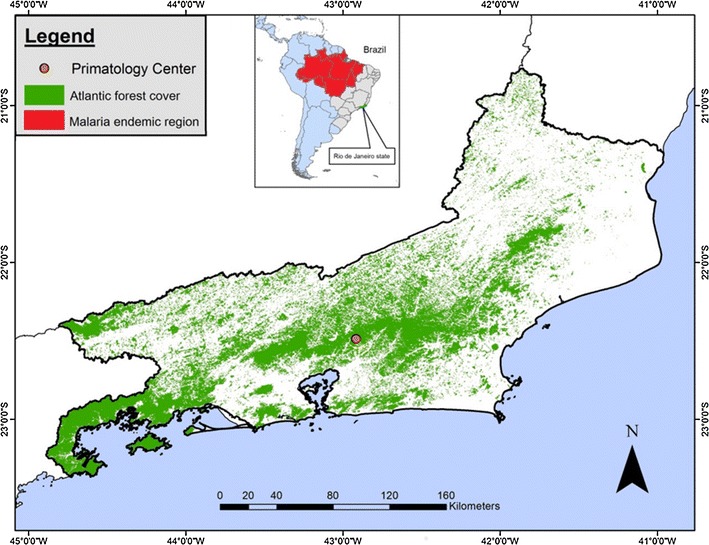
Methods: One hundred and twenty-two NHPs of the family Callitrichidae housed in the Primate Centre of Rio de Janeiro (CPRJ) were sampled in June 2015, and January and July 2016. The CPRJ is located in the Atlantic forest in the Guapimirim municipality, in the Rio de Janeiro state, where human autochthonous cases of malaria have been reported. The samples were screened for the presence of Plasmodium using optical microscopy and nested PCR for detection of 18S small subunit rRNA gene. The amplicon was sequenced to confirm the molecular diagnosis.
Results: The frequency of Plasmodium infections detected by nested PCR in New World monkeys of the family Callitrichidae was 6.6%. For the first time, Callitrichidae primates of genera Callithrix, Mico and Leontopithecus were found naturally infected with P. brasilianum. Infection was confirmed by sequencing a small fragment of 18S rRNA gene, although no parasites were detected in blood smears.
Conclusions: The reported P. brasilianum infection in NHP species maintained in captivity suggests that infection can be favoured by the presence of vectors and the proximity between known (and unknown) hosts of malaria. Thus, the list of potential malaria reservoirs needs to be further explored.
Keywords: Atlantic forest; Callithrix; Callitrichidae; Leontopithecus; Malaria; Mico; Plasmodium brasilianum.
Figures

References
-
- WHO. World malaria report 2015. Geneva: World Health Organization; 2015.
Publication types
MeSH terms
Substances
LinkOut - more resources
Full Text Sources
Other Literature Sources
Medical
