


Frailty, Physical Activity, and Mobility in Patients With Cardiac Implantable Electrical Devices
- PMID: 28188253
- PMCID: PMC5523763
- DOI: 10.1161/JAHA.116.004659
Frailty, Physical Activity, and Mobility in Patients With Cardiac Implantable Electrical Devices
Abstract
Background: This study aimed to demonstrate the feasibility of measuring frailty in patients with cardiac implantable electrical devices while validating the physiologic significance of device-detected physical activity by evaluating its association with frailty and mobility.
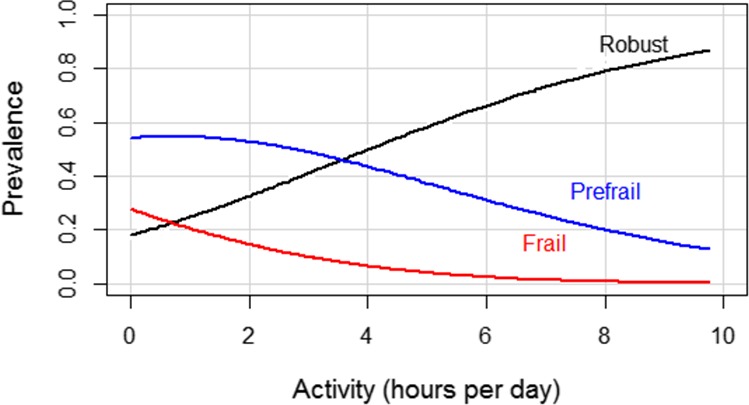
Methods and results: Outpatients with cardiac implantable electrical devices compatible with physical activity analysis with at least 7 days of data were eligible. Office testing included frailty status (Study of Osteoporotic Fractures instrument), gait speed (m/s), mobility according to the Timed Up and Go (TUG) test (seconds), and daily physical activity (h/d) as measured by cardiac implantable electrical device. Among 219 patients, Study of Osteoporotic Fractures testing found 39.7% to be robust, 47.5% prefrail, and 12.8% frail. The mean gait speed for the cohort was 0.8±0.3 m/s, mean TUG time was 10.9±4.4 seconds, and mean activity was 2.8±1.9 h/d. Frail patients were markedly more likely to have gait speeds <0.8 m/s (OR 6.25, 95% CI 1.79-33.3). In unadjusted analyses each 1-hour increase in mean daily activity was associated with a 46% reduction of frail phenotype (OR 0.54, 95% CI 0.40-0.74) versus robust and with a 27% reduction in the odds of having the prefrail phenotype (OR 0.73, 95% CI 0.62-0.86). After adjustment this association per hour of activity persisted, with an adjusted OR for frailty of 0.71 (95% CI 0.51-0.99) and adjusted OR for prefrailty of 0.81 (95% CI 0.67-0.99).
Conclusions: Frailty and mobility limitation are common among cardiac implantable electrical device patients and are correlated to device-detected physical activity.
Keywords: aging; defibrillation; pacemaker; physical exercise.
© 2017 The Authors. Published on behalf of the American Heart Association, Inc., by Wiley Blackwell.
Figures

References
-
- Fried LP, Tangen CM, Walston J, Newman AB, Hirsch C, Gottdiener J, Seeman T, Tracy R, Kop WJ, Burke G, McBurnie MA; Cardiovascular Health Study Collaborative Research Group . Frailty in older adults: evidence for a phenotype. J Gerontol A Biol Sci Med Sci. 2001;56:M146–M156. - PubMed
-
- Conraads VM, Spruit MA, Braunschweig F, Cowie MR, Tavazzi L, Borggrefe M, Hill MR, Jacobs S, Gerritse B, van Veldhuisen DJ. Physical activity measured with implanted devices predicts patient outcome in chronic heart failure. Circ Heart Fail. 2014;7:279–287. - PubMed
-
- Kadhiresan VA, Pastore J, Auricchio A, Sack S, Doelger A, Girouard S, Spinelli JC; PATH‐CHF Study Group: Pacing therapies in congestive heart failure. . A novel method—the activity log index—for monitoring physical activity of patients with heart failure. Am J Cardiol. 2002;89:1435–1437. - PubMed
Publication types
MeSH terms
Grants and funding
LinkOut - more resources
Full Text Sources
Other Literature Sources
Medical
