


High Incidence of Celiac Disease in a Long-term Study of Adolescents With Susceptibility Genotypes
- PMID: 28188747
- PMCID: PMC5533620
- DOI: 10.1053/j.gastro.2017.02.002
High Incidence of Celiac Disease in a Long-term Study of Adolescents With Susceptibility Genotypes
Abstract
Background & aims: Little is known about the incidence of celiac disease in the general population of children in the United States. We aimed to estimate the cumulative incidence of celiac disease in adolescents born in the Denver metropolitan area.
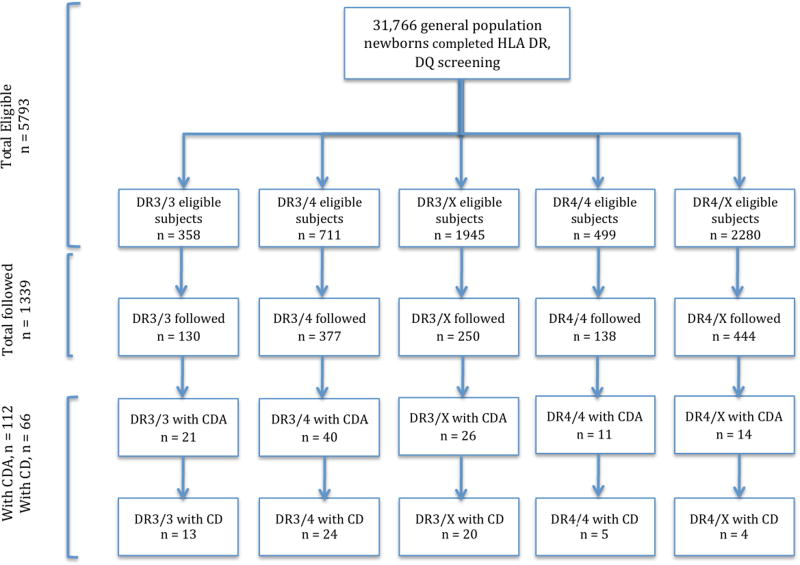
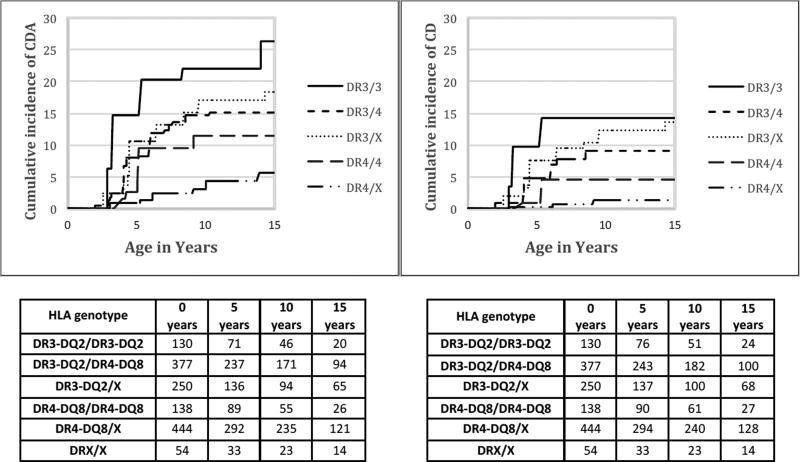
Methods: We collected data on HLA-DR, DQ genotypes of 31,766 infants, born from 1993 through 2004 at St. Joseph's Hospital in Denver, from the Diabetes Autoimmunity Study in the Young. Subjects with susceptibility genotypes for celiac disease and type 1 diabetes were followed up for up to 20 years for development of tissue transglutaminase autoantibodies (tTGA). Outcomes were the development of celiac disease autoimmunity (CDA) or celiac disease. CDA was defined as persistence of tTGA for at least 3 months or development of celiac disease. Celiac disease was defined based on detection of Marsh 2 or greater lesions in biopsy specimens or persistent high levels of tTGA. For each genotype, the cumulative incidence of CDA and celiac disease were determined. To estimate the cumulative incidence in the Denver general population, outcomes by each genotype were weighted according to the frequency of each of these genotypes in the general population.
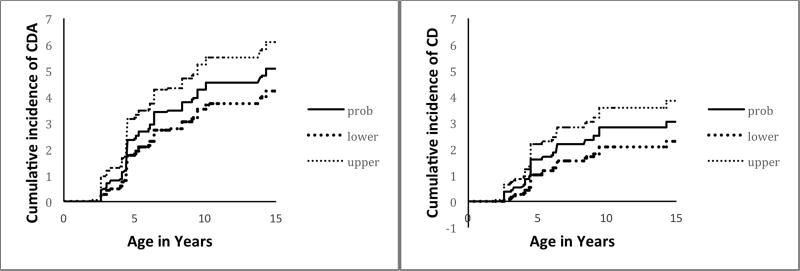
Results: Of 1339 subjects followed up, 66 developed CDA and met criteria for celiac disease and 46 developed only CDA. Seropositivity for tTGA resolved spontaneously, without treatment, in 21 of the 46 subjects with only CDA (46%). The estimated cumulative incidence for CDA in the Denver general population at 5, 10, and 15 years of age was 2.4%, 4.3%, and 5.1%, respectively, and incidence values for celiac disease were 1.6%, 2.8%, and 3.1%, respectively.
Conclusions: In a 20-year prospective study of 1339 children with genetic risk factors for celiac disease, we found the cumulative incidence of CDA and celiac disease to be high within the first 10 years. Although more than 5% of children may experience a period of CDA, not all children develop celiac disease or require gluten-free diets.
Keywords: DR3-DQ2; DR4-DQ8; Disease Progression; Transglutaminase.
Copyright © 2017 AGA Institute. Published by Elsevier Inc. All rights reserved.
Conflict of interest statement
There are no conflicts of interest to declare for any of the authors of this manuscript.
Figures
References
-
- Lionetti E, Castellaneta S, Francavilla R, et al. Introduction of gluten, HLA status, and the risk of celiac disease in children. N Engl J Med. 2014;371(14):1295–303. - PubMed
-
- Vriezinga SL, Auricchio R, Bravi E, et al. Randomized feeding intervention in infants at high risk for celiac disease. N Engl J Med. 2014;371(14):1304–15. - PubMed
-
- Catassi C, Kryszak D, Bhatti B, et al. Natural history of celiac disease autoimmunity in a USA cohort followed since 1974. Ann Med. 2010;42(7):530–8. - PubMed
-
- Lohi S, Mustalahti K, Kaukinen K, et al. Increasing prevalence of coeliac disease over time. Aliment Pharmacol Ther. 2007;26(9):1217–25. - PubMed
MeSH terms
Substances
Grants and funding
LinkOut - more resources
Full Text Sources
Other Literature Sources
Medical
Research Materials
Miscellaneous
