Prevalence of 'Food Addiction' as Measured with the Yale Food Addiction Scale 2.0 in a Representative German Sample and Its Association with Sex, Age and Weight Categories
- PMID: 28190017
- PMCID: PMC5644971
- DOI: 10.1159/000456013
Prevalence of 'Food Addiction' as Measured with the Yale Food Addiction Scale 2.0 in a Representative German Sample and Its Association with Sex, Age and Weight Categories
Abstract
Background/aims: To assess the prevalence and correlates of addictive-like eating behavior in Germany.
Methods: The German version of the Yale Food Addiction Scale (YFAS) 2.0 was used to investigate, for the first time, the prevalence of 'food addiction' in a representative sample aged 18-65 years (N = 1,034).
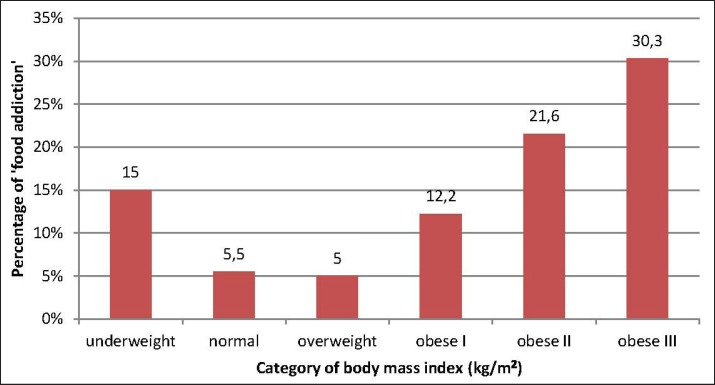
Results: The prevalence of 'food addiction' measured by the YFAS 2.0 was 7.9%. Individuals meeting criteria for 'food addiction' had higher BMI and were younger than individuals not meeting the threshold. Underweight (15.0%) and obese (17.2%) individuals exhibited the highest prevalence rate of 'food addiction'. Addictive-like eating was not associated with sex, education level, or place of residence.
Conclusion: YFAS 2.0 'food addiction' was met by nearly 8% of the population. There is a non-linear relationship between addictive-like eating and BMI, with the highest prevalence among underweight and obese persons. These findings suggest that 'food addiction' may be a contributor to overeating but may also reflect a distinct phenotype of problematic eating behavior not synonymous with obesity. Further, the elevated prevalence of YFAS 2.0 'food addiction' among underweight individuals may reflect an overlap with eating disorders and warrants attention in future research.
© 2017 The Author(s) Published by S. Karger GmbH, Freiburg.
Figures
References
-
- Mensink GBM, Schienkiewitz A, Haftenberger M, Lampert T, Ziese T, Scheidt-Nave C. Übergewicht und Adipositas in Deutschland: Ergebnisse der Studie zur Gesundheit Erwachsener in Deutschland (DEGS1) Bundesgesundheitsbl Gesundheitsforsch Gesundheitsschutz. 2013;56:786–794. - PubMed
-
- Bulik CM, Sullivan PF, Kendler KS. Genetic and environmental contributions to obesity and binge eating. Int J Eat Disord. 2003;33:293–298. - PubMed
-
- Taubes G. Demographics: as obesity rates rise, experts struggle to explain why. Science. 1998;280:1367–1368. - PubMed
-
- Wright SM, Aronne LJ. Causes of obesity. Abdom Imaging. 2012;37:730–732. - PubMed
MeSH terms
LinkOut - more resources
Full Text Sources
Other Literature Sources
Medical
Miscellaneous