Review
. 2017 Feb:220:75-79.
doi: 10.1016/j.tvjl.2016.12.020. Epub 2017 Jan 9.

Middle East respiratory syndrome (MERS) coronavirus and dromedaries

Affiliations
Review

Middle East respiratory syndrome (MERS) coronavirus and dromedaries

Ulrich Wernery et al. Vet J. 2017 Feb.

Abstract

Middle East Respiratory Syndrome (MERS) is a zoonotic viral disease that can be transmitted from dromedaries to human beings. More than 1500 cases of MERS have been reported in human beings to date. Although MERS has been associated with 30% case fatality in human beings, MERS coronavirus (MERS-CoV) infection in dromedaries is usually asymptomatic. In rare cases, dromedaries may develop mild respiratory signs. No MERS-CoV or antibodies against the virus have been detected in camelids other than dromedaries. MERS-CoV is mainly acquired in dromedaries when they are less than 1 year of age, and the proportion of seropositivity increases with age to a seroprevalence of 100% in adult dromedaries. Laboratory diagnosis of MERS-CoV infection in dromedaries can be achieved through virus isolation using Vero cells, RNA detection by real-time quantitative reverse transcriptase-PCR and antigen detection using respiratory specimens or serum. Rapid nucleocapsid antigen detection using a lateral flow platform allows efficient screening of dromedaries carrying MERS-CoV. In addition to MERS-CoV, which is a lineage C virus in the Betacoronavirus (betaCoV) genus, a lineage B betaCoV and a virus in the Alphacoronavirus (alphaCoV) genus have been detected in dromedaries. Dromedary CoV UAE-HKU23 is closely related to human CoV OC43, whereas the alphaCoV has not been detected in human beings to date.

Keywords: Coronavirus; Diagnosis; Dromedary; Middle East respiratory syndrome (MERS).


Figures

Fig. 1
Fig. 1
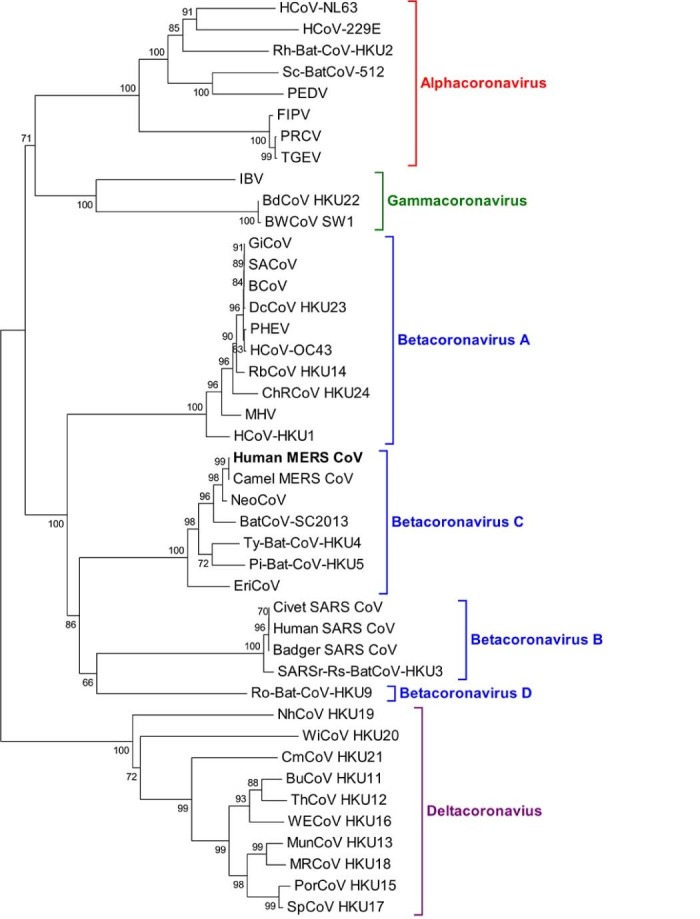
Phylogenetic analysis of RNA-dependent-RNA-polymerase (RdRp) of Middle East respiratory syndrome (MERS) coronavirus (MERS-CoV) and other coronaviruses. The tree was constructed by neighbour-joining method using maximum composite likelihood substitution model with bootstrap values calculated from 1000 trees. Virus list and GenBank accession numbers as follow: HCoV-NL63, human CoV NL63 (NC_005831); HCoV-229E (NC_002645); RhBatCoV HKU2, rhinolophus bat CoV HKU2 (EF203064); Sc-BatCoV-512, scotophilus bat CoV 512 (NC_009657); PEDV, porcine epidemic diarrhoea virus (NC_003436); FIPV, feline infectious peritonitis virus (AY994055); PRCV, porcine respiratory CoV (DQ811787); TGEV, transmissible gastroenteritis virus (NC_002306); IBV, infectious bronchitis virus (NC_001451); BdCoV HKU22, bottlenose dolphin CoV HKU22 (KF793826); BWCoV-SW1, Beluga whale CoV SW1 (NC_010646); GiCoV, giraffe CoV (EF424622); SACoV, sable antelope CoV (EF424621); BCoV, bovine CoV (NC_003045); DcCoV HKU23, dromedary camel CoV HKU23 (KF906251); PHEV, porcine haemagglutinating encephalomyelitis virus (NC_007732); HCoV-OC43, human CoV OC43 (NC_005147); RbCoV HKU14, rabbit CoV HKU14 (JN874559); ChRCoV HKU24, China Rattus CoV HKU24 (KM349742); MHV, murine hepatitis virus (NC_001846); HCoV-HKU1, human CoV HKU1 (NC_006577); human MERS-CoV, human Middle East respiratory syndrome CoV (JX869059); Camel MER-CoV, Camel Middle East respiratory syndrome CoV (KT751244); NeoCoV, Neoromicia CoV (KC869678); BatCoV-SC2013, Bat coronavirus SC2013 (KJ473821); Ty-BatCoV HKU4, tylonycteris bat CoV HKU4 (NC_009019); Pi-BatCoV HKU5, pipistrellus bat CoV HKU5 (NC_009020); EriCoV, ErinaceusCoV (KC545383); Civet SARS CoV, SARS-related palm civet CoV (AY304488); human SARS-CoV, severe acute respiratory syndrome-associated human CoV (NC_004718); badger SARS-CoV, SARS-related Chinese ferret badger CoV (AY545919); SARSr-Rs-BatCoV-HKU3, SARS-related rhinolophus bat CoV HKU3 (DQ022305); Ro-BatCoV HKU9, rousettus bat CoV HKU9 (NC_009021); NhCoV HKU19, night-heron CoV HKU19 (NC_016994); WiCoV HKU20, wigeon CoV HKU20 (NC_016995); CmCoV HKU21, common-moorhen CoV HKU21 (NC_016996); BuCoV HKU11, bulbul CoV HKU11 (FJ376619); ThCoV HKU12, thrush CoV HKU12 (FJ376621); WECoV HKU16, white-eye CoV HKU16 (NC_016991); MunCoV HKU13, munia CoV HKU13 (FJ376622); MRCoV HKU18, magpie-robin CoV HKU18 (NC_016993); PorCoV HKU15, porcine CoV HKU15 (NC_016990); SpCoV HKU17, sparrow CoV HKU17 (NC_016992).

Comment in

References

    1. Adney D.R., van Doremalen N., Brown V.R., Bushmaker T., Scott D., de Wit E., Bowen R.A., Munster V.J. Replication and shedding of MERS-CoV in upper respiratory tract of inoculated dromedary camels. Emerging Infectious Diseases. 2014;20:1999–2005. - PMC - PubMed
    1. Adney D.R., Bielefeldt-Ohmann H., Hartwig A.E., Bowen R.A. Infection, replication, and transmission of Middle East respiratory syndrome coronavirus in alpacas. Emerging Infectious Diseases. 2016;22:1031–1037. - PMC - PubMed
    1. Alagaili A.N., Briese T., Mishra N., Kapoor V., Sameroff S.C., Burbelo P.D., de Wit E., Munster V.J., Hensley L.E., Zalmout I.S. Middle East respiratory syndrome coronavirus infection in dromedary camels in Saudi Arabia. mBio. 2014;5:e00884-14. - PMC - PubMed
    1. Arabi Y.M., Arifi A.A., Balkhy H.H., Najm H., Aldawood A.S., Ghabashi A., Hawa H., Alothman A., Khaldi A., Al Raiy B. Clinical course and outcomes of critically ill patients with Middle East respiratory syndrome coronavirus infection. Annals of Internal Medicine. 2014;160:389–397. - PubMed
    1. Assiri A., McGeer A., Perl T.M., Price C.S., Al Rabeeah A.A., Cummings D.A., Alabdullatif Z.N., Assad M., Almulhim A., Makhdoom H. Hospital outbreak of Middle East respiratory syndrome coronavirus. New England Journal of Medicine. 2013;369:407–416. - PMC - PubMed

MeSH terms

LinkOut - more resources