


Possible mechanisms for sensorineural hearing loss and deafness in patients with propionic acidemia
- PMID: 28193246
- PMCID: PMC5307832
- DOI: 10.1186/s13023-017-0585-5
Possible mechanisms for sensorineural hearing loss and deafness in patients with propionic acidemia
Abstract
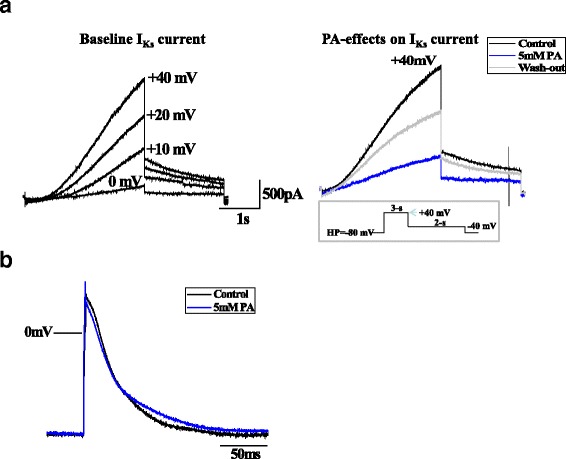
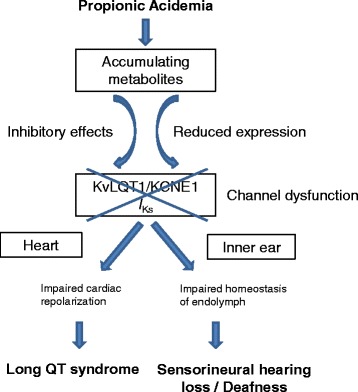
Propionic acidemia is an inborn error of metabolism caused by deficiency of the mitochondrial enzyme propionyl-CoA carboxylase. Sensorineural deafness and severe hearing loss have been described as long-term complications of this disease, however, the mechanism has not yet been elucidated. We have recently shown by patch clamping experiments and Western blots that acute and chronic effects of accumulating metabolites such as propionic acid, propionylcarnitine and methylcitrate on the KvLQT1/KCNE1 channel complex cause long QT syndrome in patients with propionic acidemia by inhibition of K+ flow via this channel. The same KvLQT1/KCNE1 channel complex is expressed in the inner ear and essential for luminal potassium secretion into the endolymphatic space. A disruption of this K+ flow results in sensorineural hearing loss or deafness. It can be assumed that acute and chronic effects of accumulating metabolites on the KvLQT1/KCNE1 channel protein may similarly cause the hearing impairment of patients with propionic acidemia.
Keywords: Hearing loss; Inner ear; KCNE1; KvLQT1; Long QT syndrome; Propionic acidemia; Propionic aciduria; Sensorineural deafness; Voltage-gated potassium channel.
Figures
References
-
- Fenton W, Gravel W, Rosenblatt D. Disorders of propionate and methylmalonate metabolism. In: Scriver C, Beaudet A, Sly W, Valle D, editors. The metabolic and molecular bases of inherited diseases. New York: McGraw-Hill; 2001. pp. 2165–93.
Publication types
MeSH terms
Substances
LinkOut - more resources
Full Text Sources
Other Literature Sources
Medical
