. 2017 Apr 24;61(5):e02236-16.
doi: 10.1128/AAC.02236-16. Print 2017 May.

Antimicrobial Resistance of Escherichia coli Urinary Isolates in the Veterans Affairs Health Care System

Affiliations

Antimicrobial Resistance of Escherichia coli Urinary Isolates in the Veterans Affairs Health Care System

Haley J Morrill et al. Antimicrob Agents Chemother. .

Abstract

We reviewed data for almost 300,000 clinical Escherichia coli urinary isolates (collected in 2009 through 2013) from 127 inpatient and outpatient facilities, to assess antibiotic resistance among Veterans Affairs health care system patients using Clinical and Laboratory Standards Institute and Centers for Disease Control and Prevention National Healthcare Safety Network definitions or guidance. Rates of resistance to amoxicillin or ampicillin/β-lactamase inhibitors were approximately 40% and rates of resistance to fluoroquinolones and trimethoprim-sulfamethoxazole approached 30%. Rates of resistance to nitrofurantoin, antipseudomonal penicillin/β-lactamase inhibitors, and carbapenems remained less than 10%. The percentage of isolates that were considered multidrug resistant varied (4% to 37%), depending on the definitions used.

Keywords: Escherichia coli; resistance; urinary tract infection.


Figures

FIG 1
FIG 1
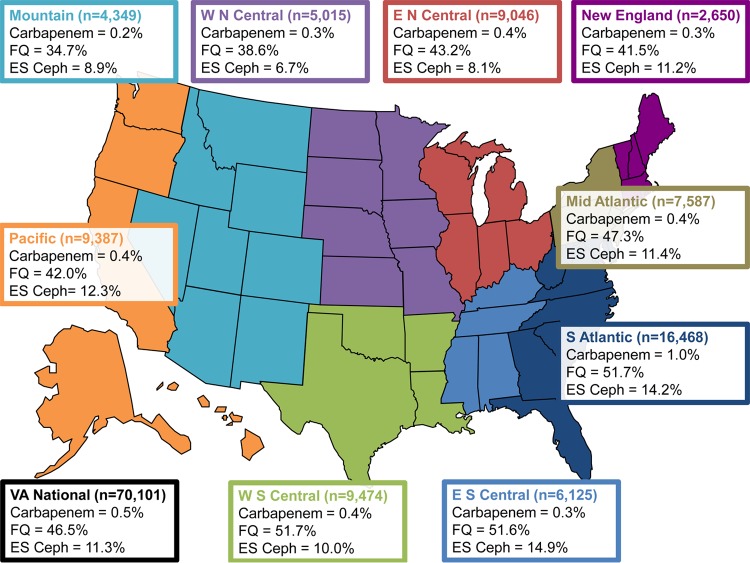
Escherichia coli antibiotic resistance among Veterans Affairs inpatient facilities nationally, by CDC region, in 2009 to 2013. Results by CDC region represent the first isolate per patient per facility per month (CDC NHSN method). E N Central, East North Central Region; E S Central, East South Central Region; ES Ceph, extended-spectrum cephalosporin; FQ, fluoroquinolone; Mid Atlantic, Middle Atlantic Region; Mountain, Mountain Region; New England, New England Region; Pacific, Pacific Region; S Atlantic, South Atlantic Region; W N Central, West North Central Region; W S Central, West South Central Region. Data are the percent nonsusceptible (total number of isolates tested). Not every antibiotic category was tested for every isolate tested. The carbapenem category included imipenem, meropenem, doripenem, and ertapenem. The extended-spectrum cephalosporin category included ceftriaxone, ceftazidime, cefotaxime, and cefepime. The fluoroquinolone category included levofloxacin and ciprofloxacin.
FIG 2
FIG 2
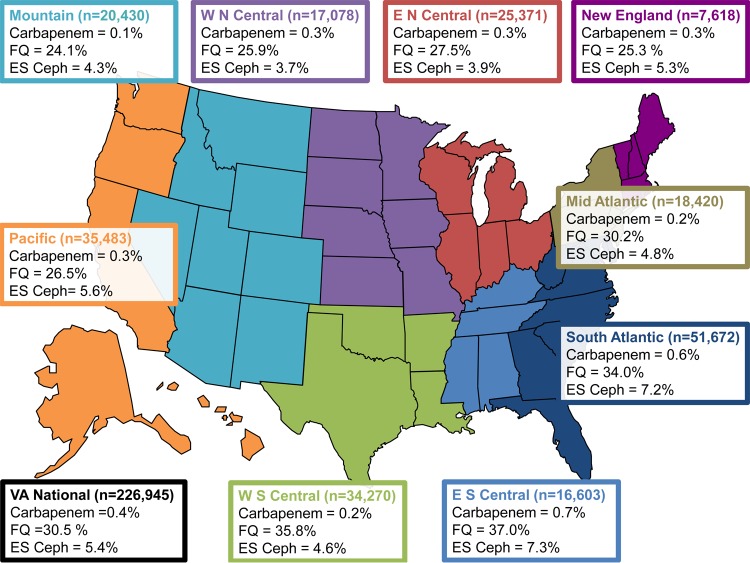
Escherichia coli antibiotic resistance among Veterans Affairs outpatient facilities nationally, by CDC region, in 2009 to 2013. Results by CDC region represent the first isolate per patient per facility per month (CDC NHSN method). E N Central, East North Central Region; E S Central, East South Central Region; ES Ceph, extended-spectrum cephalosporin; FQ, fluoroquinolone; Mid Atlantic, Middle Atlantic Region; Mountain, Mountain Region; New England, New England Region; Pacific, Pacific Region; S Atlantic, South Atlantic Region; W N Central, West North Central Region; W S Central, West South Central Region. Data are the percent nonsusceptible (total number of isolates tested). Not every antibiotic category was tested for every isolate tested. The carbapenem category included imipenem, meropenem, doripenem, and ertapenem. The extended-spectrum cephalosporin category included ceftriaxone, ceftazidime, cefotaxime, and cefepime. The fluoroquinolone category included levofloxacin and ciprofloxacin.

References

    1. Hooton TM, Bradley SF, Cardenas DD, Colgan R, Geerlings SE, Rice JC, Saint S, Schaeffer AJ, Tambayh PA, Tenke P, Nicolle LE. 2010. Diagnosis, prevention, and treatment of catheter-associated urinary tract infection in adults: 2009 International Clinical Practice Guidelines from the Infectious Diseases Society of America. Clin Infect Dis 50:625–663. doi: 10.1086/650482. - DOI - PubMed
    1. Gupta K, Hooton TM, Naber KG, Wullt B, Colgan R, Miller LG, Moran GJ, Nicolle LE, Raz R, Schaeffer AJ, Soper DE. 2011. International clinical practice guidelines for the treatment of acute uncomplicated cystitis and pyelonephritis in women: a 2010 update by the Infectious Diseases Society of America and the European Society for Microbiology and Infectious Diseases. Clin Infect Dis 52:e103–e120. doi: 10.1093/cid/ciq257. - DOI - PubMed
    1. Hindler JF, Stelling J. 2007. Analysis and presentation of cumulative antibiograms: a new consensus guideline from the Clinical and Laboratory Standards Institute. Clin Infect Dis 44:867–873. doi: 10.1086/511864. - DOI - PubMed
    1. Bax R, Bywater R, Cornaglia G, Goossens H, Hunter P, Isham V, Jarlier V, Jones R, Phillips I, Sahm D, Senn S, Struelens M, Taylor D, White A. 2001. Surveillance of antimicrobial resistance–what, how and whither? Clin Microbiol Infect 7:316–325. doi: 10.1046/j.1198-743x.2001.00239.x. - DOI - PubMed
    1. Clinical and Laboratory Standards Institute. 2014. Analysis and presentation of cumulative antimicrobial susceptibility test data; approved guideline—4th ed. CLSI document M39-A4 Clinical and Laboratory Standards Institute, Wayne, PA.

MeSH terms

LinkOut - more resources