Review
. 2017 Apr 5;372(1717):20160077.
doi: 10.1098/rstb.2016.0077.

Insect photoreceptor adaptations to night vision

Affiliations
Review

Insect photoreceptor adaptations to night vision

Anna Honkanen et al. Philos Trans R Soc Lond B Biol Sci. .

Abstract

Night vision is ultimately about extracting information from a noisy visual input. Several species of nocturnal insects exhibit complex visually guided behaviour in conditions where most animals are practically blind. The compound eyes of nocturnal insects produce strong responses to single photons and process them into meaningful neural signals, which are amplified by specialized neuroanatomical structures. While a lot is known about the light responses and the anatomical structures that promote pooling of responses to increase sensitivity, there is still a dearth of knowledge on the physiology of night vision. Retinal photoreceptors form the first bottleneck for the transfer of visual information. In this review, we cover the basics of what is known about physiological adaptations of insect photoreceptors for low-light vision. We will also discuss major enigmas of some of the functional properties of nocturnal photoreceptors, and describe recent advances in methodologies that may help to solve them and broaden the field of insect vision research to new model animals.This article is part of the themed issue 'Vision in dim light'.

Keywords: compound eye; night vision; photoreceptor; phototransduction; quantum bump.


Figures

Figure 1.
Figure 1.
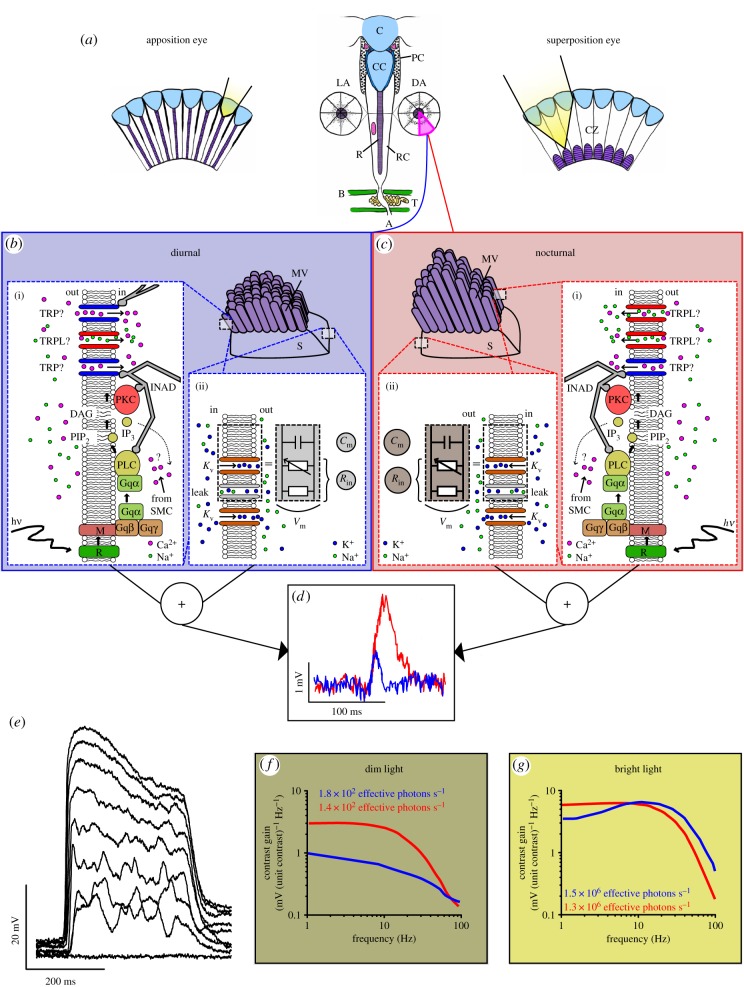
(a) Schematic structure of an insect compound eye. An ommatidium (middle; from Periplaneta americana), the functional unit of the compound eye, consists of the corneal lens C, crystalline cone CC, pigment cells PC, the photoreceptive rhabdom R made up by the photoreceptor cells RC and the RC axons A traversing the basement membranes B and the tracheal layer T. A cross section of light- (LA) and dark-adapted (DA) cockroach ommatidium demonstrating pigment migration. In an apposition eye (left) ommatidia are optically isolated and each rhabdom (purple) receives light through a single lens. In a superposition eye (right), several lenses focus light onto a rhabdom across the clear zone, CZ. (b,c) Simplifications of a transverse slice of a diurnal (b) and a nocturnal (c) photoreceptor. The schematics consist of rhabdomere microvilli MV, and cell soma S. Note the size difference of the microvilli between (b) and (c). Simplified representations of (i) the phototransduction cascade and (ii) the electrical properties of the photoreceptor membrane with their molecular constituents (see §§3–5 for full explanation). Note the hypothetical difference in TRP/TRPL channel expression between (b(i)) and (c(i)), and the IP3-induced Ca2+ release from submicrovillar cisternae (SMC). Also note that Cm (due to larger rhabdomeres) and Rin (voltage-gated and leak channels combined) are larger in (c(i)) than in (b(i)). (d) Single photon responses, quantum bumps, intracellularly recorded from dark-adapted photoreceptors of the diurnal bee Lasioglossum leucozonium (blue) and the nocturnal bee Megalopta genalis (red). A quantum bump and its shape are the combined results of (i) and (ii). (e) Intracellularly recorded graded voltage responses of P. americana photoreceptor to 300 ms light pulses with incremental intensity. (f,g) The average contrast gain functions of Lasioglossum (blue) and Megalopta (red) photoreceptors to (e) a dim and (f) a bright white-noise modulated light stimulus. The nocturnal photoreceptors are more low-passing and provide more response amplification in dim light. (d,f,g) Modified from Frederiksen et al. [1] with permission. (e) Adapted from Heimonen et al. [2].

References

    1. Frederiksen R, Wcislo WT, Warrant EJ. 2008. Visual reliability and information rate in the retina of a nocturnal bee. Curr. Biol. 18, 349–353. (10.1016/j.cub.2008.01.057) - DOI - PubMed
    1. Heimonen K, Salmela I, Kontiokari P, Weckström M. 2006. Large functional variability in cockroach photoreceptors: optimization to low light levels. J. Neurosci. 26, 13 454–13 462. (10.1523/JNEUROSCI.3767-06.2006) - DOI - PMC - PubMed
    1. Warrant EJ, Kelber A, Gislén A, Greiner B, Ribi W, Wcislo WT. 2004. Nocturnal vision and landmark orientation in a tropical halictid bee. Curr. Biol. 14, 1309–1318. (10.1016/j.cub.2004.07.057) - DOI - PubMed
    1. Kelber A, Balkenius A, Warrant EJ. 2003. Colour vision in diurnal and nocturnal hawkmoths. Integr. Comp. Biol. 43, 571–579. (10.1093/icb/43.4.571) - DOI - PubMed
    1. Dacke M, Baird E, Byrne M, Scholtz CH, Warrant EJ. 2013. Dung beetles use the Milky Way for orientation. Curr. Biol. 23, 298–300. (10.1016/j.cub.2012.12.034) - DOI - PubMed

LinkOut - more resources