


Estimation of years lived with disability due to noncommunicable diseases and injuries using a population-representative survey
- PMID: 28196151
- PMCID: PMC5308848
- DOI: 10.1371/journal.pone.0172001
Estimation of years lived with disability due to noncommunicable diseases and injuries using a population-representative survey
Abstract
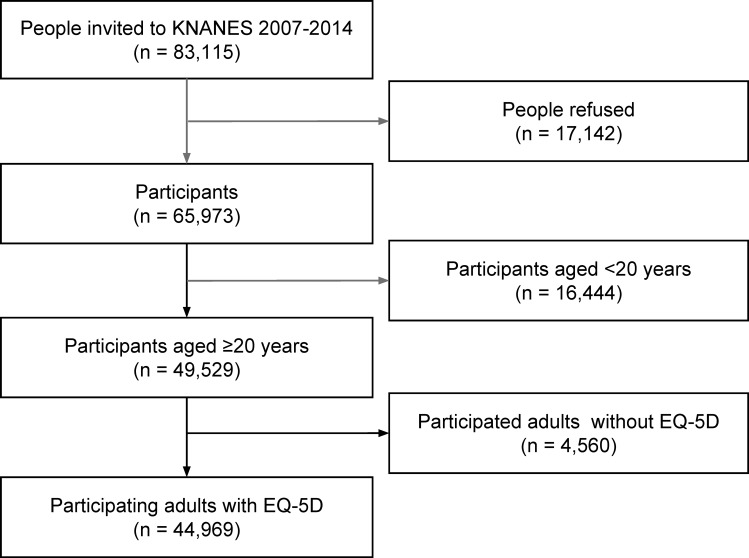
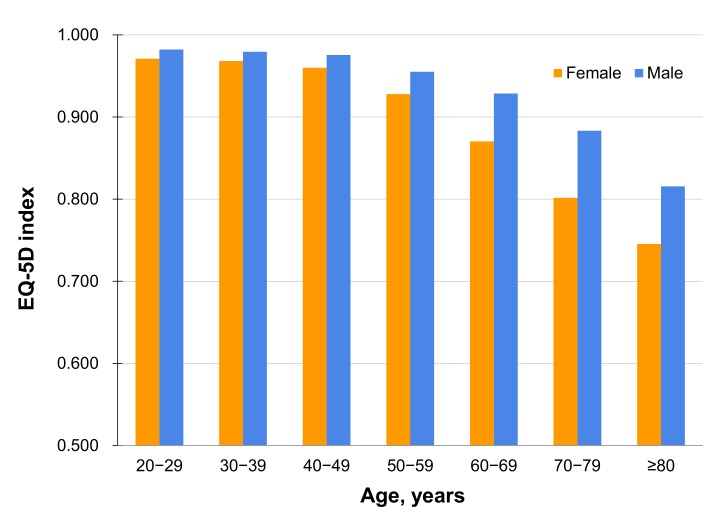
The Global Burden of Disease 2010 and the WHO Global Health Estimates of years lived with disability (YLDs) uses disability-weights obtained from lay health-state descriptions, which cannot fully reflect different disease manifestations, according to severity, treatment, and environment. The aim of this study was to provide population-representative YLDs of noncommunicable diseases and injuries using a prevalence-based approach, with the disability weight measured in subjects with specific diseases or injuries. We included a total of 44969 adults, who completed the EQ-5D questionnaire as participation in the Korea National Health and Nutrition Examination Survey 2007-2014. We estimated the prevalence of each of 40 conditions identified from the noncommunicable diseases and injuries in the WHO list. Modified condition-specific disability-weight was determined from the adjusted mean difference of the EQ-5D index between the condition and reference groups. Condition-specific YLDs were calculated as the condition's prevalence multiplied by the condition's disability-weight. All-cause YLDs, estimated as "number of population × (1 - mean score of EQ-5D)" were 2165 thousands in 39044 thousand adults aged ≥20. The combined YLDs for all 40 conditions accounted for 67.6% of all-cause YLDs, and were 1604, 2126, 8749, and 12847 per 100000 young (age 20-59) males, young females, old (age ≥60) males, and old females, respectively. Back pain/osteoarthritis YLDs were exceptionally large (442/40, 864/146, 2037/836, and 4644/3039 per 100000 young males, young females, old males, and old females, respectively). Back pain, osteoarthritis, depression, diabetes, periodontitis, and stroke accounted for 22.3%, 9.1%, 4.6%, 3.3%, 3.2%, and 2.9% of all-cause YLDs, respectively. In conclusion, this estimation of YLDs using prevalence rates and disability-weights measured in a population-representative survey may form the basis for population-level strategies to prevent age-related worsening of disability.
Conflict of interest statement
The authors have declared that no competing interests exist.
Figures
References
-
- World Health Organization. WHO | Global Burden of Disease (GBD) [Internet]. World Health Organization; 30 June 2014. [cited 26 Sep 2015]. Available: http://www.who.int/healthinfo/global_burden_disease/gbd/en/
-
- WHO methods and data sources for global burden of disease estimates 2000-2011 [Internet]. Department of Health Statistics and Information Systems, World Health Organization; 2013 Nov. Report No.: Global Health Estimates Technical Paper WHO/HIS/HSI/GHE/2013.4. Available: http://www.who.int/healthinfo/statistics/GlobalDALYmethods_2000_2011.pdf
-
- Vos T, Flaxman AD, Naghavi M, Lozano R, Michaud C, Ezzati M, et al. Years lived with disability (YLDs) for 1160 sequelae of 289 diseases and injuries 1990-2010: a systematic analysis for the Global Burden of Disease Study 2010. Lancet. 2012;380: 2163–2196. 10.1016/S0140-6736(12)61729-2 - DOI - PMC - PubMed
-
- Begg SJ, Vos T, Barker B, Stanley L, Lopez AD. Burden of disease and injury in Australia in the new millennium: measuring health loss from diseases, injuries and risk factors. Med J Aust. 2008;188: 36–40. - PubMed
Publication types
MeSH terms
LinkOut - more resources
Full Text Sources
Other Literature Sources
Medical
