. 2017 Feb 14;8(1):e02298-16.
doi: 10.1128/mBio.02298-16.

Genetic Predisposition To Acquire a Polybasic Cleavage Site for Highly Pathogenic Avian Influenza Virus Hemagglutinin

Affiliations

Genetic Predisposition To Acquire a Polybasic Cleavage Site for Highly Pathogenic Avian Influenza Virus Hemagglutinin

Naganori Nao et al. mBio. .

Abstract

Highly pathogenic avian influenza viruses with H5 and H7 hemagglutinin (HA) subtypes evolve from low-pathogenic precursors through the acquisition of multiple basic amino acid residues at the HA cleavage site. Although this mechanism has been observed to occur naturally only in these HA subtypes, little is known about the genetic basis for the acquisition of the polybasic HA cleavage site. Here we show that consecutive adenine residues and a stem-loop structure, which are frequently found in the viral RNA region encoding amino acids around the cleavage site of low-pathogenic H5 and H7 viruses isolated from waterfowl reservoirs, are important for nucleotide insertions into this RNA region. A reporter assay to detect nontemplated nucleotide insertions and deep-sequencing analysis of viral RNAs revealed that an increased number of adenine residues and enlarged stem-loop structure in the RNA region accelerated the multiple adenine and/or guanine insertions required to create codons for basic amino acids. Interestingly, nucleotide insertions associated with the HA cleavage site motif were not observed principally in the viral RNA of other subtypes tested (H1, H2, H3, and H4). Our findings suggest that the RNA editing-like activity is the key mechanism for nucleotide insertions, providing a clue as to why the acquisition of the polybasic HA cleavage site is restricted to the particular HA subtypes.IMPORTANCE Influenza A viruses are divided into subtypes based on the antigenicity of the viral surface glycoproteins hemagglutinin (HA) and neuraminidase. Of the 16 HA subtypes (H1 to -16) maintained in waterfowl reservoirs of influenza A viruses, H5 and H7 viruses often become highly pathogenic through the acquisition of multiple basic amino acid residues at the HA cleavage site. Although this mechanism has been known since the 1980s, the genetic basis for nucleotide insertions has remained unclear. This study shows the potential role of the viral RNA secondary structure for nucleotide insertions and demonstrates a key mechanism explaining why the acquisition of the polybasic HA cleavage site is restricted to particular HA subtypes in nature. Our findings will contribute to better understanding of the ecology of influenza A viruses and will also be useful for the development of genetically modified vaccines against H5 and H7 influenza A viruses with increased stability.


Figures

FIG 1
FIG 1
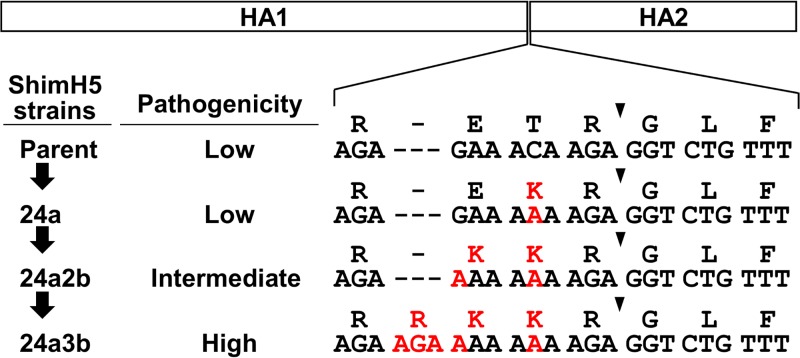
HA cleavage site sequences of ShimH5 and its variants passaged in chickens. HA was synthesized as a single polypeptide and then cleaved into HA1 and HA2 subunits at the cleavage site (indicated by arrowheads). ShimH5 and its variants (parent, 24a, 24a2b, and 24a3b) strains have different nucleotide and amino acid sequences at their HA cleavage sites and different pathogenicities for chickens (26). Nucleotide sequences at positions 1043 to 1063 (ShimH5 parent, 24a, and 24a2b) and 1043 to 1066 (24a3b) and the corresponding amino acid sequences are shown. Dashes are included to adjust the sequence alignment, and nucleotides and amino acids different from those of the parental ShimH5 sequence are shown in red.
FIG 2
FIG 2
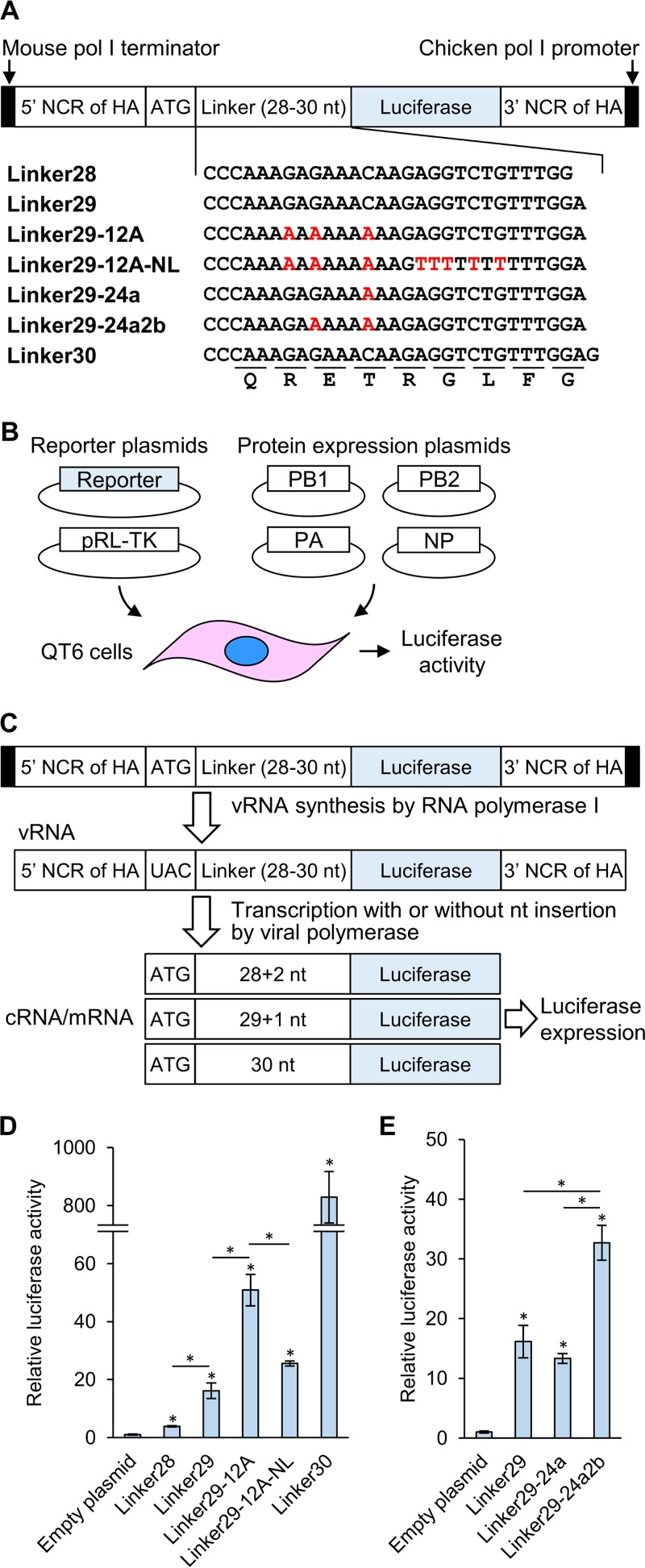
Schematic overview of the reporter assay system and luciferase activity in QT6 cells. (A) The reporter plasmids contained the chicken RNA polymerase I promoter, mouse RNA polymerase I terminator, PR8 HA segment-derived NCR, and firefly luciferase gene. Linkers (28, 29, or 30 polynucleotides) that originated from the RNA sequence encoding amino acids across the HA cleavage site of ShimH5 were inserted between a start codon and the firefly luciferase gene lacking its start codon. The nucleotide positions different from those of the parental ShimH5 sequence are indicated in red. (B) QT6 cells were transfected with the reporter plasmid, pRL-TK Renilla luciferase transfection control reporter plasmid, and a mixture of PB2-, PB1-, PA-, and NP-expressing plasmids, and luciferase (firefly and Renilla luciferase) activities were measured. (C) In this assay, negative-sense vRNA templates are transcribed from the reporter plasmid by cellular RNA polymerase I, and then mRNA and cRNA are produced by the PR8 polymerases and NP, which are provided by the cotransfected protein expression plasmids. The transcripts containing 28- or 29-polynucleotide linkers produce mRNAs that are not in frame with the ORF of the reporter gene. Therefore, the firefly luciferase is expected to be expressed when nucleotides are inserted into the linker region of mRNA, cRNA, and/or vRNA to make the linker sequence in frame with the ORF of the reporter gene. The firefly luciferase activities were standardized using the values given by the activities of the transfection control, Renilla luciferase. (D and E) Luciferase activities were expressed relative to the empty plasmid and compared among the reporter plasmids containing the indicated linkers. Representative data from three independent experiments are shown. Relative luciferase activities are presented as the averages and standard deviations from triplicate wells. Statistical significance was calculated using Student’s t test (*, P < 0.05). Asterisks placed directly above bars indicate significant differences compared to the empty plasmid, and asterisks placed between bars show significant differences between the indicated bars.
FIG 3
FIG 3
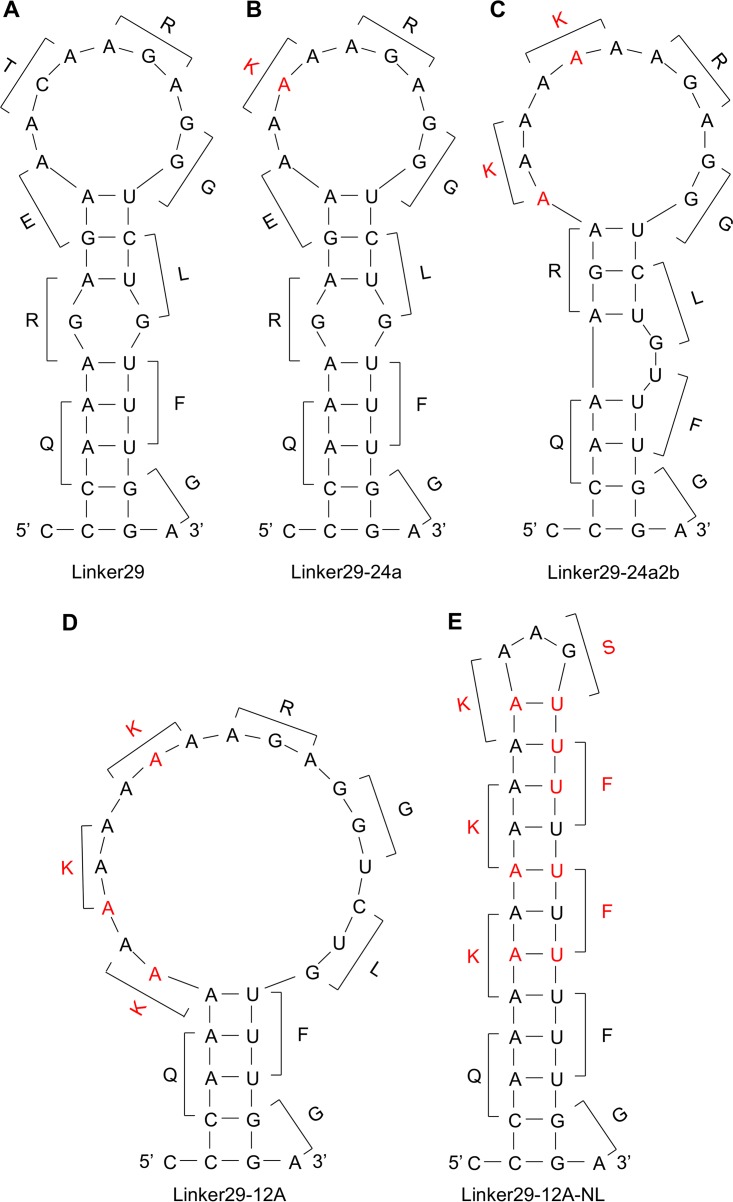
Quickfold-predicted RNA structures of the linker sequences. The predicted RNA (positive-sense) secondary structures of Linker29 (A), Linker29-24a (B), Linker29-24a2b (C), Linker29-12A (D), and Linker29-12A-NL (E) and amino acids corresponding to each codon are shown. Nucleotides and amino acids different from the parental ShimH5 sequence are shown in red.
FIG 4
FIG 4
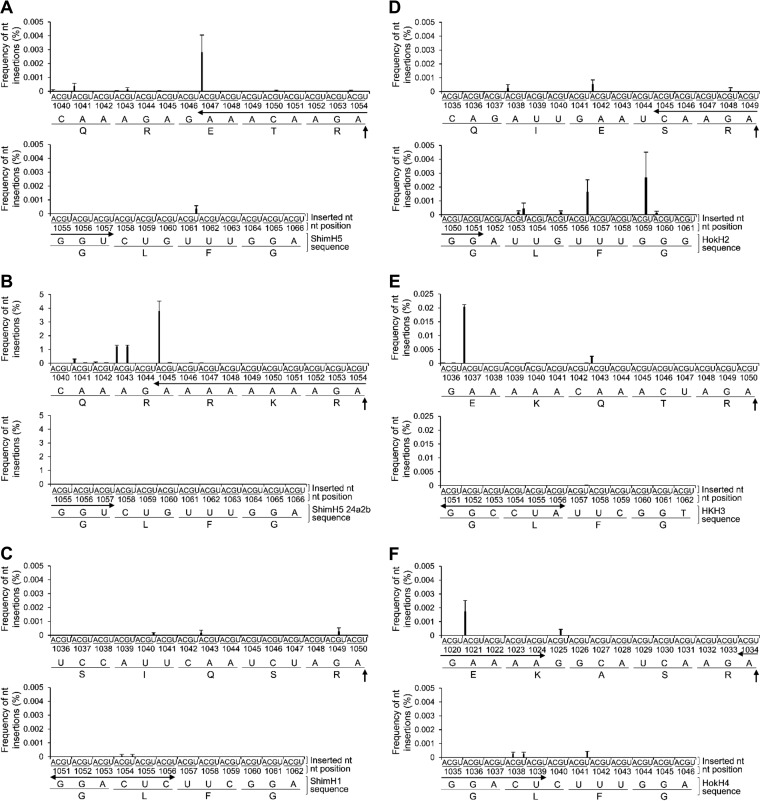
Nucleotide insertions detected by deep-sequencing analysis of vRNAs in virus particles. Total frequencies of nucleotide (nt) insertions into 9 codons in the RNAseqHAclv region of ShimH5 (A), ShimH5 24a2b (B), ShimH1 (C), HokH2 (D), HKH3 (E), and HokH4 (F) HA genes are shown. In case multiple nucleotide insertions were observed at the same position, inserted nucleotides were counted individually. (For example, if an AGA insertion was observed at nucleotide position 1045, it was counted as two adenine insertions and one guanine insertion at position 1045.) The HA cleavage site is indicated by vertical arrows. Horizontal arrows indicate the sequence corresponding to predicted loop structures (1047 to 1057, 1045 to 1057, 1051 to 1056, 1045 to 1051, 1051 to 1056, and 1020 to 1024/1035 to 1039 for the ShimH5, ShimH5 24a2b, ShimH1, HokH2, HKH3, and HokH4 HA genes, respectively). Frequencies of nucleotide insertions are presented as the averages and standard deviations from two or three independent experiments. Since which nucleotide position allowed the insertion into the consecutive adenines was not distinguishable, total frequencies for positions 1047 to 1049 (A), 1045 to 1052 (B), 1037 to 1041/1043 to 1045 (E), and 1021 to 1024 (F) are collectively shown at positions 1047, 1045, 1037/1043, and 1021, respectively. Similarly, total frequencies of uracil and guanine insertions are collectively shown at positions 1056 and 1059, respectively (D).
FIG 5
FIG 5
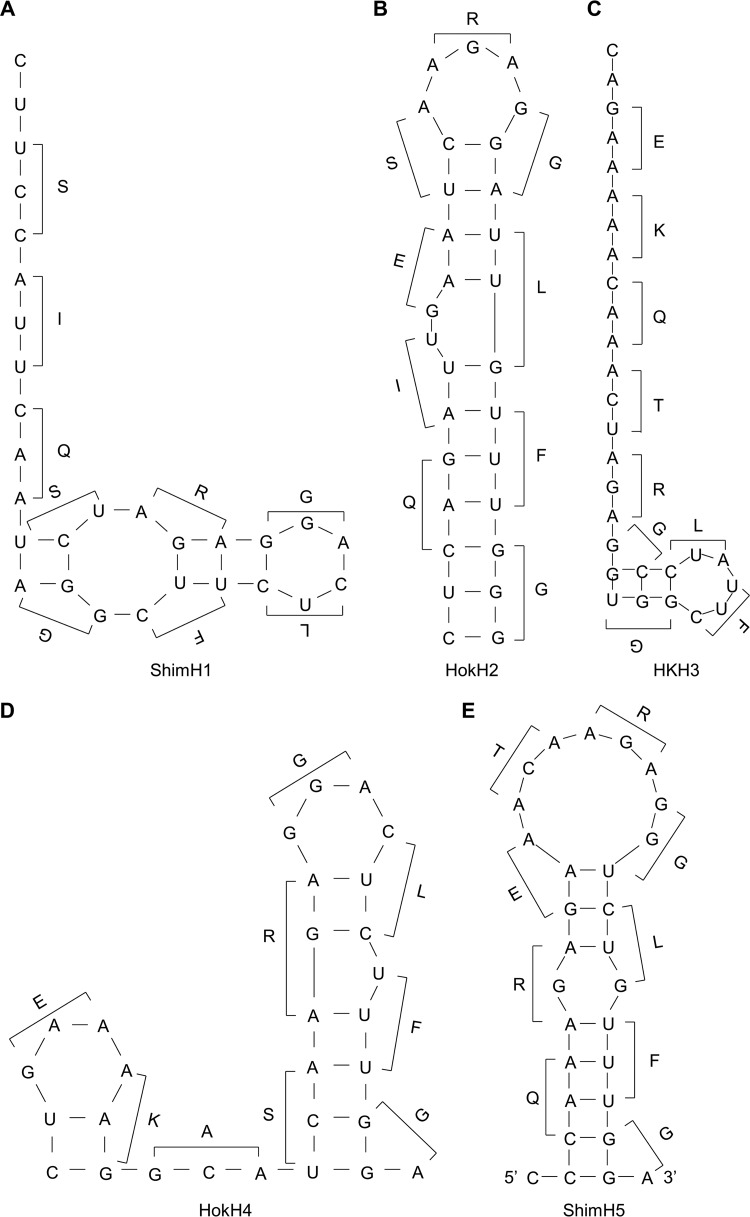
Comparison of Quickfold-predicted secondary structures of the RNAseqHAclv regions of ShimH1, HokH2, HKH3, HokH4, and ShimH5. The predicted RNA (positive-sense) secondary structures of the RNAseqHAcly region of ShimH1 (A), HokH2 (B), HKH3 (C), HokH4 (D), and ShimH5 (E) and amino acids corresponding to each codon are shown.
FIG 6
FIG 6
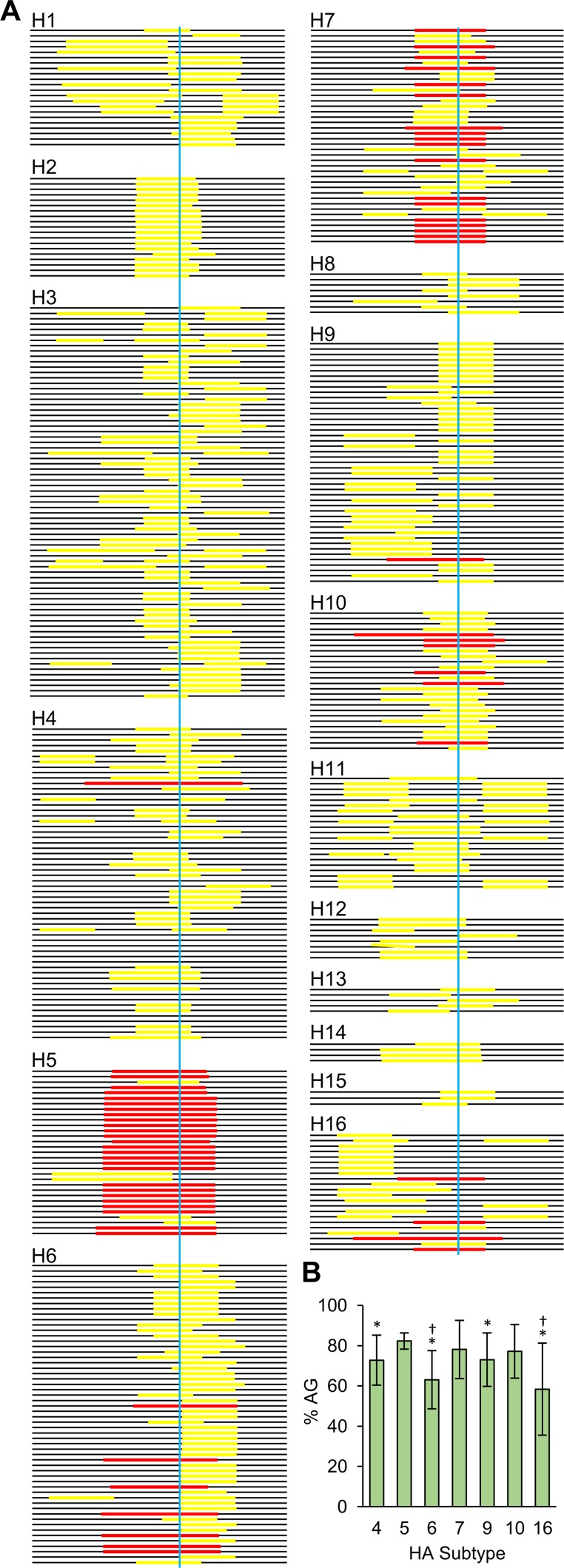
Putative loop regions found in the RNAseqHAclv region of low-pathogenic IAVs isolated from ducks. The RNA (positive-sense) secondary structures were generated by the Quickfold program. (A) Horizontal bars represent the RNAseqHAclv region, and colored (yellow and red) lines on each bar show nucleotide regions corresponding to the predicted loops in each stem-loop structure. Red lines indicate the loop structures consisting of more than 8 nucleotides that are fully included the codons for arginine and glycine at the HA cleavage site, and yellow lines show the others. The HA cleavage sites are indicated by blue vertical lines. (B) The AG ratios of the loop sequences in each RNAseqHAclv region were calculated, and averages and standard deviations of each HA subtype are shown. Statistical significance compared to H5 (*) and H7 (†) was calculated using Student’s t test (P < 0.05). There was no significant difference between H5 and H7.

References

    1. Fouchier RA, Munster V, Wallensten A, Bestebroer TM, Herfst S, Smith D, Rimmelzwaan GF, Olsen B, Osterhaus AD. 2005. Characterization of a novel influenza A virus hemagglutinin subtype (H16) obtained from black-headed gulls. J Virol 79:2814–2822. doi: 10.1128/JVI.79.5.2814-2822.2005. - DOI - PMC - PubMed
    1. Röhm C, Zhou N, Süss J, Mackenzie J, Webster RG. 1996. Characterization of a novel influenza hemagglutinin, H15: criteria for determination of influenza A subtypes. Virology 217:508–516. doi: 10.1006/viro.1996.0145. - DOI - PubMed
    1. Webster RG, Bean WJ, Gorman OT, Chambers TM, Kawaoka Y. 1992. Evolution and ecology of influenza A viruses. Microbiol Rev 56:152–179. - PMC - PubMed
    1. Webster RG, Govorkova EA. 2014. Continuing challenges in influenza. Ann N Y Acad Sci 1323:115–139. doi: 10.1111/nyas.12462. - DOI - PMC - PubMed
    1. Webster RG, Peiris M, Chen H, Guan Y. 2006. H5N1 outbreaks and enzootic influenza. Emerg Infect Dis 12:3–8. doi: 10.3201/eid1201.051024. - DOI - PMC - PubMed

Publication types

MeSH terms

LinkOut - more resources