


Fine Mapping of Carbon Assimilation Rate 8, a Quantitative Trait Locus for Flag Leaf Nitrogen Content, Stomatal Conductance and Photosynthesis in Rice
- PMID: 28197156
- PMCID: PMC5282472
- DOI: 10.3389/fpls.2017.00060
Fine Mapping of Carbon Assimilation Rate 8, a Quantitative Trait Locus for Flag Leaf Nitrogen Content, Stomatal Conductance and Photosynthesis in Rice
Abstract
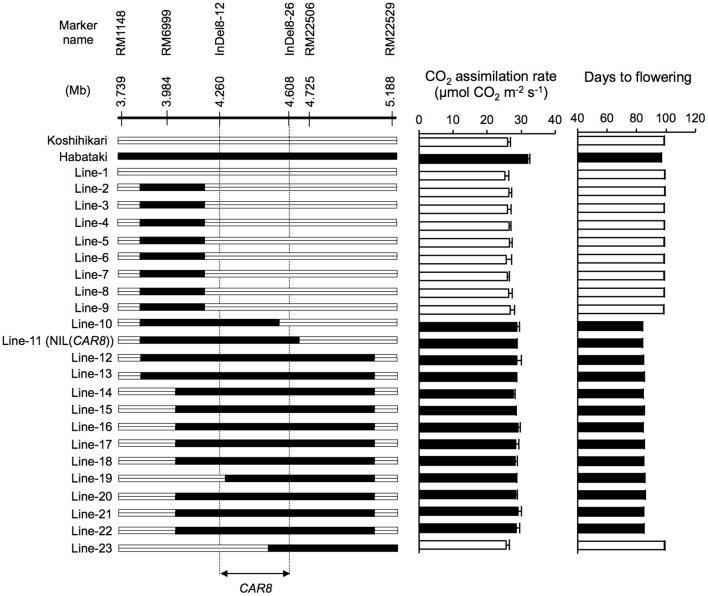
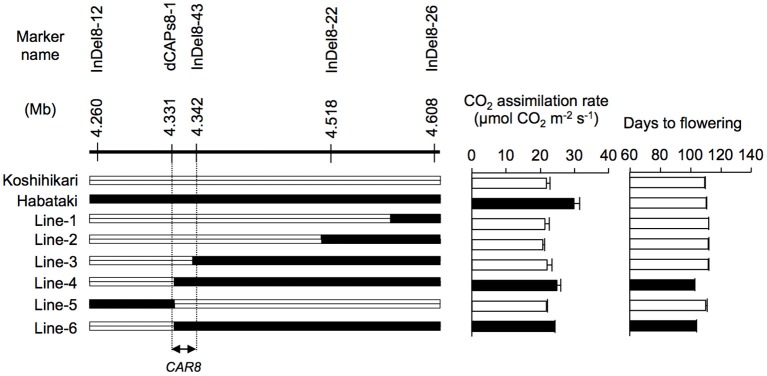
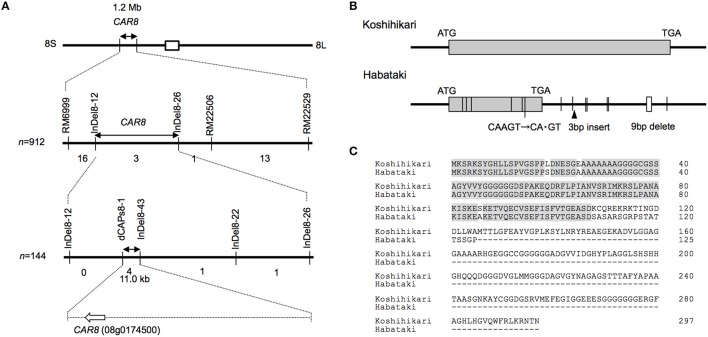
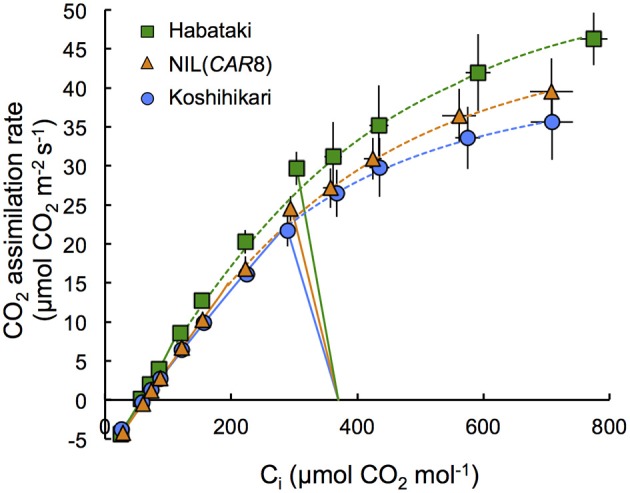
Increasing the rate of leaf photosynthesis is one important approach for increasing grain yield in rice (Oryza sativa). Exploiting the natural variation in CO2 assimilation rate (A) between rice cultivars using quantitative genetics is one promising means to identify genes contributing to higher photosynthesis. In this study, we determined precise location of Carbon Assimilation Rate 8 (CAR8) by crossing a high-yielding indica cultivar with a Japanese commercial cultivar. Fine mapping suggested that CAR8 encodes a putative Heme Activator Protein 3 (OsHAP3) subunit of a CCAAT-box-binding transcription factor called OsHAP3H. Sequencing analysis revealed that the indica allele of CAR8 has a 1-bp deletion at 322 bp from the start codon, resulting in a truncated protein of 125 amino acids. In addition, CAR8 is identical to DTH8/Ghd8/LHD1, which was reported to control rice flowering date. The increase of A is largely due to an increase of RuBP regeneration rate via increased leaf nitrogen content, and partially explained by reduced stomatal limitation via increased stomatal conductance relative to A. This allele also increases hydraulic conductivity, which would promote higher stomatal conductance. This indicates that CAR8 affects multiple physiological aspects relating to photosynthesis. The detailed analysis of molecular functions of CAR8 would help to understand the association between photosynthesis and flowering and demonstrate specific genetic mechanisms that can be exploited to improve photosynthesis in rice and potentially other crops.
Keywords: Oryza sativa; RuBP regeneration; leaf nitrogen content; photosynthesis; quantitative trait locus; stomatal conductance.
Figures
References
-
- Adachi S., Nito N., Kondo M., Yamamoto T., Arai-Sanoh Y., Ando T., et al. (2011). Identification of chromosomal regions controlling the leaf photosynthetic rate in rice by using a progeny from japonica and high-yielding indica varieties. Plant Prod. Sci. 14, 118–127. 10.1626/pps.14.118 - DOI
-
- Alam M. M., Tanaka T., Nakamura H., Ichikawa H., Kobayashi K., Yaeno T., et al. (2015). Overexpression of a rice heme activator protein gene (OsHAP2E) confers resistance to pathogens, salinity and drought, and increases photosynthesis and tiller number. Plant Biotech. J. 13, 85–96. 10.1111/pbi.12239 - DOI - PubMed
LinkOut - more resources
Full Text Sources
Other Literature Sources
