


Frequency and Predictors of Analgesic Prescribing in U.S. Nursing Home Residents with Persistent Pain
- PMID: 28198563
- PMCID: PMC9588418
- DOI: 10.1111/jgs.14512
Frequency and Predictors of Analgesic Prescribing in U.S. Nursing Home Residents with Persistent Pain
Abstract
Objectives: To quantify prescription analgesic use of elderly nursing home (NH) residents with persistent noncancer pain and to identify individual and facility traits associated with no treatment.
Design: Cross-sectional study.
Setting: Linked Minimum Data Set (MDS) assessments; Online Survey, Certification and Reporting (OSCAR) records; and Medicare Part D claims.
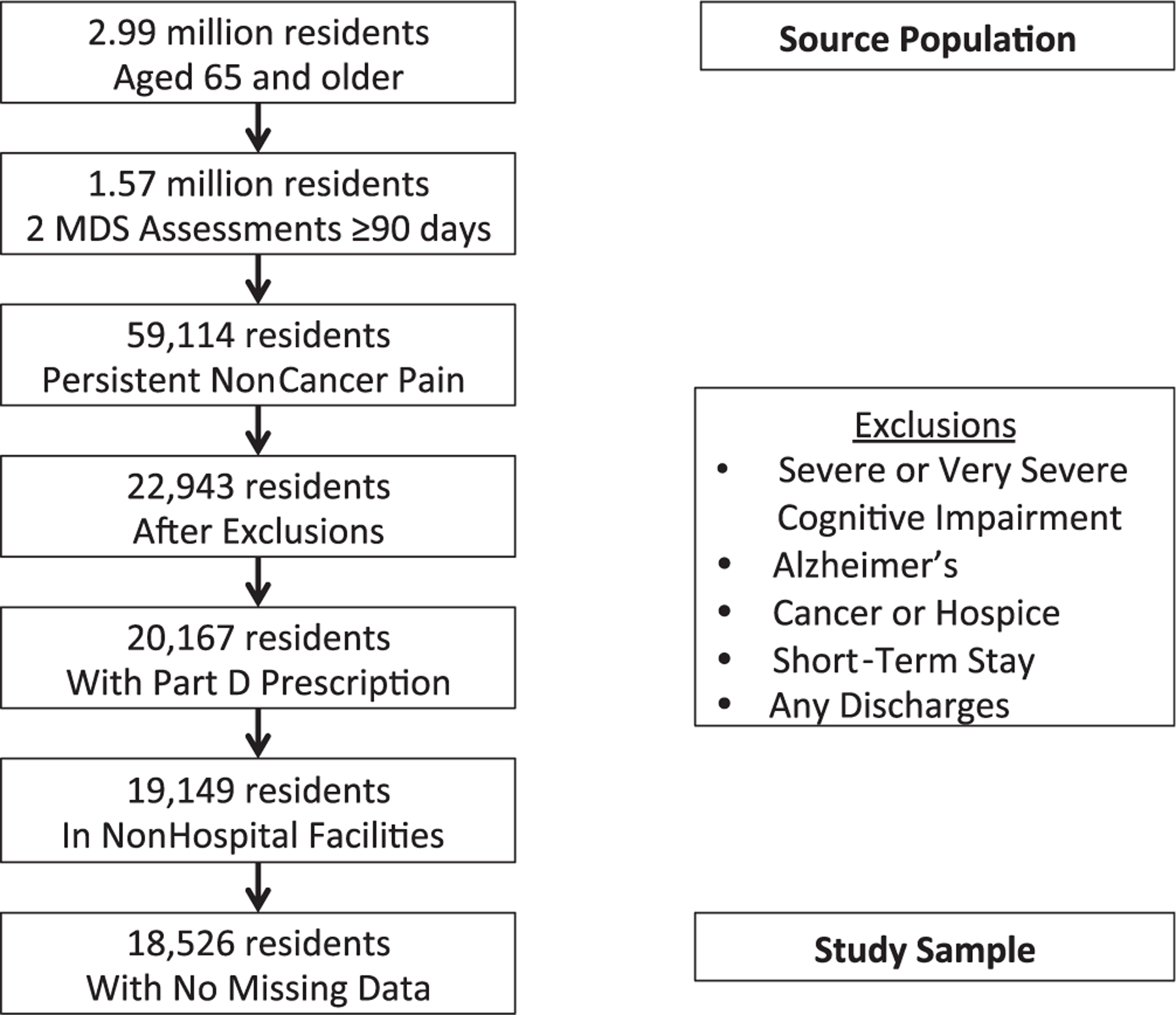
Participants: Individuals aged 65 and older with persistent noncancer pain were identified from a cross-section of all long-stay U.S. NH residents with an MDS assessment and Medicare Part D enrollment in 2008, excluding those who were terminally ill, those with Alzheimer's disease, and those with the most-severe cognitive impairment.
Measurements: Residents with moderate to severe daily pain on consecutive assessments at least 90 days apart constituted the cohort with persistent pain. Part D dispensing for an opioid or nonsteroidal anti-inflammatory drug (NSAID) within 30 days of persistent pain onset was identified. Information on resident and facility characteristics was obtained from MDS and OSCAR records. Associations between resident and facility attributes and pain treatment were estimated using multilevel mixed-effects logistic regression analyses.
Results: Of the study sample of 18,526 residents with persistent pain, 3,094 (16.7%) did not receive prescription analgesics, 12,815 (69.2%) received a prescription opioid, 485 (2.6%) received a prescription NSAID, and 2,132 (11.5%) received a prescription opioid and NSAID. After adjusting for potentially confounding covariates, residents who were older (≥95, odds ratio (OR) = 2.06, 95% confidence interval (CI) = 1.70-2.49), more cognitively impaired (moderately severe cognitive impairment, OR = 2.12, 95% CI = 1.71-2.62), or black (OR = 1.20, 95% CI = 1.03-1.39) or Asian (OR = 1.97, 95% CI = 1.22-3.20) were less likely to receive a prescription analgesic.
Conclusion: Through 2008, pain remained undertreated in NHs, especially in certain subpopulations, including cognitively impaired and older residents. Changes in pain management practice and policies may be necessary to target these vulnerable residents.
Keywords: health disparities; nursing homes; persistent pain; prescription opioids.
© 2016, Copyright the Authors Journal compilation © 2016, The American Geriatrics Society.
Conflict of interest statement
Figures
Comment in
-
Assessment and treatment of persistent pain in nursing home residents should be implemented systematically to prevent suffering.Evid Based Nurs. 2017 Jul;20(3):91. doi: 10.1136/eb-2017-102617. Epub 2017 Mar 30. Evid Based Nurs. 2017. PMID: 28360077 No abstract available.
-
Dementia care and treatment issues.Evid Based Nurs. 2020 Apr;23(2):40-42. doi: 10.1136/ebnurs-2020-103260. Evid Based Nurs. 2020. PMID: 32209613 No abstract available.
References
-
- U.S. Centers for Medicare and Medicaid Services. National Nursing Home Compendium—2010 Edition Washington, DC: Centers for Medicare and Medicaid Services, 2010.
-
- Won A, Lapane KL, Vallow S et al. Persistent nonmalignant pain and analgesic prescribing patterns in elderly nursing home residents. JAGS 2004;52:867–874. - PubMed
-
- Winn PAS, Dentino AN. Effective pain management in the long-term care setting. J Am Med Dir Assoc 2004;5:342–352. - PubMed
-
- Teno J, Weitzen S, Wetle T et al. Persistent pain in nursing home residents. JAMA 2001;285:2081. - PubMed
-
- Lapane KL, Quilliam BJ, Chow W et al. The association between pain and measures of well-being among nursing home residents. J Am Med Dir Assoc 2012;13:344–349. - PubMed
MeSH terms
Substances
Grants and funding
LinkOut - more resources
Full Text Sources
Other Literature Sources
Medical
Research Materials
Miscellaneous
