. 2017 Jan 25;18(Suppl 1):1043.
doi: 10.1186/s12864-016-3263-4.

Predicting disease-related genes using integrated biomedical networks

Affiliations

Predicting disease-related genes using integrated biomedical networks

Jiajie Peng et al. BMC Genomics. .

Abstract

Background: Identifying the genes associated to human diseases is crucial for disease diagnosis and drug design. Computational approaches, esp. the network-based approaches, have been recently developed to identify disease-related genes effectively from the existing biomedical networks. Meanwhile, the advance in biotechnology enables researchers to produce multi-omics data, enriching our understanding on human diseases, and revealing the complex relationships between genes and diseases. However, none of the existing computational approaches is able to integrate the huge amount of omics data into a weighted integrated network and utilize it to enhance disease related gene discovery.

Results: We propose a new network-based disease gene prediction method called SLN-SRW (Simplified Laplacian Normalization-Supervised Random Walk) to generate and model the edge weights of a new biomedical network that integrates biomedical data from heterogeneous sources, thus far enhancing the disease related gene discovery.

Conclusions: The experiment results show that SLN-SRW significantly improves the performance of disease gene prediction on both the real and the synthetic data sets.

Keywords: Disease gene prediction; Integrated network; Laplacian normalization; Supervised random walk.


Figures
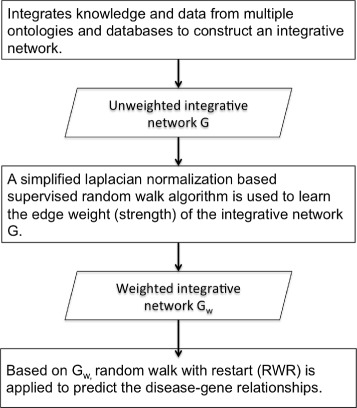
Fig. 1
Fig. 1
The Framework of SLNSRW. Framework of SLN-SRW for estimating the edge weight of the integrated network automatically and predicting disease genes based on it. The second step is the essential part of SLN-SRW algorithm
Fig. 2
Fig. 2
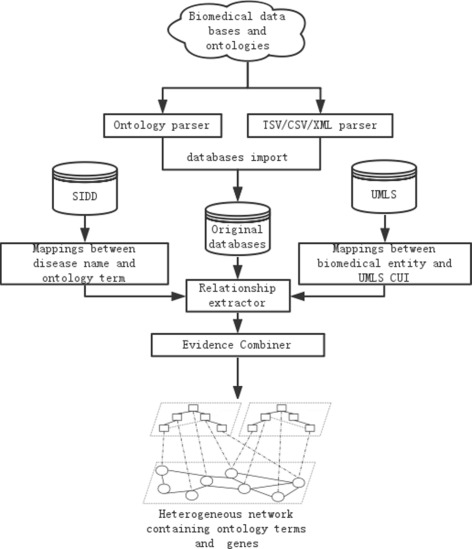
The workflow of constructing the integrated network. Work flow of constructing the integrated network based on multiple data sources
Fig. 3
Fig. 3
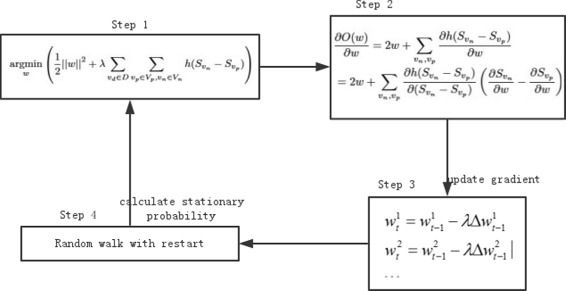
The process of training the the parameter w. The steps of training the the parameter w
Fig. 4
Fig. 4
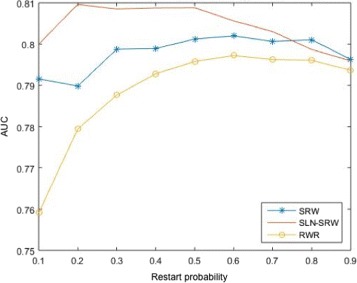
he AUC score for each given restart probability for three methods. The AUC score for each given restart probability for three methods. The red, blue and yellow lines are represent SLN-SRW, SRW and RWR method respectively
Fig. 5
Fig. 5
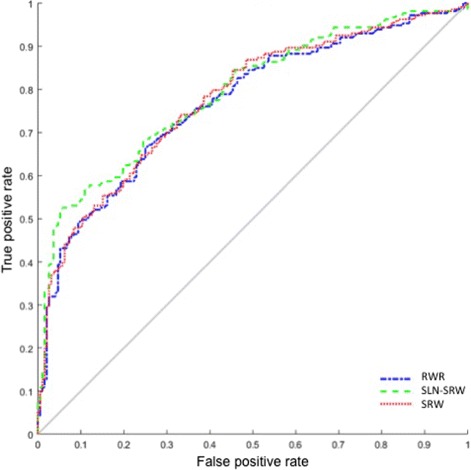
ROC curves for the experimental results on testing set. ROC curves for the experimental results on testing set. ROC curves for the experimental results calculated with SLN-SRW (green), SRW (red) and RWR (blue)
Fig. 6
Fig. 6
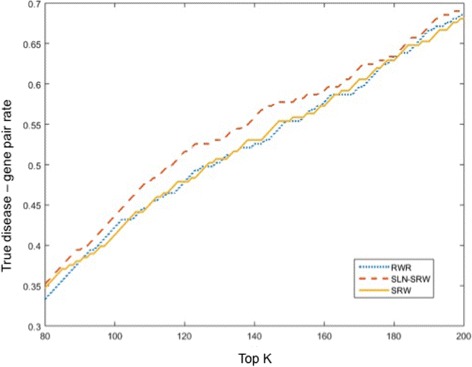
True disease-gene pair rates. True disease-gene pair rates at different top k levels
Fig. 7
Fig. 7
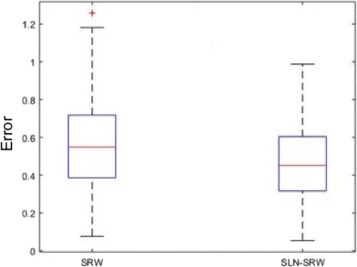
The boxplot of the error score. The boxplot of the error score for SLN-SRW and SRW

References

    1. Wang X, Gulbahce N, Yu H. Network-based methods for human disease gene prediction. Brief Funct Genomics. 2011;10(5):280–93. doi: 10.1093/bfgp/elr024. - DOI - PubMed
    1. Ala U, Piro RM, Grassi E, Damasco C, Silengo L, Oti M, Provero P, Di Cunto F. Prediction of human disease genes by human-mouse conserved coexpression analysis. PLoS Comput Biol. 2008;4(3):e1.000043. doi: 10.1371/journal.pcbi.1000043. - DOI - PMC - PubMed
    1. Kann MG. Advances in translational bioinformatics: computational approaches for the hunting of disease genes. Brief Bioinformatics. 2010;11(1):96–110. doi: 10.1093/bib/bbp048. - DOI - PMC - PubMed
    1. Jiang Q, Wang J, Wu X, Ma R, Zhang T, Jin S, Han Z, Tan R, Peng J, Liu G. LncRNA2Target: a database for differentially expressed genes after lncRNA knockdown or overexpression. Nucleic Acids Res. 2015;43(Database issue):193–6. doi: 10.1093/nar/gku1173. - DOI - PMC - PubMed
    1. Navlakha S, Kingsford C. The power of protein interaction networks for associating genes with diseases. Bioinformatics. 2010;26(8):1057–63. doi: 10.1093/bioinformatics/btq076. - DOI - PMC - PubMed

Publication types

LinkOut - more resources