. 2017 Feb 1;68(5):931-941.
doi: 10.1093/jxb/erw503.

Waxy and non-waxy barley cultivars exhibit differences in the targeting and catalytic activity of GBSS1a

Affiliations

Waxy and non-waxy barley cultivars exhibit differences in the targeting and catalytic activity of GBSS1a

Kim H Hebelstrup et al. J Exp Bot. .

Abstract

Amylose synthesis is strictly associated with activity of granule-bound starch synthase (GBSS) enzymes. Among several crops there are cultivars containing starch types with either little or no amylose known as near-waxy or waxy. This (near) amylose-free phenotype is associated with a single locus (waxy) which has been mapped to GBSS-type genes in different crops. Most waxy varieties are a result of either low or no expression of a GBSS gene. However, there are some waxy cultivars where the GBSS enzymes are expressed normally. For these types, single nucleotide polymorphisms have been hypothesized to represent amino-acid substitutions leading to loss of catalytic activity. We here confirm that the HvGBSSIa enzyme from one such waxy barley variety, CDC_Alamo, has a 90% reduction in catalytic activity. We also engineered plants with expression of transgenic C-terminal green fluorescent protein-tagged HvGBSSIa of both the non-waxy type and of the CDC_Alamo type to monitor their subcellular localization patterns in grain endosperm. HvGBSSIa from non-waxy cultivars was found to localize in discrete concentric spheres strictly within starch granules. In contrast, HvGBSSIa from waxy CDC_Alamo showed deficient starch targeting mostly into unknown subcellular bodies of 0.5-3 µm in size, indicating that the waxy phenotype of CDC_Alamo is associated with deficient targeting of HvGBSSIa into starch granules.

Keywords: Amylose; GBSS; starch biosynthesis; starch functionality; subcellular targeting; waxy..


Figures

Fig. 1.
Fig. 1.
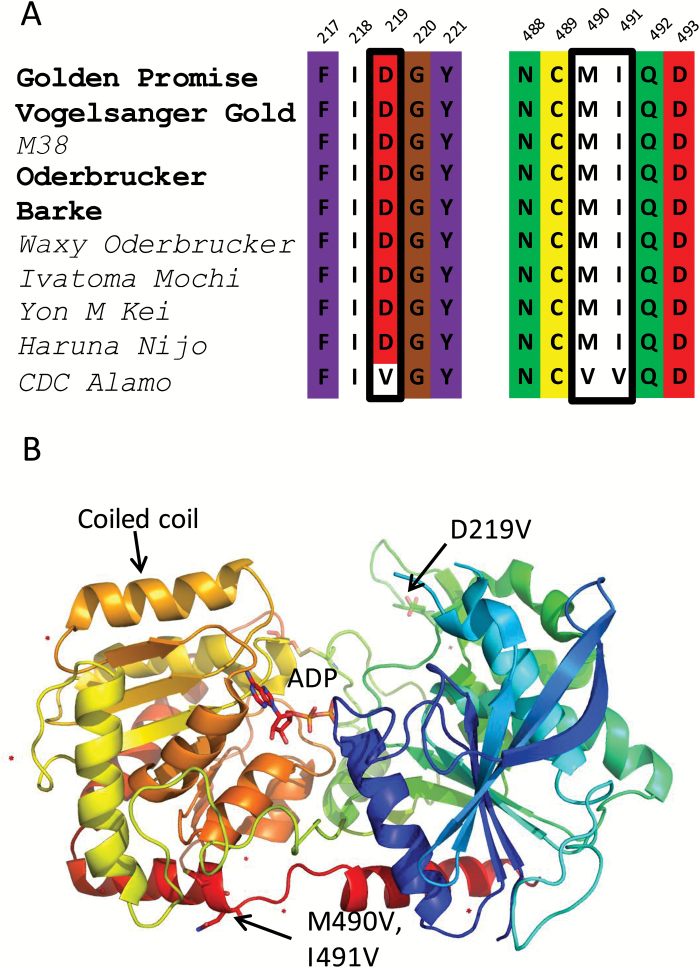
(A) Three unique amino acid substitutions were identified in HvGBSSIaCDC_Alamo (D219V, M490V, and I491V) as compared with a number of other waxy and non-waxy (in bold) barley varieties. (B) Mapping of these three amino acid substitutions on the structure of the catalytic domain of rice GBSSIa (Momma and Fujimoto, 2012; PDB entry 4VUF). D219V is located on the N-terminal Rossman fold while M490V and I491V are on the C-terminal Rossman fold. None of the three amino acids are positioned in the catalytic site in which ADP is bound, or involved in any other putative substrate, or protein binding sites.
Fig. 2.
Fig. 2.
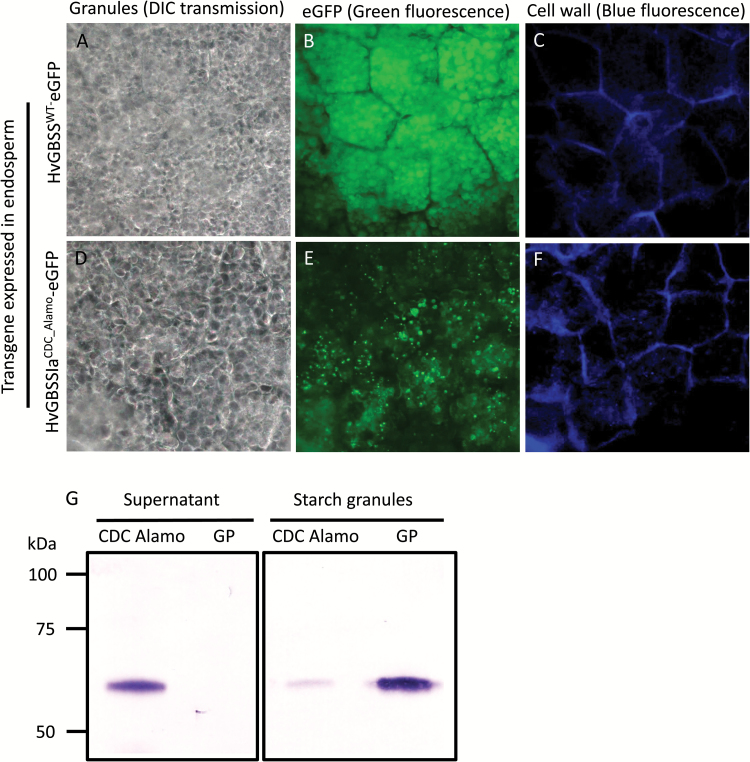
(A–F) Subcellular localization of HvGBSSIaWT-eGFP (A–C) and HvGBSSIaCDC_Alamo-eGFP (D–F) in 100 µm-thick sections of developing endosperm (30 DAP) of grains from transgenic barley plants. Starch granules were detected with transmitted light using differential interference contrast (DIC) settings (A, D); HvGBSSIaCDC_Alamo-eGFP and HvGBSSIaWT-eGFP were detected as green epifluorescence (B, E); cell walls were detected as blue epifluorescence (C, F). HvGBSSIaWT-eGFP is strictly targeted to starch granules (B), whereas HvGBSSIaCDC_Alamo-eGFP is mostly targeted into unknown subcellular bodies (E). (G) Western blotting with GBSSI antiserum confirms that HvGBSSIa is strictly targeted to starch granules in the endosperm of Golden Promise, whereas it is mostly found in the supernatant of the endosperm cell fraction of CDC Alamo. All lanes are from the same blot.
Fig. 3.
Fig. 3.
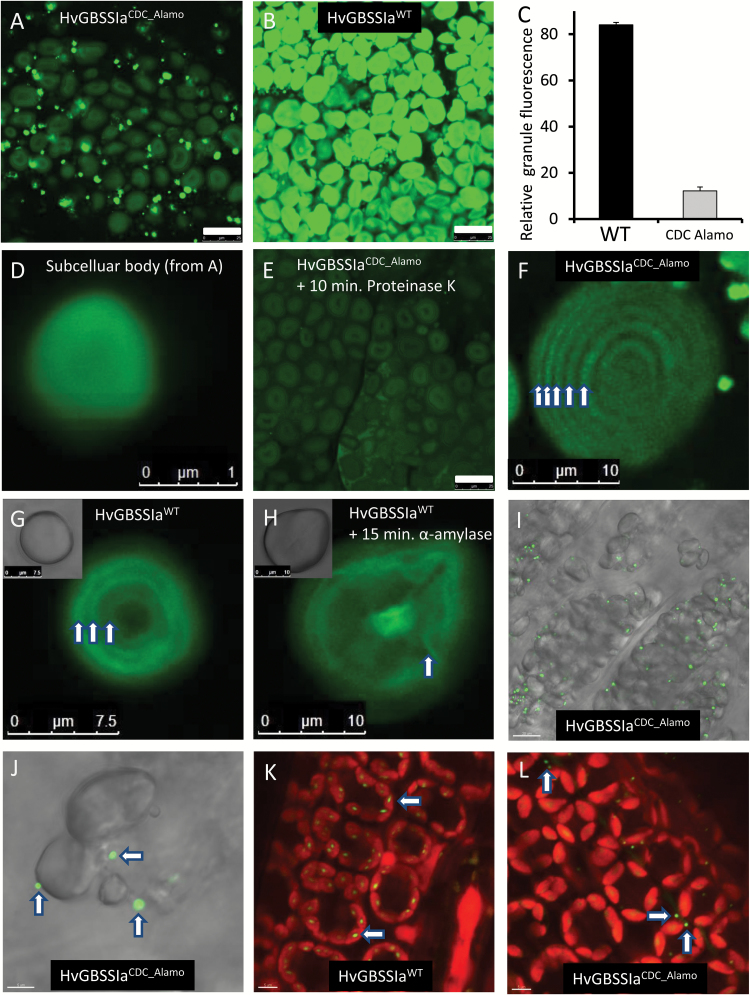
Confocal laser scanning microscopy of starch granules from the endosperm of developing grains at the late grain filling stage (30 DAP) of transgenic barley plants expressing HvGBSSIaWT-eGFP (B, G, H, K) or HvGBSSIaCDC_Alamo-eGFP (A, E, F). (A), (B), (E) and (F) are recorded with same sensitivity, whereas (D), (G) and (H) were recorded with lower sensitivity to avoid oversaturation. (C) The relative fluorescence intensities were much stronger in HvGBSSIaWT-eGFP starch granules than in HvGBSSIaCDC_Alamo-eGFP starch granules (n=10). Bars indicate standard errors. (D) Magnified subcellular body from HvGBSSIaCDC_Alamo-eGFP endosperm cells from panel A. (E) The subcellular bodies in panel (A) disappeared after treatment with proteinase K (1 mg ml–1 in H2O) for 10 min. (G, H) Both HvGBSSIaWT-eGFP and HvGBSSIaCDC_Alamo-eGFP are localized into concentric spheres (indicates by arrows) within starch granules. (H) These concentric spheres became blurred (indicated by the arrow) upon treatment with α-amylase. (I, J) Transmission light was used to visualize subcellular structures in thin sections of endosperm cells simultaneously with localization of HvGBSSIaCDC_Alamo-eGFP recorded as overlaid eGFP fluorescence. (K, L) HvGBSSIaWT-eGFP (green; K) was located in granules inside chloroplasts (red fluorescence) in leaves whereas HvGBSSIaCDC_Alamo-eGFP (L) was mostly localized in subcellular bodies (green, indicated by arrows) outside of the red chloroplasts. The scale bars in (A, B, E) are 25 µm; the scale bar in (I) is 20 µm; the scale bars in (F, H) are 10 µm; the scale bar in (G) is 7.5 µm; the scale bars in (J, K, L) are 5 µm; and the scale bar in (D) is 1 µm.
Fig. 4.
Fig. 4.
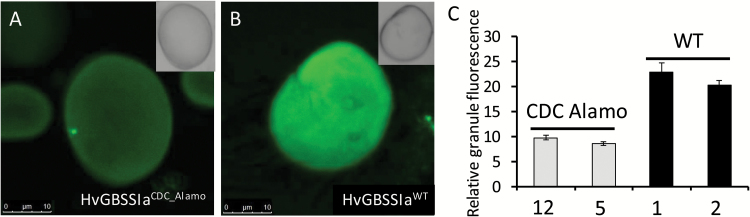
(A, B) Confocal laser scanning microscopy of starch granules from mature dry grains of transgenic barley plants expressing HvGBSSIaCDC_Alamo-eGFP (A) and HvGBSSIaWT-eGFP (B). (C) Relative fluorescence intensities in HvGBSSIaWT-eGFP and HvGBSSIaCDC_Alamo-eGFP starch granules (n=10) from two different lines each: HvGBSSIaCDC_Alamo-eGFP (lines 12 and 5) and HvGBSSIaWT-eGFP (lines 1 and 2). Bars indicate standard errors.
Fig. 5.
Fig. 5.
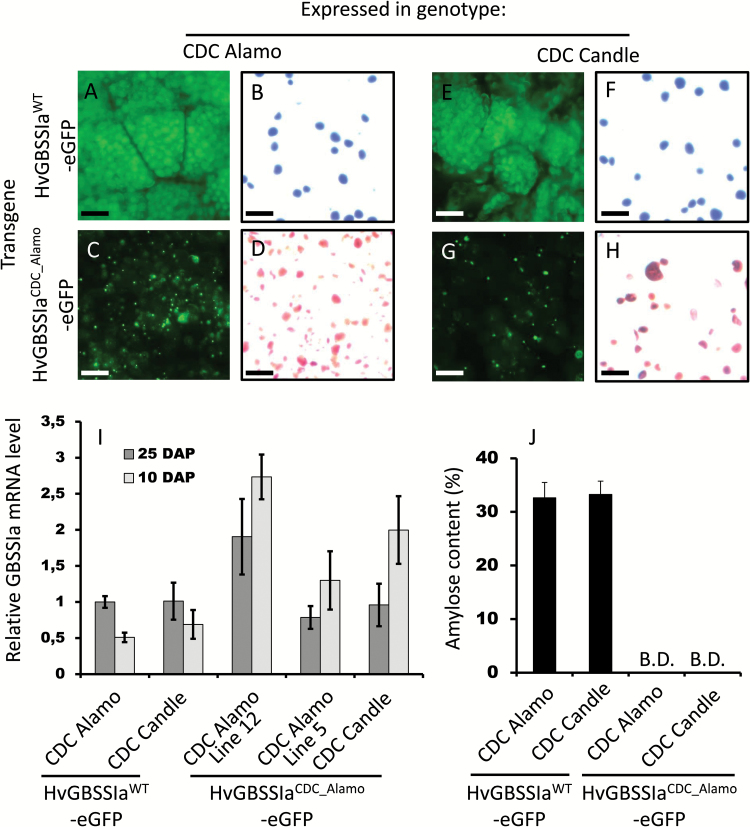
(A–H) eGFP fluorescence from endosperm cells (A, C, E, G) and iodine-stained starch granules (B, D, F, H) from developing grains (30 DAP) of plants with transgenic expression of HvGBSSIaWT-eGFP (A, B, E, F) or HvGBSSIaCDC_Alamo-eGFP (C, D, G, H) in the three waxy cultivars CDC Alamo (A–D), CDC Candle (E–H) and SB94912. The results for SB94912 were identical to those of CDC Candle, so for simplicity, only CDC Candle is shown. The scale bars in (A–H) are 50 µm. (I) Relative gene expression levels of HvGBSSIa determined by qPCR in developing grains (10 and 25 DAP) from plants with overexpression of either HvGBSSIaWT-eGFP or HvGBSSIaCDC_Alamo-eGFP (two different lines: 12 and 5) in the cultivars CDC Alamo and CDC Candle. (J) Amylose content in starch isolated from dry mature grains of plants expressing either HvGBSSIaWT-eGFP or HvGBSSIaCDC_Alamo-eGFP in CDC Alamo or CDC Candle.

References

    1. Asare EK, Båga M, Rossnagel BG, Chibbar RN. 2012. Polymorphism in the barley granule bound starch synthase 1 (gbss1) gene associated with grain starch variant amylose concentration. Journal of Agricultural and Food Chemistry 60, 10082–10092. - PubMed
    1. Blennow A, Jensen SL, Shaik SS, Skryhan K, Carciofi M, Holm PB, Hebelstrup KH, Tanackovic V. 2013. Future cereal starch bioengineering: cereal ancestors encounter gene technology and designer enzymes. Cereal Chemistry 90, 274–287.
    1. Buléon A, Colonna P, Planchot V, Ball S. 1998. Starch granules: structure and biosynthesis. International Journal of Biological Macromolecules 23, 85–112. - PubMed
    1. Carciofi M, Blennow A, Nielsen MM, Holm PB, Hebelstrup KH. 2012. Barley callus: a model system for bioengineering of starch in cereals. Plant Methods 8, 36. - PMC - PubMed
    1. Carciofi M, Shaif SS, Jensen SL, Blennow A, Svensson JT, Vincze E, Hebelstrup KH. 2011. Hyperphosphorylation of cereal starch. Journal of Cereal Science 54, 339–346.

Publication types