


Associations of Incident Cardiovascular Events With Restless Legs Syndrome and Periodic Leg Movements of Sleep in Older Men, for the Outcomes of Sleep Disorders in Older Men Study (MrOS Sleep Study)
- PMID: 28199705
- PMCID: PMC5806566
- DOI: 10.1093/sleep/zsx023
Associations of Incident Cardiovascular Events With Restless Legs Syndrome and Periodic Leg Movements of Sleep in Older Men, for the Outcomes of Sleep Disorders in Older Men Study (MrOS Sleep Study)
Abstract
Study objectives: Both restless legs syndrome (RLS) and periodic leg movements in sleep (PLMS) may be associated with incident cardiovascular disease (CVD). However, the individual contributions of these factors to adverse CVD outcomes are unknown.
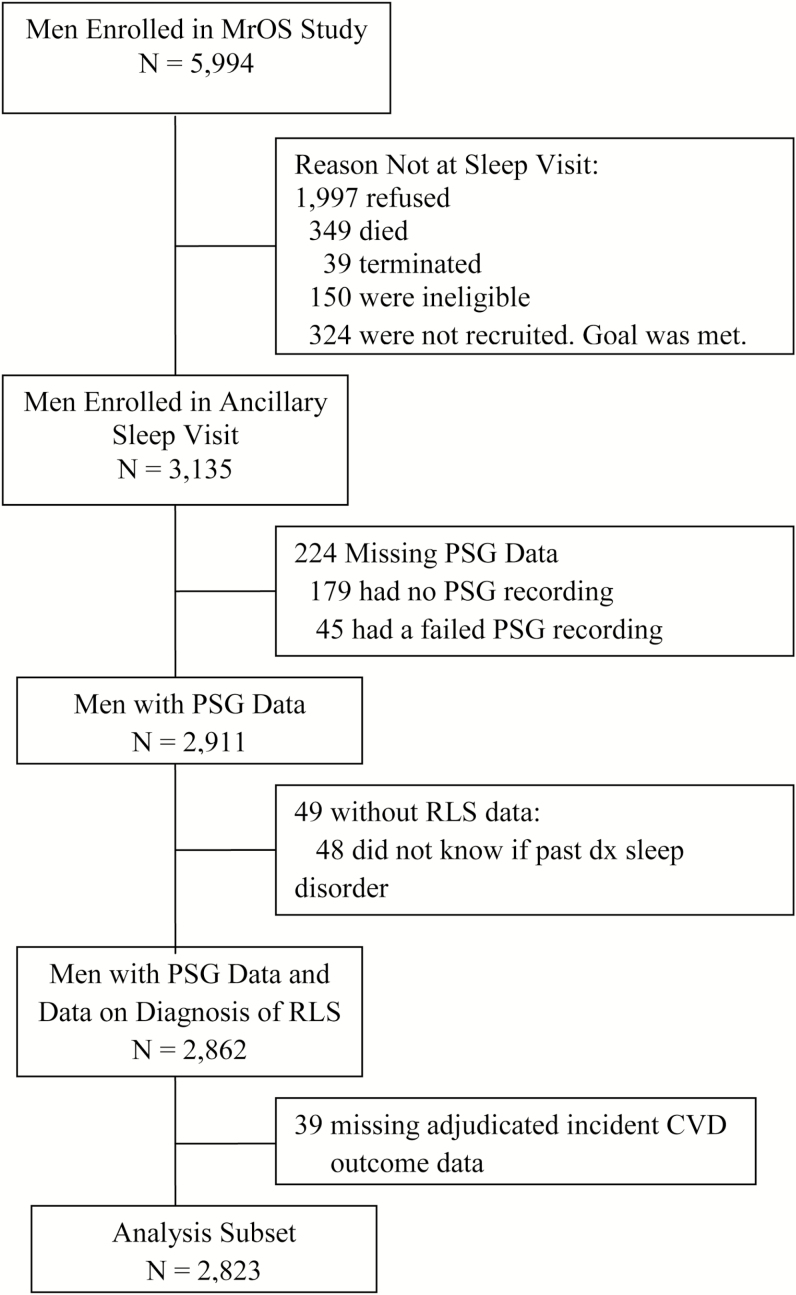
Methods: During the MrOS Sleep Study, 2823 men (mean age = 76.3 years) participated in a comprehensive sleep assessment from 2000 to 2002. RLS was identified by self-report of a physician diagnosis of RLS. A periodic limb movement of sleep index (PLMI) was derived from unattended in-home polysomnography. Incident cardiovascular events were centrally adjudicated during 8.7 ± 2.6 years of follow-up. The primary outcome was all-cause CVD; secondary outcomes included incident myocardial infarction (MI) and cerebrovascular disease. Cox proportional hazards regression models were adjusted for multiple covariates, including PLMI, to examine if there were independent associations of RLS and PLMI to the outcomes.
Results: Physician-diagnosed RLS was reported by 2.2% and a PLMI ≥ 15 was found in 59.6% of men. RLS was not associated with the composite CVD outcome. RLS was significantly associated with incident MI (Hazard ratio [HR] = 2.02, 95% CI, 1.04-3.91) even after adjustment for multiple covariates. Results were only modestly attenuated when PLMI was added to the model. PLMI also was found to predict incident MI (per SD increase in PLMI, HR = 1.14, 95% CI, 1.00-1.30, p = .05), and was materially unchanged after addition of RLS.
Conclusions: The independent risk that RLS confers for MI suggests a role for non-PLMS factors such as sleep disturbance, shared genetic factors, or PLM-independent sympathetic hyperactivity.
Keywords: coronary artery disease; insomnia.; periodic limb movements; restless legs syndrome.
© Sleep Research Society 2017. Published by Oxford University Press on behalf of the Sleep Research Society. All rights reserved. For permissions, please e-mail journals.permissions@oup.com.
References
-
- Szentkirályi A, Völzke H, Hoffmann W, Happe S, Berger K. A time sequence analysis of the relationship between cardiovascular risk factors, vascular diseases and restless legs syndrome in the general population. J Sleep Res. 2013; 22(4): 434–442. - PubMed
Publication types
MeSH terms
Grants and funding
- R01 HL070848/HL/NHLBI NIH HHS/United States
- R01 HL071194/HL/NHLBI NIH HHS/United States
- R01 HL070847/HL/NHLBI NIH HHS/United States
- UL1 TR000128/TR/NCATS NIH HHS/United States
- U01 AG042145/AG/NIA NIH HHS/United States
- U01 AG042168/AG/NIA NIH HHS/United States
- R01 HL070841/HL/NHLBI NIH HHS/United States
- R01 HL070839/HL/NHLBI NIH HHS/United States
- U01 AG027810/AG/NIA NIH HHS/United States
- U01 AG042139/AG/NIA NIH HHS/United States
- U01 AR066160/AR/NIAMS NIH HHS/United States
- R01 HL070842/HL/NHLBI NIH HHS/United States
- U01 AG042124/AG/NIA NIH HHS/United States
- U01 AG042140/AG/NIA NIH HHS/United States
- R01 HL070838/HL/NHLBI NIH HHS/United States
- R01 HL070837/HL/NHLBI NIH HHS/United States
- U01 AG042143/AG/NIA NIH HHS/United States
LinkOut - more resources
Full Text Sources
Other Literature Sources
Medical
