


Simplifying the Odor Landscape
- PMID: 28200040
- PMCID: PMC5863555
- DOI: 10.1093/chemse/bjx002
Simplifying the Odor Landscape
Abstract
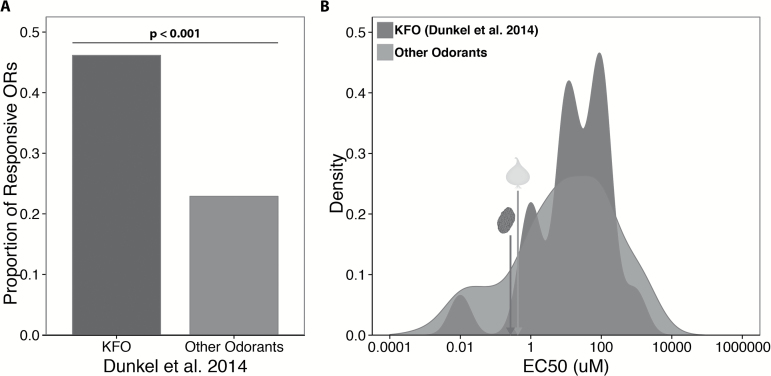
The vast number of detectable odors makes matching olfactory receptors (ORs) to their ligands a daunting task. Krautwurst and colleagues have hypothesized that this process can be simplified by focusing on those odorants that are perceptually relevant food odors. In this issue of Chemical Senses, they use this framework to identify highly sensitive receptors for 2 key food odorants found in red wine and onions, that activate broadly tuned OR1A1 and narrowly tuned OR2M3, respectively. This work provides further evidence for the advantage of screening receptors against ecologically relevant odors, and we discuss it in the context of current limitations in OR screening methods.
Keywords: genetic variability; key food odors; odor; olfaction; onion; wine.
© The Author 2017. Published by Oxford University Press. All rights reserved. For permissions, please e-mail: journals.permissions@oup.com.
Figures
Comment on
-
The Broadly Tuned Odorant Receptor OR1A1 is Highly Selective for 3-Methyl-2,4-nonanedione, a Key Food Odorant in Aged Wines, Tea, and Other Foods.Chem Senses. 2017 Mar 1;42(3):181-193. doi: 10.1093/chemse/bjw117. Chem Senses. 2017. PMID: 27916747
References
-
- Dunkel A, Steinhaus M, Kotthoff M, Nowak B, Krautwurst D, Schieberle P, Hofmann T. 2014. Nature’s chemical signatures in human olfaction: a foodborne perspective for future biotechnology. Angew Chem Int Ed Engl. 53:7124–7143. - PubMed
-
- Geithe C, Noe F, Kreissl J, Krautwurst D. 2016. The broadly tuned odorant receptor OR1A1 is highly selective for 3-methyl-2,4-nonanedione, a key food odorant in aged wines, tea, and other foods. Chem Senses. 42: 181–194. - PubMed
-
- Li S, Ahmed L, Zhang R, Pan Y, Matsunami H, Burger JL, Block E, Batista VS, Zhuang H. 2016. Smelling sulfur: copper and silver regulate the response of human odorant receptor OR2T11 to low-molecular-weight thiols. J Am Chem Soc. 138:13281–13288. - PubMed
Publication types
MeSH terms
Substances
Grants and funding
LinkOut - more resources
Full Text Sources
Other Literature Sources
