


Discontinuation, Efficacy, and Safety of Cholinesterase Inhibitors for Alzheimer's Disease: a Meta-Analysis and Meta-Regression of 43 Randomized Clinical Trials Enrolling 16 106 Patients
- PMID: 28201726
- PMCID: PMC5492783
- DOI: 10.1093/ijnp/pyx012
Discontinuation, Efficacy, and Safety of Cholinesterase Inhibitors for Alzheimer's Disease: a Meta-Analysis and Meta-Regression of 43 Randomized Clinical Trials Enrolling 16 106 Patients
Abstract
Background: We investigated the effect of cholinesterase inhibitors on all-cause discontinuation, efficacy and safety, and the effects of study design-, intervention-, and patient-related covariates on the risk-benefit of cholinesterase inhibitors for Alzheimer's disease.
Methods: A systematic review and meta-analysis of randomized placebo-controlled clinical trials comparing cholinesterase inhibitors and placebo was performed. The effect of covariates on study outcomes was analysed by means of meta-regression using a Bayesian framework.
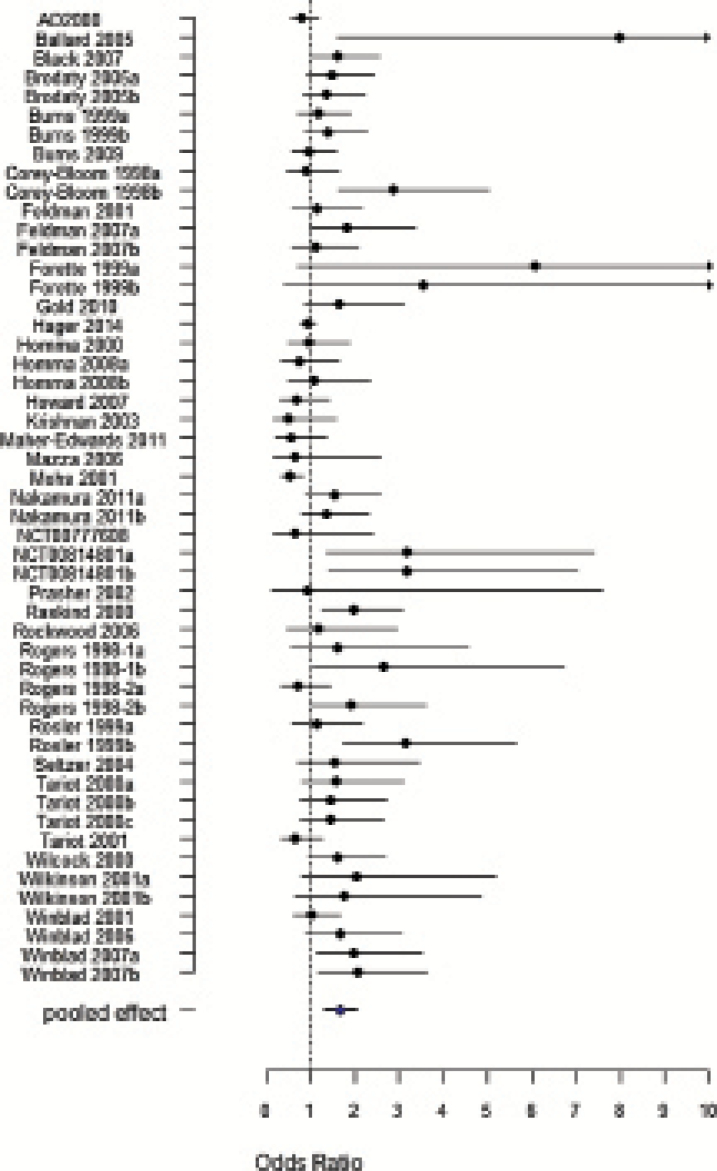
Results: Forty-three randomized placebo-controlled clinical trials involving 16106 patients were included. All-cause discontinuation was higher with cholinesterase inhibitors (OR = 1.66), as was discontinuation due to adverse events (OR=1.75). Cholinesterase inhibitors improved cognitive function (standardized mean difference = 0.38), global symptomatology (standardized mean difference=0.28) and functional capacity (standardized mean difference=0.16) but not neuropsychiatric symptoms. Rivastigmine was associated with a poorer outcome on all-cause discontinuation (Diff OR = 1.66) and donepezil with a higher efficacy on global change (Diff standardized mean difference = 0.41). The proportion of patients with serious adverse events decreased with age (Diff OR = -0.09). Mortality was lower with cholinesterase inhibitors than with placebo (OR = 0.65).
Conclusion: While cholinesterase inhibitors show a poor risk-benefit relationship as indicated by mild symptom improvement and a higher than placebo all-cause discontinuation, a reduction of mortality was suggested. Intervention- and patient-related factors modify the effect of cholinesterase inhibitors in patients with Alzheimer's disease.
Keywords: Alzheimer’s disease; Bayesian meta-analysis; cholinesterase inhibitor; discontinuation; efficacy.
© The Author 2017. Published by Oxford University Press on behalf of CINP.
Figures
References
-
- AD2000 Collaborative Group (2000) Long-term donepezil treatment in 565 patients with Alzheimer’s disease (AD2000): randomised double-blind trial. Lancet 363:2105–2115. - PubMed
-
- Brunnström HR, Englund EM. (2009) Cause of death in patients with dementia disorders. Eur J Neurol 16:488–492. - PubMed
-
- California Workgroup on Guidelines for Alzheimer’s Disease Management (2008) Guideline for Alzheimer’s disease management. Los Angeles: Alzheimer’s Disease and Related Disorders Association.
Publication types
MeSH terms
Substances
LinkOut - more resources
Full Text Sources
Other Literature Sources
Medical
