


Social capital and job satisfaction among substance abuse treatment employees
- PMID: 28202070
- PMCID: PMC5312434
- DOI: 10.1186/s13011-017-0093-6
Social capital and job satisfaction among substance abuse treatment employees
Abstract
Background: Job satisfaction is an important predictor for management and clinical ratios. Although it is accepted that is affected by many aspects, the influence of social capital remains to be determined. The main purpose of the article is to examine the relationship between job satisfaction and individual social capital for employees offering services in the treatment of addiction.
Methods: A cross-sectional study was conducted on 239 employees from 14 therapeutic programs at KETEA (Therapy Center for Dependent Individuals in Greece) (KETHEA). A revised Greek Version of the Social Capital Questionnaire (SCQ-G) for the individual social capital measurement, and of the Job Satisfaction Survey (JSS) for the job satisfaction measurement, were used.
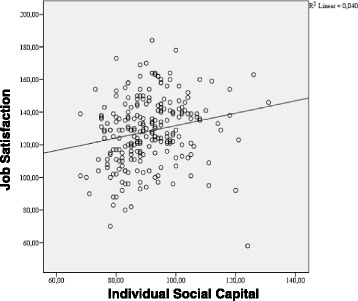
Results: Individual Social Capital ranged in medium levels. We observed a significant positive association between social capital and its' different aspects and gender, age, place of residence and working experience. Men, older employees, those who lived in smaller places, and those working more years, reached higher levels of individual social capital. Concerning overall job satisfaction most of the participants were ambivalent (61.5%), while 21.8% were satisfied and 16.7% were dissatisfied. Concerning its separate aspects, 77% were least satisfied with pay, 69.9% were least satisfied with advancement opportunities, 60.3% were least satisfied with fringe benefits, 85.8% were most satisfied with the nature of their work, 80.8% with their relationship with colleagues, and 77.8% were satisfied with supervision. Total Job Satisfaction was positively associated with place of residence and monthly salary. A significant positive correlation between social capital and job satisfaction was also observed.
Conclusions: Early evidence suggests that social capital is associated with job satisfaction of employees providing services in the treatment of substance abuse. Further research, regarding social capital on job satisfaction, is suggested. We need to design and implement individual and organizational interventions for the empowerment of Social Capital.
Keywords: Employees; Job Satisfaction; Social Capital; Substance abuse.
Figures
References
-
- Weiss HM. Deconstructing job satisfaction: Separating evaluations beliefs and affective experiences. Hum Resour Manag Rev. 2002;12:173–94. doi: 10.1016/S1053-4822(02)00045-1. - DOI
-
- Astrauskaite M, Vaitkevicius R, Perminas A. Job satisfaction survey: A confirmatory factor analysis based on secondary school teachers’ sample. IJBM. 2011;6:41–50. doi: 10.5539/ijbm.v6n5p41. - DOI
-
- Murphy G, Athanasou J, King N. Job satisfaction and organizational citizenship behaviour: A study of Australian human-service professionals. J Manag Psychol. 2002;17:287–97. doi: 10.1108/02683940210428092. - DOI
MeSH terms
LinkOut - more resources
Full Text Sources
Other Literature Sources
