. 2017 Feb 2:10:35-42.
doi: 10.2147/CCID.S123575. eCollection 2017.

A new dermocosmetic containing retinaldehyde, delta-tocopherol glucoside and glycylglycine oleamide for managing naturally aged skin: results from in vitro to clinical studies

Affiliations

A new dermocosmetic containing retinaldehyde, delta-tocopherol glucoside and glycylglycine oleamide for managing naturally aged skin: results from in vitro to clinical studies

Céline Rouvrais et al. Clin Cosmet Investig Dermatol. .

Abstract

Introduction: Natural aging of skin tissues, the addition of the cumulative action of the time and radiation exposure result in skin atrophy, wrinkles and degeneration of the extracellular matrix (ECM). The aim of the study was to investigate the beneficial effect of a combination containing retinaldehyde (RAL), delta-tocopherol glucoside (delta-TC) and glycylglycine ole-amide (GGO) and of a dermocosmetic containing the combination.

Materials and methods: The protective effect of the combination was assessed through in vitro gene expression of ultraviolet (UV)-irradiated fibroblasts. A skin aging assay using UV light on ex vivo skin samples and a clinical study conducted in 36 women aged from 35 to 55 years with a minimum of level 4 to a maximum of level 6 on the crow's feet photoscale assessed the antiaging effect of the dermocosmetic.

Results: When added to UV-irradiated fibroblasts, the combination substantially improved the ECM in activating the elastin fiber production (fibrillin 2, fibulin 1 and 5 and lysyl oxidase-like 2) as well as that of proteins involved in the cellular ECM interactions (integrin b1, paxillin and actin a2). An ex vivo photodamaged human skin model showed that the dermocosmetic formulation containing the combination of the active ingredients protected the elastic network against UV-induced alterations including both elastin and fibrillin-rich fibers in the dermis. A daily application of the dermocosmetic for 2 months on naturally aged skin resulted in a statistically significant improvement (p<0.05) of visible signs of aging comprising crow's feet, wrinkles and periocular fine lines. Finally, the formulation was well tolerated.

Conclusion: The dermocosmetic containing RAL, delta-TC and GGO provides a substantial benefit in the daily care of naturally aged skin in women aged 35-55 years.

Keywords: delta-tocopherol glucoside; formulation; glycylglycine oleamide; preclinical aged skin model; retinaldehyde; statistics.


Conflict of interest statement

Disclosure All authors are employees of Pierre Fabre Dermo-Cosmétique, France. The authors report no other conflicts of interest in this work.

Figures
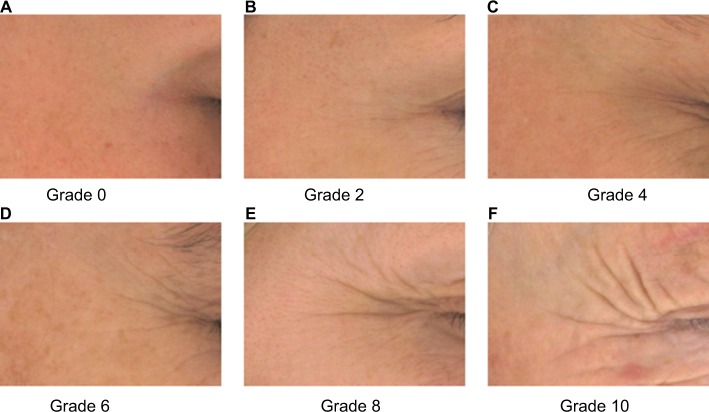
Figure 1
Figure 1
Pierre Fabre Dermo-Cosmetics Crow’s feet wrinkle photo scale. Notes: The photo scale was graded according to wrinkle appearance: (A) Grade 0; (B) Grade 2; (C) Grade 4 (D) Grade 6; (E) Grade 8; and (F) Grade 10.
Figure 2
Figure 2
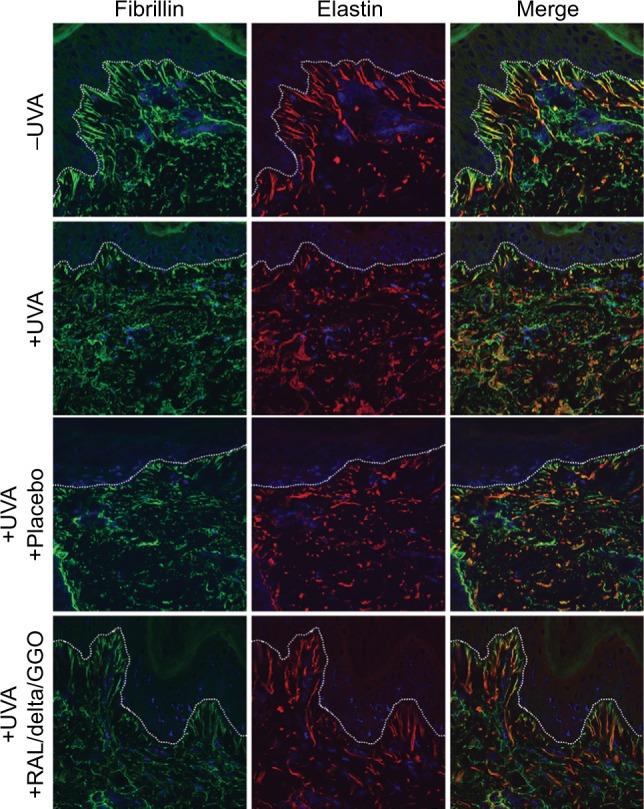
Not irradiated (−UVA), UVA-irradiated (+UVA) and UVA-irradiated human skin explants treated with a placebo or a preformulation containing a combination of RAL/delta-TC/GGO assessed by using immunohistochemistry and confocal microscopy. Notes: UVA induced a strong alteration of the elastic network, especially in the papillary dermis close to the dermoepidermal junction (dashed line). The fibrillin-rich fibers and elastin were visualized in green and red colors, respectively. Blue color denotes cell nuclei. Merge showed colocation of both proteins in the skin. The preformulation protected the dermis against UVA damage, whereas a placebo was not effective to prevent elastin network degradation. Field of view: 215 × 215 μm. Abbreviations: UVA, ultraviolet A; RAL, retinaldehyde; delta-TC, delta-tocopherol glucoside; GGO, glycylglycine oleamide.
Figure 3
Figure 3
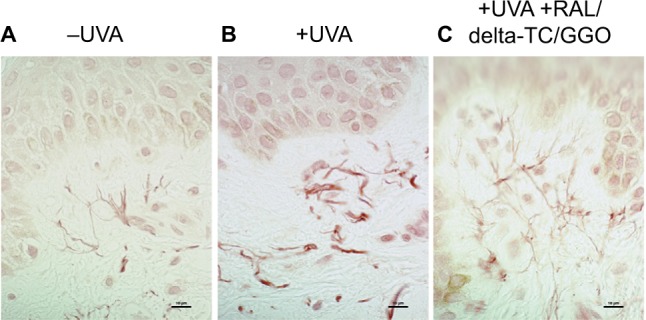
Ex vivo histology using Orcein staining of skin explants (A) before (−UVA), (B) after UVA (+UVA) and (C) after UVA and a preformulation containing a combination of RAL/delta-TC/GGO. Note: Scale bar = 10 μm. Abbreviations: UVA, ultraviolet A; RAL, retinaldehyde; delta-TC, delta-tocopherol glucoside; GGO, glycylglycine oleamide.
Figure 4
Figure 4
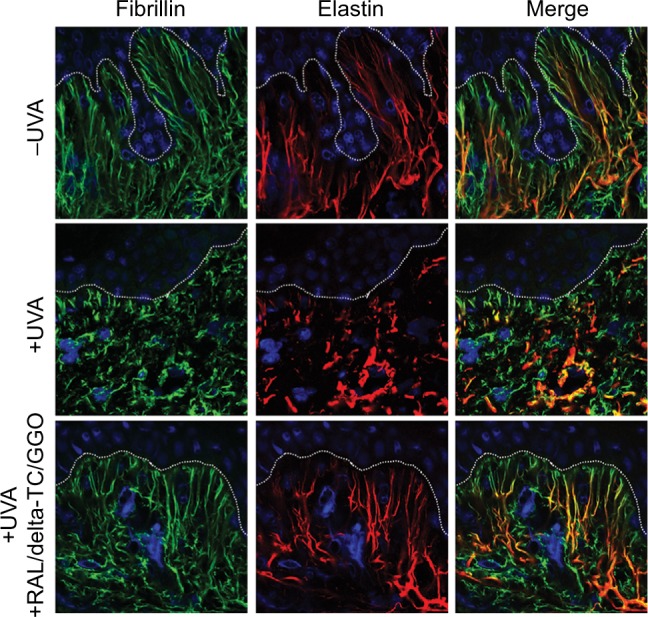
Not irradiated (−UVA), UVA-irradiated (+UVA) and UVA-irradiated human skin explants treated with a dermocosmetic formulation containing a combination of RAL/delta-TC/GGO assessed by using immunohistochemistry and confocal microscopy. Notes: A dermocosmetic product containing a combination of RAL 0.1%/delta-TC 0.1%/GGO 0.1% was formulated and was able to prevent UVA-induced elastin network alterations in the dermis. Dashed line indicates the dermoepidermal junction. Fibrillin-rich fibers and elastin are visualized in green and red colors, respectively. Blue color denotes cell nuclei. Merge showed colocation of both proteins in the skin. Field of view: 123 × 123 μm. Abbreviations: UVA, ultraviolet A; RAL, retinaldehyde; delta-TC, delta-tocopherol glucoside; GGO, glycylglycine oleamide.
Figure 5
Figure 5
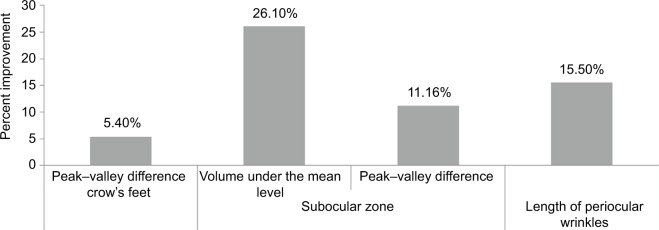
Improvement of skin aging parameters using specific devices after 2 months of daily application of the combination of a dermocosmetic formulation containing a combination of RAL/delta-TC/GGO. Notes: Skin surface changes in crow’s feet and in subocular area wrinkles were analyzed by profilometric technique on skin negative replicas. The length of crow’s feet wrinkles was quantified by image analysis on photographs. Changes from baseline for all assessed parameters were statistically significant (p<0.05). Abbreviations: RAL, retinaldehyde; delta-TC, delta-tocopherol glucoside; GGO, glycylglycine oleamide.

References

    1. Mukherjee S, Date A, Patravale V, Korting HC, Roeder A, Weindl G. Retinoids in the treatment of skin aging: an overview of clinical efficacy and safety. Clin Interv Aging. 2006;1(4):327–348. - PMC - PubMed
    1. Uitto J. The role of elastin and collagen in cutaneous aging: intrinsic aging versus photoexposure. J Drugs Dermatol. 2008;7(2 Suppl):s12–s16. - PubMed
    1. Quan T, Little E, Quan H, Qin Z, Voorhees JJ, Fisher GJ. Elevated matrix metalloproteinases and collagen fragmentation in photodamaged human skin: impact of altered extracellular matrix microenvironment on dermal fibroblast function. J Invest Dermatol. 2013;133(5):1362–1366. - PMC - PubMed
    1. Chung JH, Seo JY, Choi HR, et al. Modulation of skin collagen metabolism in aged and photoaged human skin in vivo. J Invest Dermatol. 2001;117(5):1218–1224. - PubMed
    1. Flament F, Bazin R, Laquieze S, Rubert V, Simonpietri E, Piot B. Effect of the sun on visible clinical signs of aging in Caucasian skin. Clin Cosmet Investig Dermatol. 2013;6:221–232. - PMC - PubMed