Case Reports
. 2017 Jan 1;6(2):2058460116688719.
doi: 10.1177/2058460116688719. eCollection 2017 Feb.

MR appearance of the temporal evolution and resolution of spontaneous osteonecrosis of the knee: a case report

Affiliations
Case Reports

MR appearance of the temporal evolution and resolution of spontaneous osteonecrosis of the knee: a case report

Mats Geijer et al. Acta Radiol Open. .

Abstract

Spontaneous osteonecrosis of the knee (SONK) is a feared condition of unknown cause, in its classic form appearing in the medial femoral condyle in middle-aged or elderly subjects. Diagnosis with radiography is notoriously difficult with a long latency before typical changes appear. Magnetic resonance imaging (MRI) is regarded as a diagnostic tool with the possibility to give an earlier diagnosis with improved chances for treatment. However, also with MRI there may be an initial diagnostic blind spot before typical changes appear. Little is known about the temporal evolution of the MRI changes. In the current case report, a case of SONK is reported where serial imaging with MRI was performed, from initial symptoms to eventual resolution after almost three years.

Keywords: Osteonecrosis; knee; magnetic resonance imaging (MRI).


Figures
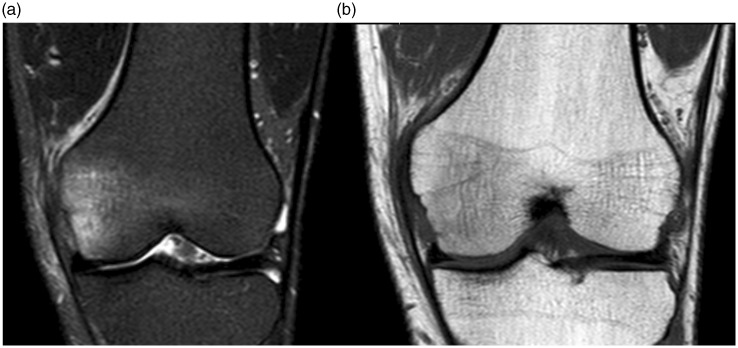
Fig. 1.
Fig. 1.
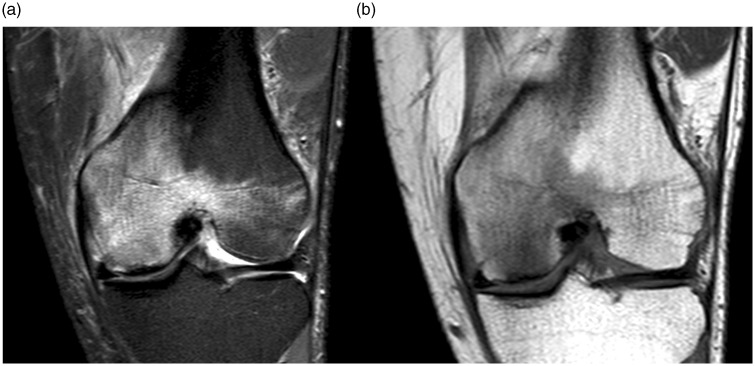
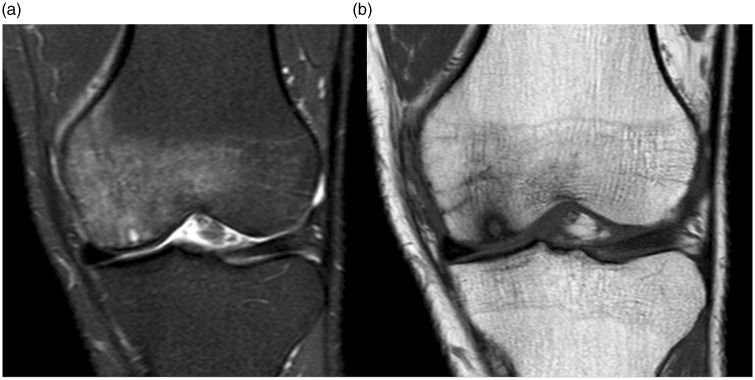
MRI at presentation, three weeks after symptom onset. (a) Coronal STIR and (b) coronal T1W images. There was bone marrow edema mostly in the medial half of the medial femoral condyle, otherwise milder and more diffuse in the rest of the condyle, with an appearance more suggestive of contusion than of osteonecrosis. No specific trauma preceded the symptoms, however, the patient had been walking a lot on hard surfaces three weeks earlier.
Fig. 2.
Fig. 2.
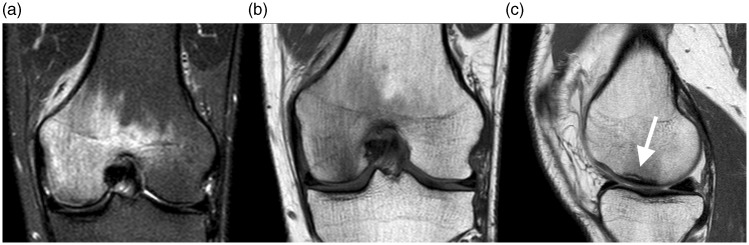
MRI three weeks after presentation. (a) Coronal STIR and (b) coronal T1W images. Increase of bone marrow edema both in intensity and extension, with the edema on sagittal images (not shown) now centered around the weight bearing area of the medial femoral condyle, suggestive of osteonecrosis.
Fig. 3.
Fig. 3.
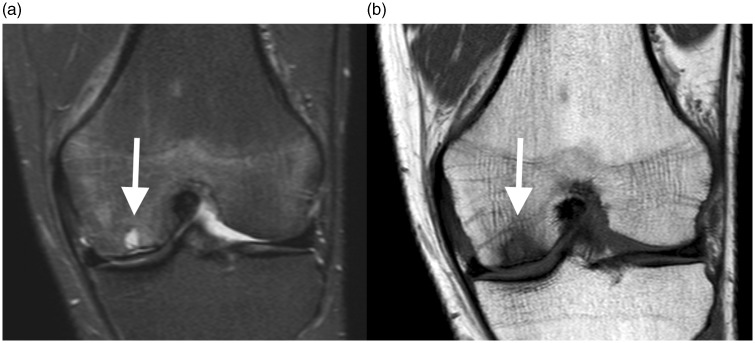
MRI at three months. (a) Coronal STIR, (b) coronal T1W, (c) sagittal PD-weighted images. Further progression of signal intensity of the bone marrow edema on a STIR sequence with stable distribution. On the sagittal T1W images a double sclerotic line (arrow) could be seen in the subchondral weight-bearing area.
Fig. 4.
Fig. 4.
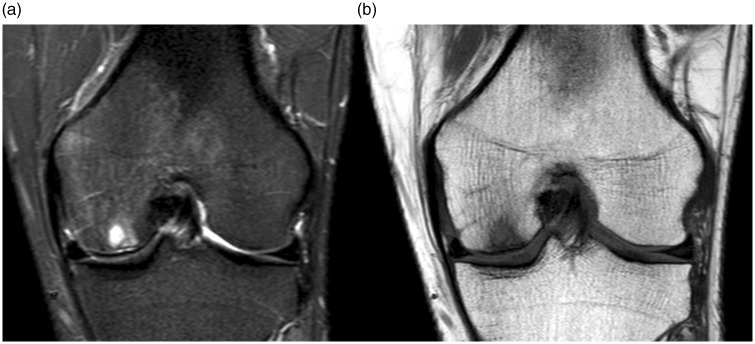
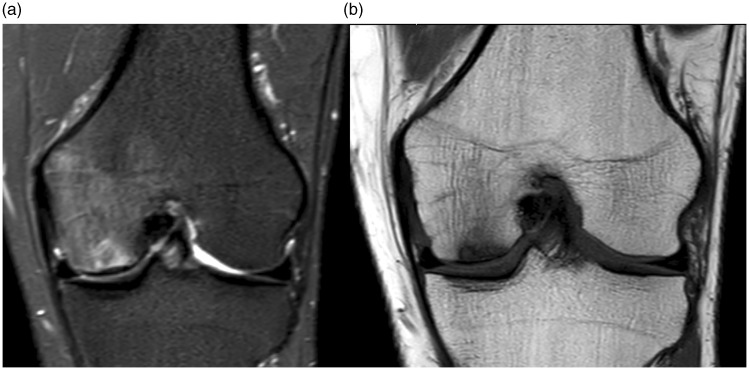
MRI at five months. (a) Coronal STIR and (b) coronal T1W images. Subtotal regression of the bone marrow edema on coronal STIR images. The subchondral double line was still present on sagittal T1W images (not shown), and a small cystic area with minimal impression and flattening of the joint surface on the weight-bearing area of the medial femoral condyle had appeared (arrows). The findings were now interpreted as osteonecrosis.
Fig. 5.
Fig. 5.
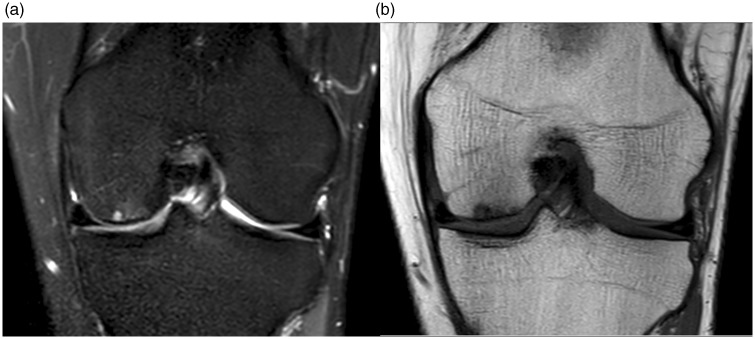
MRI at seven months. (a) Coronal STIR and (b) coronal T1W images. Slight progression of the subchondral cystic area and reappearance of a discrete bone marrow edema.
Fig. 6.
Fig. 6.
MRI at ten months. (a) Coronal STIR and (b) coronal T1W images. Further slight progression of bone marrow edema, with filling out of the cyst, discernible on T1W images.
Fig. 7.
Fig. 7.
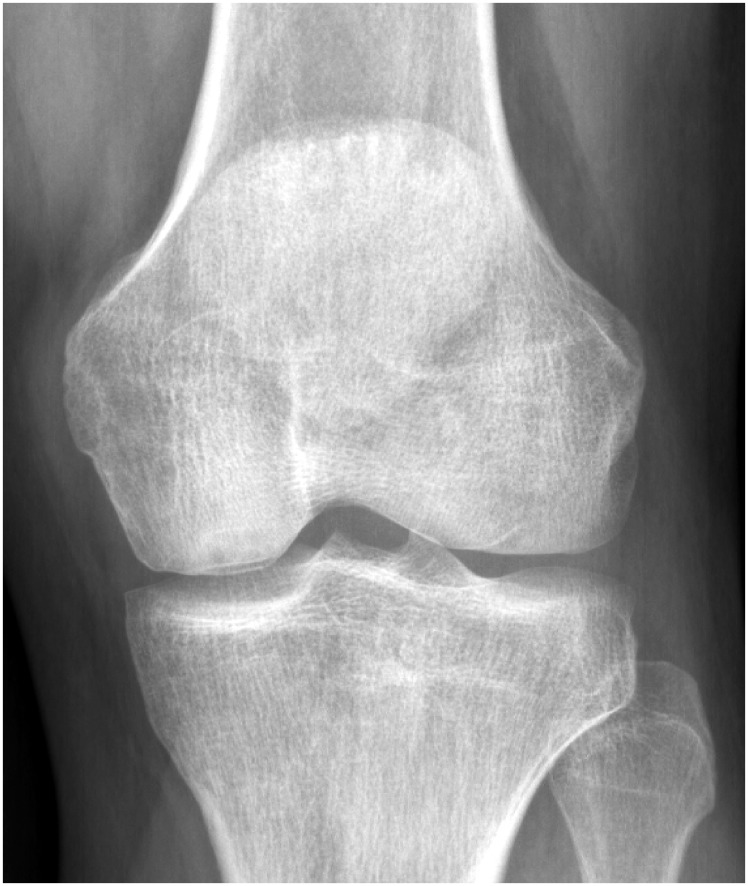
Radiography at one year and three months. Minimal subchondral lucency with preserved joint congruency and joint space width.
Fig. 8.
Fig. 8.
MRI at one year and three months. (a) Coronal STIR and (b) coronal T1W images. Unchanged bone marrow edema on STIR images and further filling out of the cyst on T1W images.
Fig. 9.
Fig. 9.
MRI at one year and nine months. (a) Coronal fat-suppressed PD-weighted and (b) coronal T1W images. Minimal remaining subchondral edema on fat-suppressed PD-weighted images with mildly irregular trabecular structure at the location of the former cyst.
Fig. 10.
Fig. 10.
MRI at two years and six months. (a) Coronal fat-suppressed PD-weighted and (b) coronal T1W images. Further healing on fat-suppressed PD-weighted images with disappearance of bone marrow edema with remaining small subchondral irregularities, preserved joint surfaces and cartilage.

References

    1. Bradway JK, Morrey BF. The natural history of the silent hip in bilateral atraumatic osteonecrosis. J Arthroplasty 1993; 8: 383–387. - PubMed
    1. Juréus J, Lindstrand A, Geijer M, et al. The natural course of spontaneous osteonecrosis of the knee (SPONK). A 1- to 27-year follow-up of 40 patients. Acta Orthop 2013; 84: 410–414. - PMC - PubMed
    1. Zywiel MG, McGrath MS, Seyler TM, et al. Osteonecrosis of the knee: a review of three disorders. Orthop Clin North Am 2009; 40: 193–211. - PubMed
    1. Kraenzlin ME, Graf C, Meier C, et al. Possible beneficial effect of bisphosphonates in osteonecrosis of the knee. Knee Surgery, Sport Traumatol Arthrosc 2010; 18: 1638–1644. - PubMed
    1. Kantor H. Bone marrow pressure in osteonecrosis of the femoral condyle (Ahlback’s disease). Arch Orthop Trauma Surg 1987; 106: 349–352. - PubMed

Publication types

LinkOut - more resources