. 2016 Oct 21;6(12):1186-1200.
doi: 10.1002/2211-5463.12127. eCollection 2016 Dec.

The widespread occurrence of tRNA-derived fragments in Saccharomyces cerevisiae

Affiliations

The widespread occurrence of tRNA-derived fragments in Saccharomyces cerevisiae

Kamilla Bąkowska-Żywicka et al. FEBS Open Bio. .

Abstract

Short RNAs derived from the cleavage of tRNA molecules are observed in most organisms. Their occurrence seems to be induced by stress conditions, but still little is known about their biogenesis and functions. We find that the recovery of tRNA fragments depends on the RNA isolation method. Using an optimized RNA extraction protocol and northern blot hybridization technique, we show that the tRNA-derived fragments in yeast are widespread in 12 different growth conditions. We did not observe significant stress-dependent changes in the amounts of tRNA fragments pool. Instead, we show the differential processing of almost all individual tRNAs. We also provide evidence that 3'-part-derived tRNA fragments are as abundant as the 5'- one in Saccharomyces cerevisiae. The resulting set of S. cerevisiae tRNA fragments provides a robust basis for further experimental studies on biological functions of tRFs.

Keywords: Saccharomyces cerevisiae; northern blot hybridization; small RNAs; tRNA; tRNA‐derived fragments.


Figures
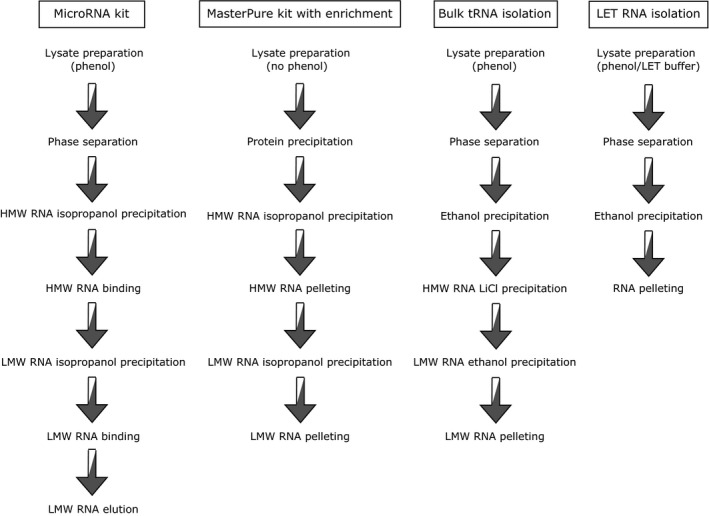
Figure 1
Figure 1
Schematic illustration of different RNA isolation methods used in this study.
Figure 2
Figure 2
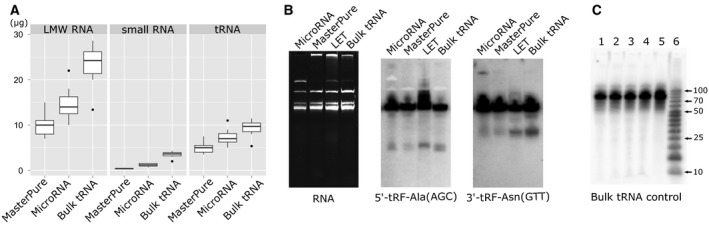
Comparison of LMW RNA extraction methods. (A) Box plot diagram showing the distributions of the absolute RNA amounts [μg] obtained from 3 × 10⁷ S. cerevisiae cells grown in 12 different conditions. Three different isolation methods, MasterPure, Micro RNA, and bulk tRNA are compared. Panels are representing the amounts of low molecular weight RNA (LMW, < 200 nt), small RNA (14–40 nt), and tRNA obtained with every method. The quantities were measured by Bioanalyzer 2100 using Small RNA kit. Central lines represent the medians, boxes indicate the range from 25th to 75th percentile, whiskers extend 1.5 times the above interquartile range, outliers are represented as dots. n = 12 sample points for all panels. (B) PAGE result showing RNA samples obtained by the employment of four different isolation procedures: Micro RNA, MasterPure, LET and bulk tRNA, and Northern blot hybridization result. Detection of 5′‐tRF‐Ala(AGC) and 3′‐tRNA‐Asn(GTT) is shown. All membranes were exposed for 16 h. Differential recovery of tRF can be observed. (C) Visualization of exogenous cellular tRNA pool (1) added at the following steps of the bulk tRNA isolation procedure: 2) directly to the cell pellet; 3) to the unbuffered phenol before shaking; 4) to the aqueous phase after phenol extraction and 5) during removal of ribosomal RNAs with LiCl. 6—size marker.
Figure 3
Figure 3
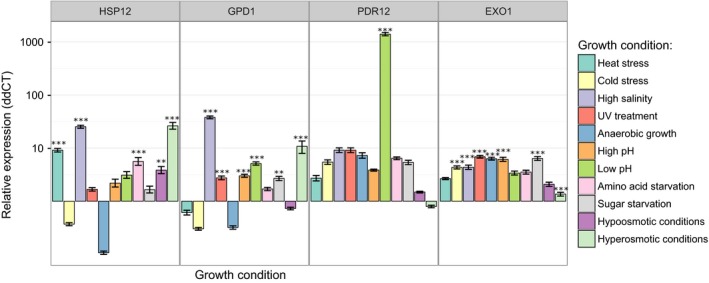
Status of a cell stress analyzed by quantitative real‐time PCR method. The expression change of four stress‐regulated yeast genes (HSP12, GPD1, PDR12, and EXO1) is shown. Expression changes are presented in log10 scale as the expression relative to the optimal growth conditions (∆∆CT values). Significance was designated as ** P ˂ 0.01, and *** P ˂ 0.001.
Figure 4
Figure 4
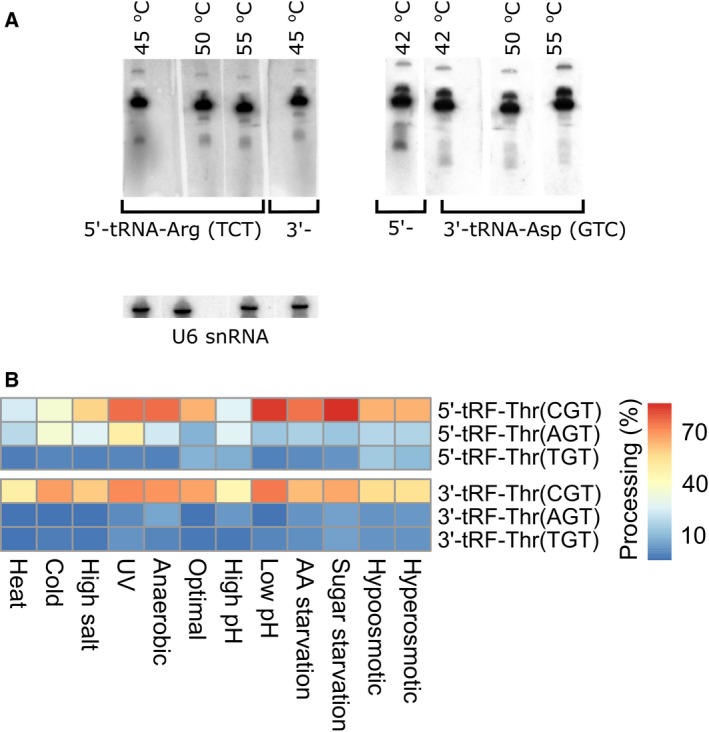
Verification of the possibility to distinguish the differential processing of tRNA isoforms. (A) Northern blot hybridization result. Detection of 5′‐ and 3′‐tRNA‐Arg (TCT) and 5′‐ and 3′‐ tRNA‐Asp (GTC) at different hybridization temperatures. U6 snRNA served as a loading control. (B) Differential processing of 3′ and 5′ parts of individual threonine tRNA isoforms. Absolute processing efficiency, calculated as the percentage of tRNA‐derived fragment signal compared to overall (fragment + tRNA) signal, is encoded in a color scale.
Figure 5
Figure 5
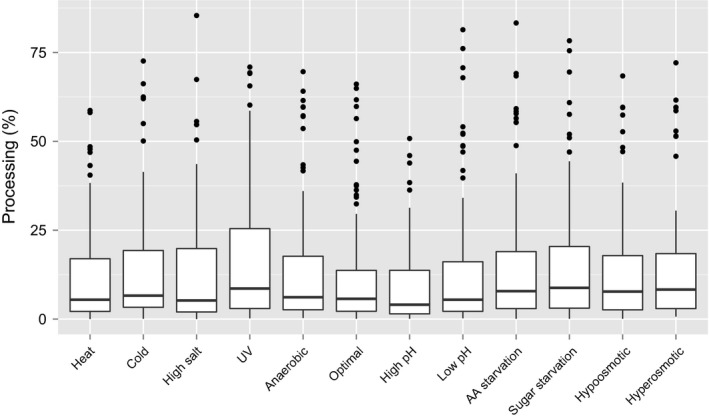
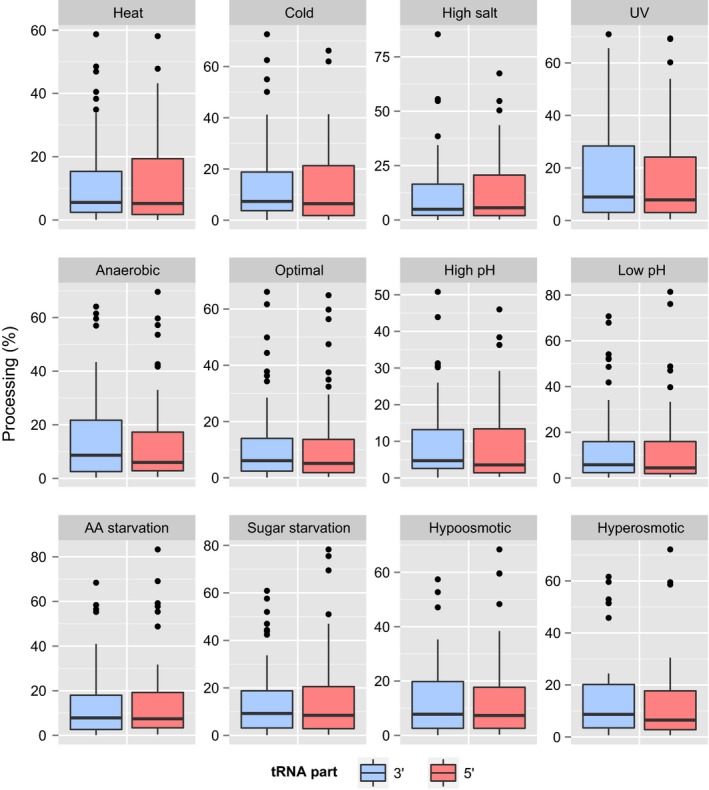
Distribution of tRNA processing efficiency in 12 growth conditions. Box plot representing distributions of the processing efficiencies of tRNAs in individual stress conditions. Central lines represent the medians, boxes indicate the range from 25th to 75th percentile, whiskers extend 1.5 times the above interquartile range, outliers are represented as dots. n = 96 sample points for all conditions.
Figure 6
Figure 6
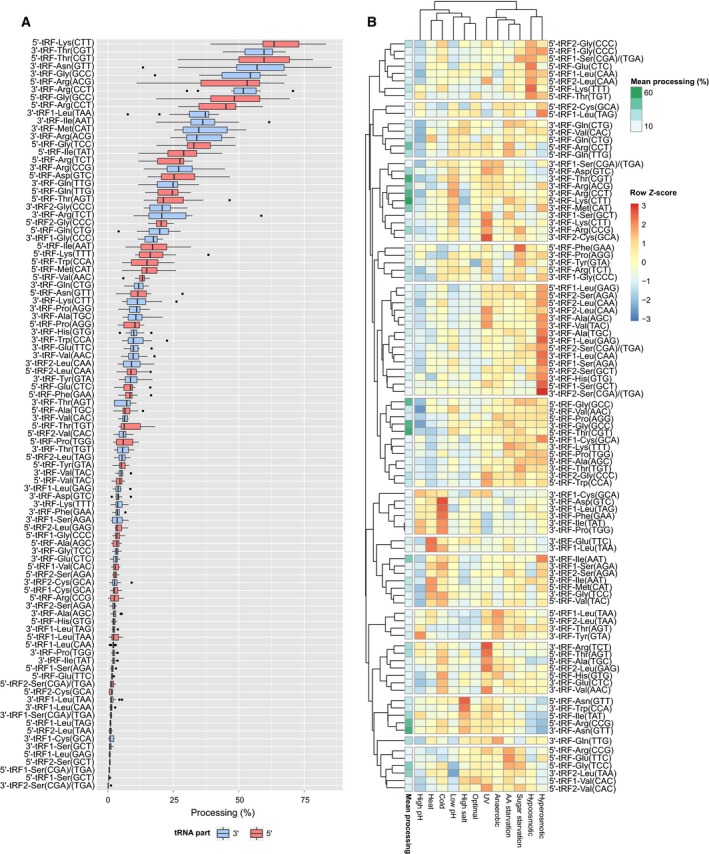
Differential processing of tRNAs. (A) Box plot representing the distributions of processing efficiencies of individual tRNA‐derived fragments among 12 different yeast growth conditions. Fragments are ordered by mean processing efficiency. tRNA fragments derived from 3′ part of tRNAs are marked with blue, and those derived from 5′ part with red. 2 tRFs, derived from the same part of particular tRNA are marked as follows: tRF1—longer tRF, tRF2—shorter tRF. Central lines represent the medians, boxes indicate the range from 25th to 75th percentile, whiskers extend 1.5 times the above interquartile range, outliers are represented as dots. n = 12 sample points for all tRNA fragments. (B) Clustered heat map representing the variations in tRNA processing efficiencies among 12 yeast growth conditions. The color scale encodes for the normalized Z‐scores calculated within the rows of the matrix, representing deviation of processing of a given tRNA fragment in a given condition from the mean processing of a given tRNA. In the first column, in a green scale, the mean processing efficiency of tRNAs has been presented.
Figure 7
Figure 7
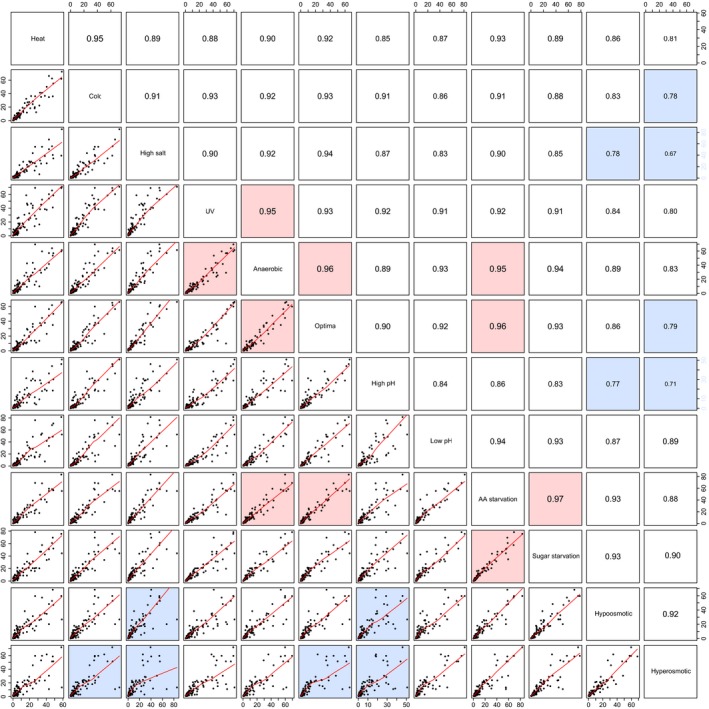
Cross‐comparison of the tRNA processing efficiencies. Scatter plot matrix containing the series of 1 : 1 comparisons of tRNA processing efficiencies between individual growth conditions. The lower triangle of the matrix represents the scatter plots of tRNA‐derived signals from compared growth conditions together with the loess fit (the red line). The upper triangle of the matrix represents the Pearson correlation of the tRNA processing between given growth conditions. Fields highlighted in red represent the conditions with highest correlation (lowest variation) of the tRNA processing, fields highlighted in blue represent the lowest correlation (highest variation). n = 96 for every comparison.
Figure 8
Figure 8
Comparison of 3′‐ and 5′‐derived tRNA fragments processing. Box plot representing the distribution of processing efficiencies of 3′‐ and 5′‐derived tRNA fragments in 12 yeast growth conditions. Central lines represent the medians, boxes indicate the range from 25th to 75th percentile, whiskers extend 1.5 times the above interquartile range, outliers are represented as dots. n = 46 for 3′ and 50 for 5′ fragments for all panels.

References

    1. Węgrzyn G and Węgrzyn A (2008) Is tRNA only a translation factor or also a regulator of other processes? J Appl Genet 49, 115–122. - PubMed
    1. Dong J, Qiu H, Garcia‐Barrio M, Anderson J and Hinnebusch AG (2000) Uncharged tRNA activates GCN2 by displacing the protein kinase moiety from a bipartite tRNA‐binding domain. Mol Cell 6, 269–279. - PubMed
    1. Hao S, Sharp JW, Ross‐Inta CM, McDaniel BJ, Anthony TG, Wek RC, Cavener DR, McGrath BC, Rudell JB, Koehnle TJ et al (2005) Uncharged tRNA and sensing of amino acid deficiency in mammalian piriform cortex. Science 307, 1776–1778. - PubMed
    1. Hopper AK and Shaheen HH (2008) A decade of surprises for tRNA nuclear‐cytoplasmic dynamics. Trends Cell Biol 18, 98–104. - PubMed
    1. Raina M and Ibba M (2014) tRNAs as regulators of biological processes. Front Genet 11, 5–171. - PMC - PubMed