


Modeling Fragile X syndrome in neurogenesis: An unexpected phenotype and a novel tool for future therapies
- PMID: 28203608
- PMCID: PMC5293320
- DOI: 10.1080/23262133.2016.1270384
Modeling Fragile X syndrome in neurogenesis: An unexpected phenotype and a novel tool for future therapies
Abstract
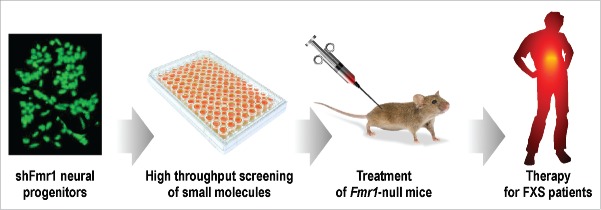
FMRP is an RNA-binding protein involved in synaptic translation. Its absence causes a form of intellectual disability, the Fragile X syndrome (FXS). Small neuroanatomical abnormalities, present both in human and mouse FMRP-deficient brains, suggest a subtle critical role of this protein in neurogenesis. Stable depletion of FMRP has been obtained in a mouse embryonic stem cell line Fmr1 (shFmr1 ES) that does not display morphological alterations, but an abnormal expression of a subset of genes mainly involved in neuronal differentiation and maturation. Inducing the differentiation of shFmr1 ES cells into the neuronal lineage results in an accelerated generation of neural progenitors and neurons during the first steps of neurogenesis. This transient phenotype is due to an elevated level of the Amyloid Precursor Protein (APP), whose mRNA is a target of FMRP. APP is processed by the BACE-1 enzyme, producing the β-amyloid (Aβ) peptide accelerating neurogenesis by activating the expression of Ascll. Inhibition of the BACE-1 enzyme rescues the phenotype of shFmr1 ES cells. Here we discuss the importance of the shFmr1 ES line not only to understand the physiopathology of FXS but also as a tool to screen biomolecules for new FXS therapies.
Keywords: Fragile X Syndrome; cell model for Fragile X syndrome; neurogenesis; therapy for Fragile X syndrome.
Figures
References
-
- Maurin T, Zongaro S, Bardoni B. Fragile X Syndrome: from molecular pathology to therapy. Neurosci Biobehav Rev 2014. October; 46 Pt 2:242-55; PMID:24462888; http://dx.doi.org/10.1016/j.neubiorev.2014.01.006 - DOI - PubMed
-
- Bardoni B, Mandel JL, Fisch GS. FMR1 gene and fragile X syndrome. Am J Med Genet 2000; 97(2):153-63; PMID:11180223; http://dx.doi.org/10.1002/1096-8628(200022)97:2%3c153::AID-AJMG7%3e3.0.C... - DOI - PubMed
-
- Ramakers GJA. Rho proteins, mental retardation and the cellular basis of cognition. Trends Neurosci 2002. April; 25(4):191-9; PMID:11998687; http://dx.doi.org/10.1016/S0166-2236(00)02118-4 - DOI - PubMed
-
- Irwin SA, Galvez R, Greenough WT. Dendritic spine structural anomalies in fragile-X mental retardation syndrome. Cereb Cortex 2000. October; 10(10):1038-44; PMID:11007554; http://dx.doi.org/10.1093/cercor/10.10.1038 - DOI - PubMed
-
- Grossman AW, Aldridge GM, Weiler IJ, Greenough WT. Local protein synthesis and spine morphogenesis: Fragile X syndrome and beyond. J Neurosci Society for Neuroscience; 2006. July 5; 26(27):7151-5; http://dx.doi.org/10.1523/JNEUROSCI.1790-06.2006 - DOI - PMC - PubMed
LinkOut - more resources
Full Text Sources
Other Literature Sources
