


When Helping Hurts: Nonabusing Family, Friends, and Neighbors in the Lives of Elder Mistreatment Victims
- PMID: 28204580
- PMCID: PMC6044408
- DOI: 10.1093/geront/gnw257
When Helping Hurts: Nonabusing Family, Friends, and Neighbors in the Lives of Elder Mistreatment Victims
Abstract
Purpose of the study: Elder mistreatment is an epidemic with significant consequences to victims. Little is known, however, about another affected group: nonabusing family members, friends, and neighbors in the lives of the older victim or "concerned persons." This study aimed to identify (a) the prevalence of adults aged 18 and older who have encountered an elder mistreatment situation, (b) the proportion of these who helped the elder victim, and (c) the subjective levels of distress experienced by respondents who helped the victim versus those who did not.
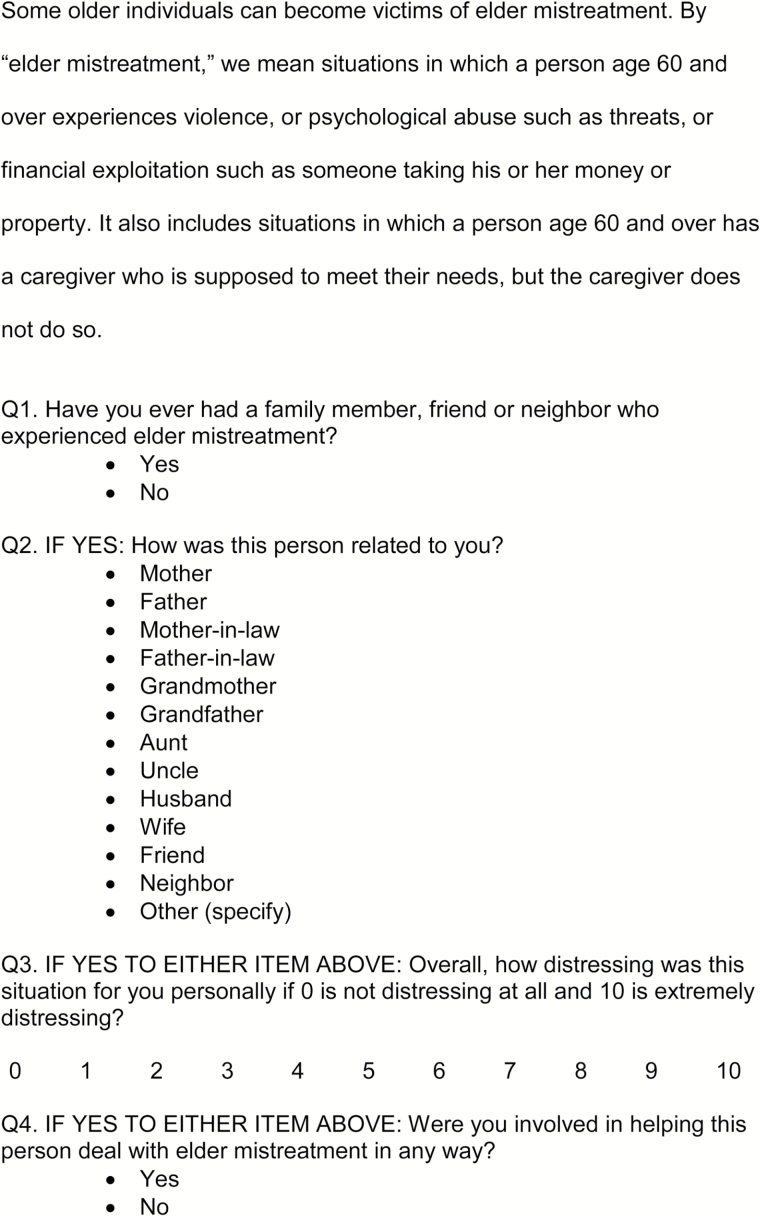
Design and methods: Data were collected from a nationally representative telephone survey of 1,000 adults (18+). Multiple linear regression was used to test the relationship between "helping status" and personal distress attributed to an elder mistreatment, defined as someone aged 60 and older experiencing violence, psychological abuse, financial exploitation, or neglect by a caregiver.
Results: Nearly 30% of adults knew a relative, friend, or neighbor who experienced elder mistreatment. Of these, 67% reported personal distress resulting from the mistreatment at a level of 8 or more out of 10. Assuming a helping role was associated with significantly higher levels of personal distress. Greater distress was also associated with being a woman, increasing age, and lower household income.
Implications: Knowing about an elder mistreatment situation is highly distressing for millions of adults in the United States, particularly for those assuming a helping role. We suggest intervention approaches and future research to better understand the role and needs of concerned persons.
Figures
References
-
- Acierno R. Hernandez-Tejada M. Muzzy W., & Steve K (2008). National elder mistreatment study. Retrieved July 28, 2016, from https://www.ncjrs.gov/pdffiles1/nij/grants/226456.pdf
-
- Ahrens C. E., & Campbell R (2000). Assisting rape victims as they recover from rape: The impact on friends. Journal of Interpersonal Violence, 15, 959–986. doi:10.1177/088626000015009004
-
- Breckman R., & Adelman R (1988). Strategies for helping victims of elder mistreatment. Newbury Park, CA: Sage Publications.
-
- Burnes D. Rizzo V. M. Gorroochurn P. Pollack M. H., & Lachs M. S (2016). Understanding service utilization in cases of elder abuse to inform best practices. Journal of Applied Gerontology, 35, 1036–1057. doi:10.1177/0733464814563609 - PubMed
-
- Cwik M. S. (1996). The many effects of rape: The victim, her family, and suggestions for family therapy. Family Therapy, 23, 95–116.
Publication types
MeSH terms
Grants and funding
LinkOut - more resources
Full Text Sources
Other Literature Sources
Medical
Research Materials
