


Increased Endovascular Staphylococcus aureus Inoculum Is the Link Between Elevated Serum Interleukin 10 Concentrations and Mortality in Patients With Bacteremia
- PMID: 28205673
- PMCID: PMC5411397
- DOI: 10.1093/cid/cix157
Increased Endovascular Staphylococcus aureus Inoculum Is the Link Between Elevated Serum Interleukin 10 Concentrations and Mortality in Patients With Bacteremia
Erratum in
-
Erratum.Clin Infect Dis. 2017 Oct 15;65(8):1431-1433. doi: 10.1093/cid/cix563. Clin Infect Dis. 2017. PMID: 29017252 Free PMC article. No abstract available.
Abstract
Background: Cell wall peptidoglycan stimulates interleukin 10 (IL-10) production in Staphylococcus aureus bacteremia (SaB) animal models, but clinical data are not available. This study evaluates the impact of intravascular bacterial cell numbers (ie, the level of bacteremia), in patients at the time of clinical presentation on IL-10 production and its association with S. aureus bacteremia (SaB) mortality.
Methods: Blood and isolates were collected in 133 consecutive SaB patients. Serum IL-10 was quantified by an electrochemoluminescence assay. Bacterial inoculum was measured in patient sera with elevated (n = 8) or low (n = 8) IL-10 using a magnetic bacterial capture assay. Staphylococcus aureus from these 2 groups were introduced into whole blood ex vivo to determine IL-10 production with variable inocula.
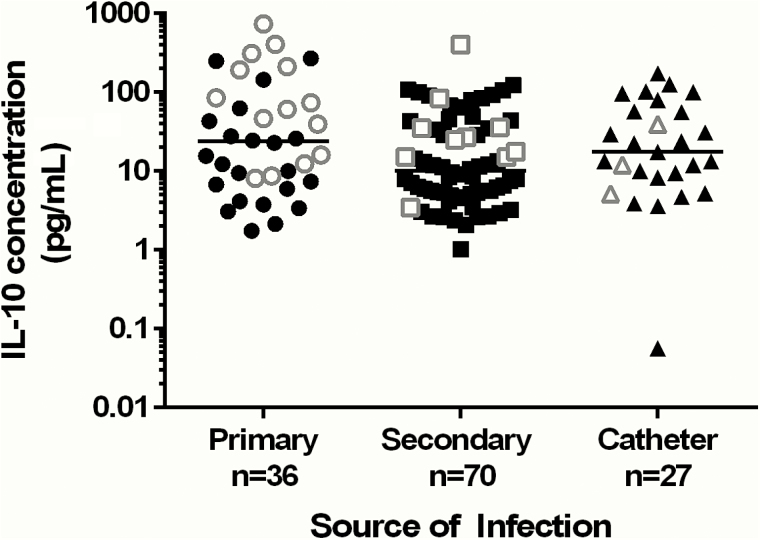
Results: IL-10 serum concentration was higher in SaB patient mortality (n = 27) vs survival (n = 106) (median, 36.0 pg/mL vs 10.4 pg/mL, respectively, P < .001). Patients with elevated IL-10 more often had endovascular SaB sources. The inoculum level of SaB was higher in patients with elevated serum IL-10 vs patients with low IL-10 (35.5 vs 0.5 median CFU/mL; P = .044). Ex vivo studies showed that 108 CFU/mL yielded greater IL-10 than did 103 CFU/mL (4.4 ± 1.8 vs 1.0 ± 0.6 pg/mL; P < .01).
Conclusions: Elevated IL-10 serum concentrations at clinical presentation of SaB were highly associated with mortality. High intravascular peptidoglycan concentration, driven by a higher level of bacteremia, is a key mediator of IL-10 anti-inflammatory response that portends poor clinical outcome. Using IL-10 as an initial biomarker, clinicians may consider more aggressive antimicrobials for rapid bacterial load reduction in high-risk SaB patients.
Keywords: Staphylococcus aureus; bacteremia; biomarker; inoculums.; mortality.
© The Author 2017. Published by Oxford University Press for the Infectious Diseases Society of America. All rights reserved. For permissions, e-mail: journals.permissions@oup.com.
Figures

References
-
- Hota B, Lyles R, Rim J, et al. ; CDC Prevention Epicenters Predictors of clinical virulence in community-onset methicillin-resistant Staphylococcus aureus infections: the importance of USA300 and pneumonia. Clin Infect Dis 2011; 53:757–65. - PubMed
-
- Rooijakkers SH, Ruyken M, van Roon J, van Kessel KP, van Strijp JA, van Wamel WJ. Early expression of SCIN and CHIPS drives instant immune evasion by Staphylococcus aureus. Cell Microbiol 2006; 8:1282–93. - PubMed
-
- Nienaber JJ, Sharma Kuinkel BK, Clarke-Pearson M, et al. ; International Collaboration on Endocarditis-Microbiology Investigators Methicillin-susceptible Staphylococcus aureus endocarditis isolates are associated with clonal complex 30 genotype and a distinct repertoire of enterotoxins and adhesins. J Infect Dis 2011; 204:704–13. - PMC - PubMed
MeSH terms
Substances
Grants and funding
LinkOut - more resources
Full Text Sources
Other Literature Sources
Medical
