


Indonesia's road to universal health coverage: a political journey
- PMID: 28207049
- PMCID: PMC5400042
- DOI: 10.1093/heapol/czw120
Indonesia's road to universal health coverage: a political journey
Abstract
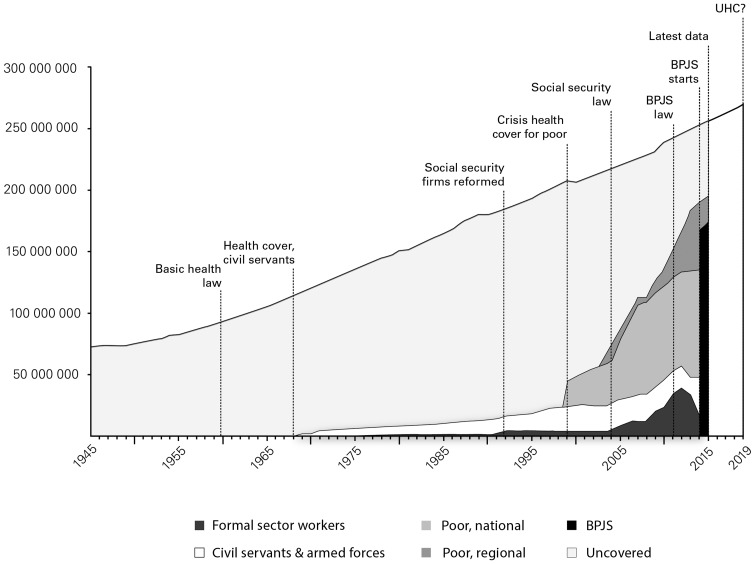
In 2013 Indonesia, the world's fourth most populous country, declared that it would provide affordable health care for all its citizens within seven years. This crystallised an ambition first enshrined in law over five decades earlier, but never previously realised. This paper explores Indonesia's journey towards universal health coverage (UHC) from independence to the launch of a comprehensive health insurance scheme in January 2014. We find that Indonesia's path has been determined largely by domestic political concerns – different groups obtained access to healthcare as their socio-political importance grew. A major inflection point occurred following the Asian financial crisis of 1997. To stave off social unrest, the government provided health coverage for the poor for the first time, creating a path dependency that influenced later policy choices. The end of this programme coincided with decentralisation, leading to experimentation with several different models of health provision at the local level. When direct elections for local leaders were introduced in 2005, popular health schemes led to success at the polls. UHC became an electoral asset, moving up the political agenda. It also became contested, with national policy-makers appropriating health insurance programmes that were first developed locally, and taking credit for them. The Indonesian experience underlines the value of policy experimentation, and of a close understanding of the contextual and political factors that drive successful UHC models at the local level. Specific drivers of success and failure should be taken into account when scaling UHC to the national level. In the Indonesian example, UHC became possible when the interests of politically and economically influential groups were either satisfied or neutralised. While technical considerations took a back seat to political priorities in developing the structures for health coverage nationally, they will have to be addressed going forward to achieve sustainable UHC in Indonesia.
Figures
References
-
- Abimanyu A. 2011. Pro-kontra Keberadaan BPJS. Kompas.
-
- Agyepong IA, Adjei S. 2008. Public social policy development and implementation: a case study of the Ghana National Health Insurance scheme. Health Policy and Planning 23: 150–60. - PubMed
-
- Arifianto A. et al. 2005. Making Services Work for the Poor in Indonesia: A Report on Health Financing Mechanisms (JPK-Gakin) Scheme in Kabupaten Purbalingga, East Sumba, and Tabanan, Jakarta: SMERU.
-
- Asian Development Bank. 2006. Social Protection Sector Development Program in Indonesia (Loans 1622/1623-INO), Manila: ADB Independent Evaluation Department.
-
- Aspinall E. 2014. Health care and democratization in Indonesia. Democratization 21: 803–23.
MeSH terms
LinkOut - more resources
Full Text Sources
Other Literature Sources
