


Novel multiplex assay platforms to detect influenza A hemagglutinin subtype-specific antibody responses for high-throughput and in-field applications
- PMID: 28207986
- PMCID: PMC5410722
- DOI: 10.1111/irv.12449
Novel multiplex assay platforms to detect influenza A hemagglutinin subtype-specific antibody responses for high-throughput and in-field applications
Abstract
Background: Detections of influenza A subtype-specific antibody responses are often complicated by the presence of cross-reactive antibodies. We developed two novel multiplex platforms for antibody detection. The multiplexed magnetic fluorescence microsphere immunoassay (MAGPIX) is a high-throughput laboratory-based assay. Chembio Dual Path Platform (DPP) is a portable and rapid test that could be used in the field.
Methods: Twelve recombinant globular head domain hemagglutinin (GH HA1) antigens from A(H1N1)pdm09 (pH1N1), A(H2N2), A(H3N2), A(H5N1), A(H7N9), A(H9N2), A(H13N9), B/Victoria lineage, B/Yamagata lineage viruses, and protein A control were used. Human sera from U.S. residents either vaccinated (with H5N1 or pH1N1) or infected with pH1N1 influenza viruses and sera from live bird market workers in Bangladesh (BDPW) were evaluated. GH HA1 antigens and serum adsorption using full ectodomain recombinant hemagglutinins from A(pH1N1) and A(H3N2) were introduced into the platforms to reduce cross-reactivity.
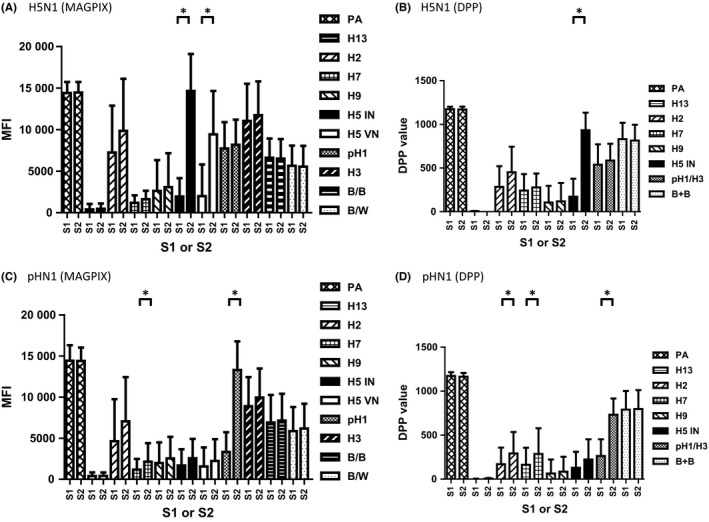
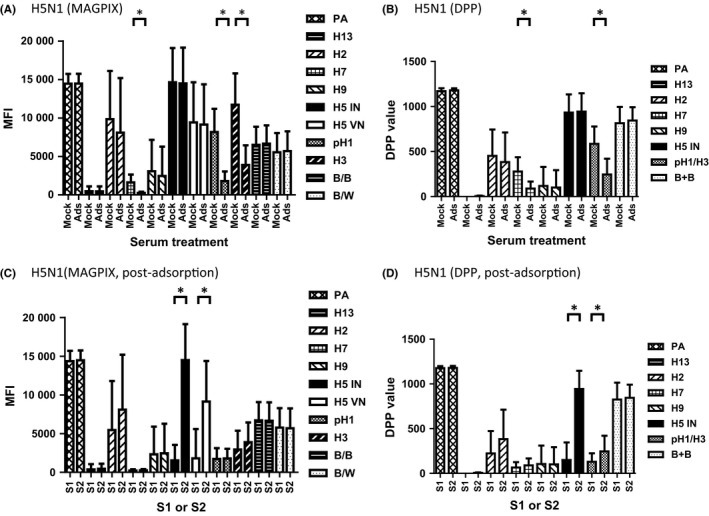
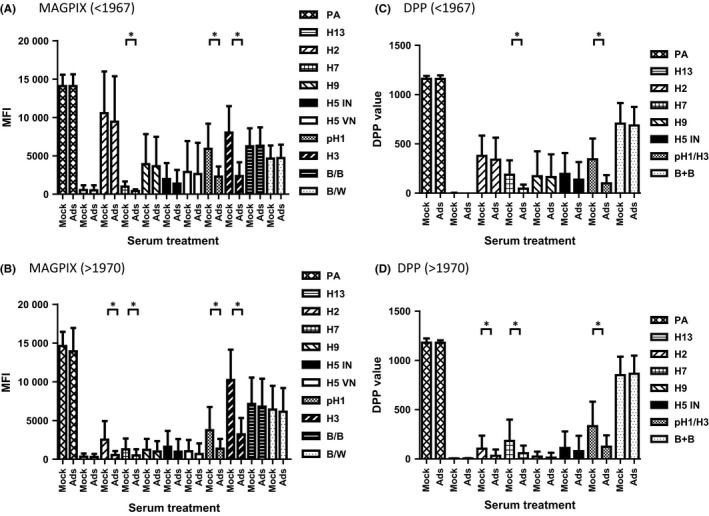
Results: Serum adsorption reduced cross-reactivity to novel subtype HAs. Compared to traditional hemagglutination inhibition or microneutralization assays, when serum adsorption and the highest fold rise in signals were used to determine positivity, the correct subtype-specific responses were identified in 86%-100% of U.S. residents exposed to influenza antigens through vaccination or infection (N=49). For detection of H5N1-specific antibodies in sera collected from BDPW, H5 sensitivity was 100% (six of six) for MAGPIX, 83% (five of six) for DPP, H5 specificity was 100% (15/15), and cross-reactivity against other subtype was 0% (zero of six) for both platforms.
Conclusion: MAGPIX and DPP platforms can be utilized for high-throughput and in-field detection of novel influenza virus infections.
Keywords: MAGPIX; Chembio Dual Path Platform; antibody; hemagglutinin; influenza.
© 2017 The Authors. Influenza and Other Respiratory Viruses Published by John Wiley & Sons Ltd.
Figures
References
-
- Katz JM, Hancock K, Xu X. Serologic assays for influenza surveillance, diagnosis and vaccine evaluation. Expert Rev Anti Infect Ther. 2011;9:669‐683. - PubMed
Publication types
MeSH terms
Substances
Grants and funding
LinkOut - more resources
Full Text Sources
Other Literature Sources
Medical
Research Materials
