


Dietary Fatty Acids and Changes in Blood Lipids during Adolescence: The Role of Substituting Nutrient Intakes
- PMID: 28208667
- PMCID: PMC5331558
- DOI: 10.3390/nu9020127
Dietary Fatty Acids and Changes in Blood Lipids during Adolescence: The Role of Substituting Nutrient Intakes
Abstract
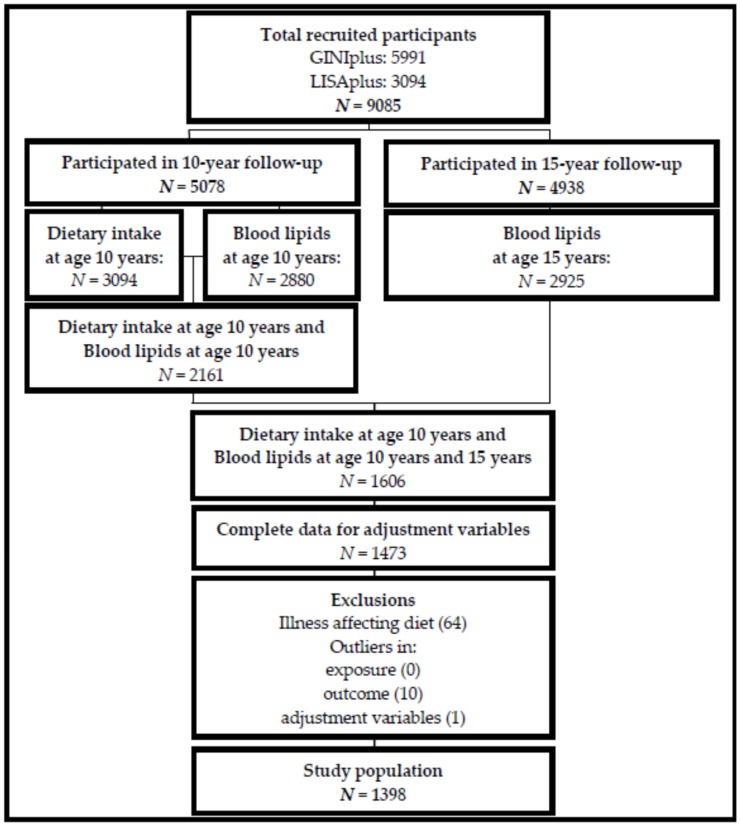
The relevance of dietary fatty acids (FA) for blood lipids should be assessed in the context of substituting nutrients. Such evidence is lacking for adolescents. This study describes prospective associations of dietary FA with changes in serum lipids during adolescence, and considers the theoretical isocaloric replacements of saturated FA (SFA) with other FA or carbohydrates (CHO). Children from the GINIplus and LISAplus birth cohorts, with data on FA intakes (at age 10 years) and serum lipids (at age 10 and 15 years), were included (n = 1398). Associations of SFA, monounsaturated FA (MUFA), n-3 polyunsaturated FA (n-3 PUFA) and n-6 PUFA, with changes in low-density lipoprotein (LDL), high-density lipoprotein (HDL), triglycerides (TAG), and total cholesterol to HDL ratio (TOTAL:HDL), were assessed by linear regression. Substitution models assessed isocaloric replacements of SFA with MUFA, n-3 PUFA, n-6 PUFA or CHO. Higher SFA intakes were associated with decreasing TAG. No associations were observed for fatty acid intakes with LDL, HDL or TOTAL:HDL. In females, replacing SFA with CHO was associated with increasing LDL, TAG and TOTAL:HDL. Our findings confirm observations in adults, although sex-specific determinants seem relevant in our adolescent population. Overlooking the nutrient context when limiting SFA intakes might have detrimental consequences appreciable as early as adolescence.
Keywords: adolescence; carbohydrates; diet; epidemiology; fatty acids; isocaloric substitution; lipids.
Conflict of interest statement
The authors declare no conflict of interest.
Figures
References
-
- World Health Organization . Diet, Nutrition and the Prevention of Chronic Diseases. Volume 916. World Health Organization; Geneva, Switzerland: 2003. pp. 1–149. (World Health Organization Technical Report Series). - PubMed
MeSH terms
Substances
LinkOut - more resources
Full Text Sources
Other Literature Sources
Medical
