


Stakeholder perspectives on the implementation of genetic carrier screening in a changing landscape
- PMID: 28209157
- PMCID: PMC5314610
- DOI: 10.1186/s12913-017-2083-9
Stakeholder perspectives on the implementation of genetic carrier screening in a changing landscape
Abstract
Background: In most countries, genetic carrier screening is neither offered, nor embedded in mainstream healthcare. Technological developments have triggered a two-fold transition in carrier screening: the expansion from screening one single disorder to many disorders simultaneously, and offering screening universally, regardless of ancestry. This study aims to identify general and population-specific barriers and needs reflected by stakeholders regarding the implementation of carrier screening in a changing landscape.
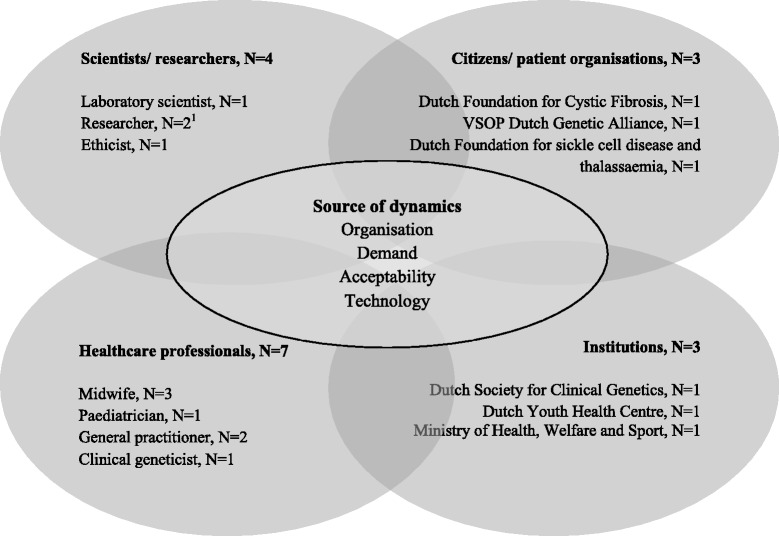
Methods: Seventeen semi-structured interviews were conducted with Dutch key stakeholders working in the practical and scientific field of carrier screening. The constellation approach was used to categorise barriers and needs into three levels: culture, structure and practice.
Results: Barriers on a cultural level include: undecidedness about the desirability of carrier screening, and a lack of priority of screening in mainstream healthcare. On a structural level barriers included: need for organisational structures in healthcare for embedding carrier screening, need for guidelines, financial structures, practical tools for overcoming challenges during counselling, and a need for training and education of both professionals and the public. A lack of demand for screening by the public, and a need for a division of responsibilities were barriers on a practical level.
Conclusion: The absence of a collective sense of urgency for genetic carrier screening, a lack of organisational structures, and uncertainty or even disagreement about the responsibilities seem to be important barriers in the implementation of carrier screening. Stakeholders therefore suggest that change agents should be formally acknowledged to strategically plan broadening of current initiatives and attune different stakeholders.
Keywords: Barriers; Carrier screening; Expanded universal carrier screening; Implementation; Interviews; Needs; Stakeholders.
Figures
References
-
- Kaback MM. Screening and prevention in Tay-sachs disease: origins, update, and impact. Adv Genet. 2001;44:253–265. - PubMed
-
- NHS . Sickle cell and thalassaemia, handbook for laboratories. 3 2012.
MeSH terms
LinkOut - more resources
Full Text Sources
Other Literature Sources
Medical
