The effect of patient age at intervention on risk of implant revision after total replacement of the hip or knee: a population-based cohort study
- PMID: 28209371
- PMCID: PMC5522532
- DOI: 10.1016/S0140-6736(17)30059-4
The effect of patient age at intervention on risk of implant revision after total replacement of the hip or knee: a population-based cohort study
Erratum in
-
Department of Error.Lancet. 2017 Apr 8;389(10077):1398. doi: 10.1016/S0140-6736(17)30936-4. Lancet. 2017. PMID: 28402822 Free PMC article. No abstract available.
Abstract
Background: Total joint replacements for end-stage osteoarthritis of the hip and knee are cost-effective and demonstrate significant clinical improvement. However, robust population based lifetime-risk data for implant revision are not available to aid patient decision making, which is a particular problem in young patient groups deciding on best-timing for surgery.
Methods: We did implant survival analysis on all patients within the Clinical Practice Research Datalink who had undergone total hip replacement or total knee replacement. These data were adjusted for all-cause mortality with data from the Office for National Statistics and used to generate lifetime risks of revision surgery based on increasing age at the time of primary surgery.
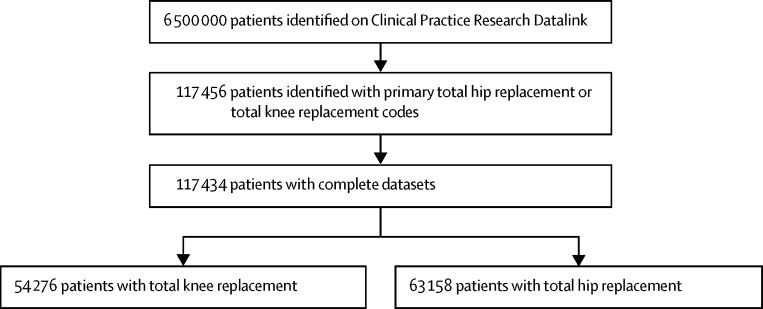
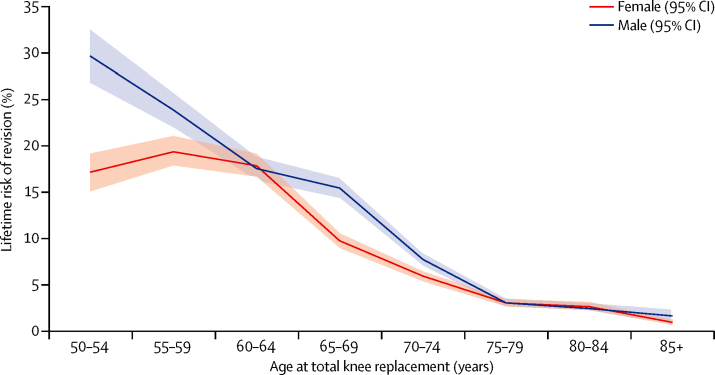
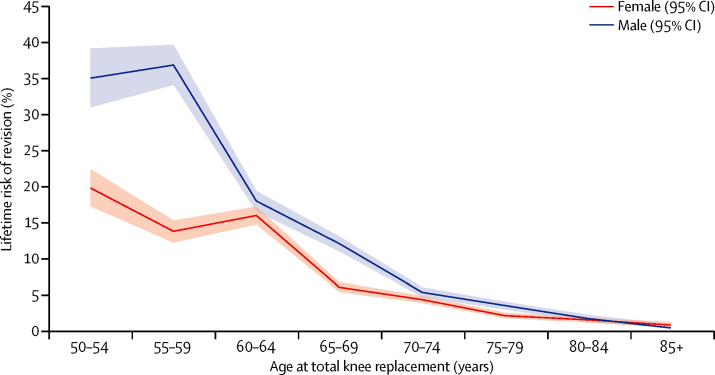
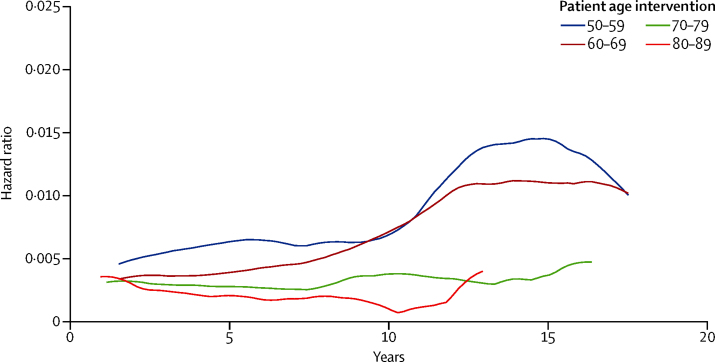
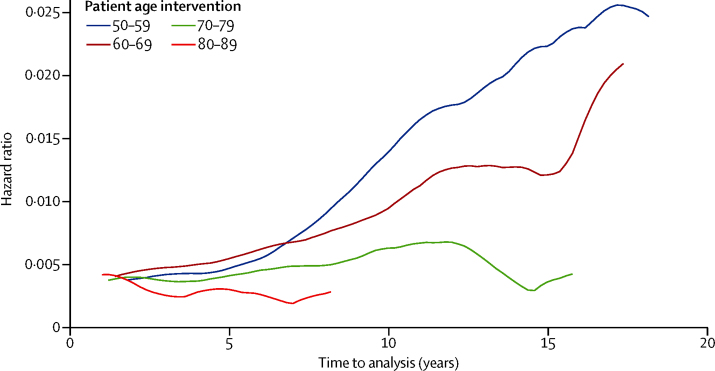
Findings: We identified 63 158 patients who had undergone total hip replacement and 54 276 who had total knee replacement between Jan 1, 1991, and Aug 10, 2011, and followed up these patients to a maximum of 20 years. For total hip replacement, 10-year implant survival rate was 95·6% (95% CI 95·3-95·9) and 20-year rate was 85·0% (83·2-86·6). For total knee replacement, 10-year implant survival rate was 96·1% (95·8-96·4), and 20-year implant survival rate was 89·7% (87·5-91·5). The lifetime risk of requiring revision surgery in patients who had total hip replacement or total knee replacement over the age of 70 years was about 5% with no difference between sexes. For those who had surgery younger than 70 years, however, the lifetime risk of revision increased for younger patients, up to 35% (95% CI 30·9-39·1) for men in their early 50s, with large differences seen between male and female patients (15% lower for women in same age group). The median time to revision for patients who had surgery younger than age 60 was 4·4 years.
Interpretation: Our study used novel methodology to investigate and offer new insight into the importance of young age and risk of revision after total hip or knee replacement. Our evidence challenges the increasing trend for more total hip replacements and total knee replacements to be done in the younger patient group, and these data should be offered to patients as part of the shared decision making process.
Funding: Oxford Musculoskeletal Biomedical Research Unit, National Institute for Health Research.
Copyright © 2017 The Author(s). Published by Elsevier Ltd. This is an Open Access article under the CC BY license. Published by Elsevier Ltd.. All rights reserved.
Figures
Comment in
-
Total joint arthroplasty in younger patients: heading for trouble?Lancet. 2017 Apr 8;389(10077):1374-1375. doi: 10.1016/S0140-6736(17)30190-3. Epub 2017 Feb 14. Lancet. 2017. PMID: 28209372 No abstract available.
-
Patients' decisions on joint replacement need data on earnings and welfare benefits.Lancet. 2017 Jul 8;390(10090):123-124. doi: 10.1016/S0140-6736(17)31596-9. Lancet. 2017. PMID: 28699586 No abstract available.
References
-
- Carr AJ, Robertsson O, Graves S. Knee replacement. Lancet. 2012;379:1331–1340. - PubMed
-
- Learmonth ID, Young C, Rorabeck C. The operation of the century: total hip replacement. Lancet. 2007;370:1508–1519. - PubMed
-
- NJR National Joint Registry for England, Wales and Northern Ireland. 12th Annual Report. 2015;2015:41. http://www.njrcentre.org.uk/njrcentre/Portals/0/Documents/England/Report... (accessed Nov 11, 2015).
-
- Hunt LP, Ben-Shlomo Y, Clark EM. 45-day mortality after 467,779 knee replacements for osteoarthritis from the National Joint Registry for England and Wales: an observational study. Lancet. 2014;384:1429–1436. - PubMed
-
- Hunt LP, Ben-Shlomo Y, Clark EM. 90-day mortality after 409,096 total hip replacements for osteoarthritis, from the National Joint Registry for England and Wales: a retrospective analysis. Lancet. 2013;382:1097–1104. - PubMed
Publication types
MeSH terms
Grants and funding
LinkOut - more resources
Full Text Sources
Other Literature Sources
Medical