. 2017 Mar;27(3):419-426.
doi: 10.1101/gr.219089.116. Epub 2017 Feb 16.

Genome surgery using Cas9 ribonucleoproteins for the treatment of age-related macular degeneration

Affiliations

Genome surgery using Cas9 ribonucleoproteins for the treatment of age-related macular degeneration

Kyoungmi Kim et al. Genome Res. 2017 Mar.

Abstract

RNA-guided genome surgery using CRISPR-Cas9 nucleases has shown promise for the treatment of diverse genetic diseases. Yet, the potential of such nucleases for therapeutic applications in nongenetic diseases is largely unexplored. Here, we focus on age-related macular degeneration (AMD), a leading cause of blindness in adults, which is associated with retinal overexpression of, rather than mutations in, the VEGFA gene. Subretinal injection of preassembled, Vegfa gene-specific Cas9 ribonucleoproteins (RNPs) into the adult mouse eye gave rise to mutagenesis at the target site in the retinal pigment epithelium. Furthermore, Cas9 RNPs effectively reduced the area of laser-induced choroidal neovascularization (CNV) in a mouse model of AMD. Genome-wide profiling of Cas9 off-target effects via Digenome-seq showed that off-target mutations were rarely induced in the human genome. Because Cas9 RNPs can function immediately after in vivo delivery and are rapidly degraded by endogenous proteases, their activities are unlikely to be hampered by antibody- and cell-mediated adaptive immune systems. Our results demonstrate that in vivo genome editing with Cas9 RNPs has the potential for the local treatment for nongenetic degenerative diseases, expanding the scope of RNA-guided genome surgery to a new dimension.


Figures

Figure 1.
Figure 1.
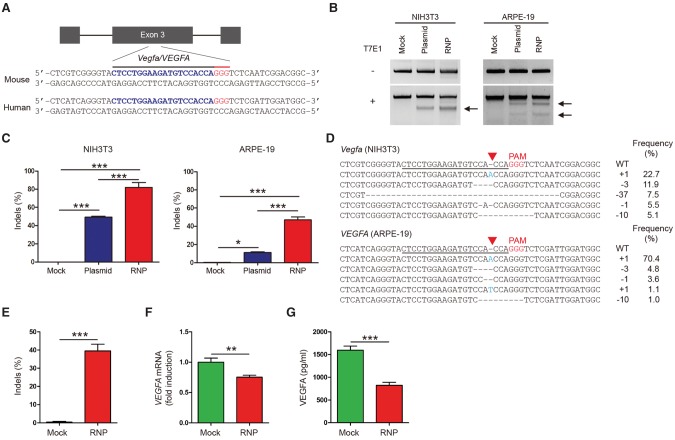
Targeted mutagenesis in the Vegfa/VEGFA gene via Cas9 ribonucleoproteins (RNPs). (A) The target sequence in the Vegfa/VEGFA locus. The PAM sequence and the sgRNA target sequence are shown in red and blue, respectively. (B) Vegfa-specific Cas9 RNP-driven mutations in NIH3T3 and ARPE-19 cells detected by the T7 endonuclease I (T7E1) assay. Arrows indicate the expected positions of DNA bands cleaved by T7E1. (C) Mutation frequencies measured by targeted deep sequencing. Error bars indicate SEM (n = 3). One-way ANOVA and Tukey post-hoc tests: (*) P < 0.05; (***) P < 0.001. (D) Representative mutant DNA sequences at the Vegfa/VEGFA locus. The PAM sequence is shown in red, and inserted nucleotides are shown in blue. The target sequence is underlined. The red triangle indicates the cleavage position. The column on the right indicates the number of inserted or deleted bases and indel frequencies (%). (WT) wild type. (E) Vegfa-specific Cas9 RNP-driven mutation frequencies in confluent ARPE-19 cells at 64 h post-transfection detected by targeted deep sequencing. (F) Relative VEGFA mRNA levels measured by quantitative PCR (qPCR). (G) Secreted VEGFA protein in the supernatant measured by ELISA. Error bars indicate SEM (n = 5). Student's t-test: (**) P < 0.01; (***) P < 0.001.
Figure 2.
Figure 2.
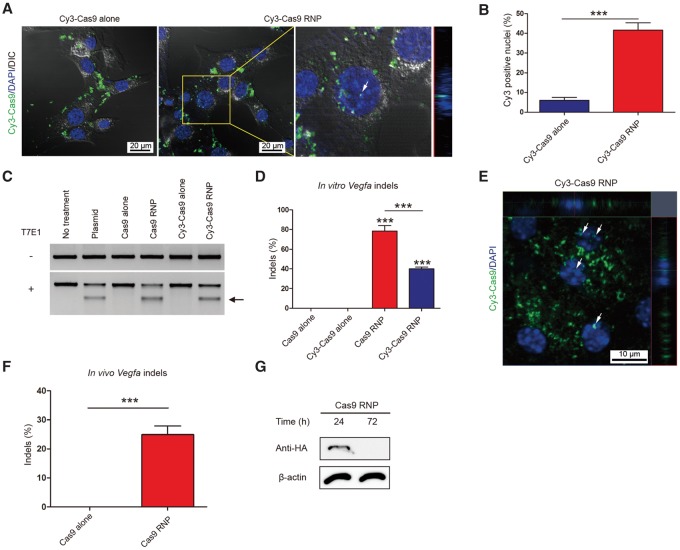
In vitro and in vivo delivery of Cy3-labeled Cas9 RNP. (A) Localization of Cy3 dye in NIH3T3 cells transfected with Cy3-labeled Cas9 RNP or Cy3-labeled Cas9 alone (as a control) at 24 h post-transfection. White arrow indicates nuclear colocalization of Cy3 dye. The z-axis image on the right shows that Cy3-Cas9 is localized inside the nucleus. (B) Proportion of Cy3 positive nuclei in total DAPI positive nuclei at 24 h post-transfection. Error bars indicate SEM (n = 3). Student's t-test: (***) P < 0.001. (C) Vegfa-specific Cas9 RNP-mediated mutations in NIH3T3 cells detected by the T7E1 assay. The arrow indicates the expected position of DNA bands cleaved by T7E1. (D) Mutation frequencies were measured using targeted deep sequencing. Error bars are SEM (n = 3). One-way ANOVA and Tukey post-hoc tests: (***) P < 0.001. (E) Representative RPE flat-mount at day 3 post-injection of Cy3-labeled Cas9 RNP into mouse eye. White arrows indicate nuclear colocalization of Cy3 dye. (F) Frequencies of indels induced in vivo determined using genomic DNA isolated from the retinal pigment epithelium (RPE). Indels were analyzed by deep sequencing at day 3 post-injection. Error bars are SEM (n = 5). Student's t-test: (***) P < 0.001. (G) Representative Western blot analysis to measure the level of Cas9 protein in the RPE/choroid/scleral complex 24 and 72 h after injection (n = 4).
Figure 3.
Figure 3.
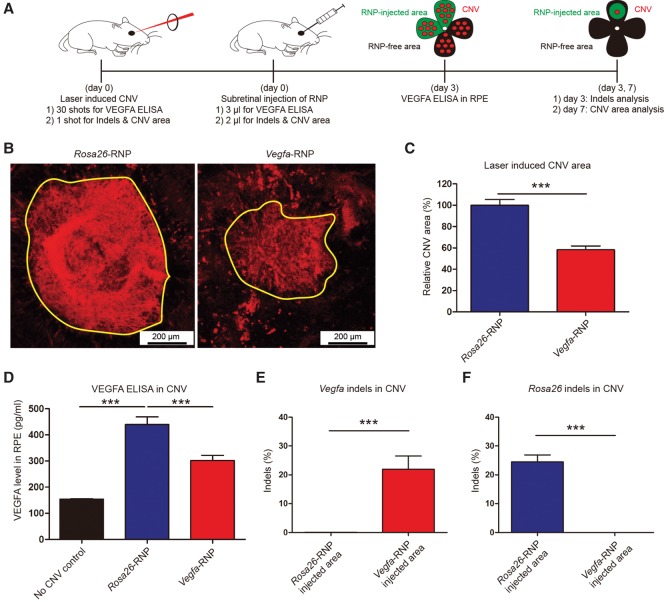
Subretinal injection of Cas9 RNPs targeting Vegfa reduces the area of laser-induced choroidal neovascularization (CNV) in a mouse model of age-related macular degeneration (AMD). (A) Mice with laser-induced CNV were treated with subretinal injection of the Vegfa-specific preassembled Cas9 RNP (Vegfa-RNP). After the retinal pigment epithelium (RPE) complex in the eye was flat-mounted, the CNV area was analyzed at day 7 post-injection. Genomic DNA isolated from the Cas9 RNP-injected area or from the opposite noninjected area (RNP-free area) was analyzed by deep sequencing. VEGFA ELISA was performed at day 3 post-injection. (B) Representative laser-induced CNV stained with isolectin B4 (IB4) in C57BL/6J mice injected with the Rosa26-specific Cas9 RNP (as a control) or the Vegfa-RNP. The yellow line demarcates the area of CNV. (C) The CNV area. Error bars indicate SEM (n = 15). Student's t-test: (***) P < 0.001. (D) VEGFA level in CNV. Error bars indicate SEM (n = 10). One-way ANOVA and Tukey post-hoc tests: (***) P < 0.001. (E) Indel frequencies at the Vegfa target site in the RPE cells. Error bars indicate SEM (n = 5). Student's t-test: (***) P < 0.001. (F) Indel frequencies at the Rosa26 target site in the RPE cells. Error bars indicate SEM (n = 5). Student's t-test: (***) P < 0.001.
Figure 4.
Figure 4.
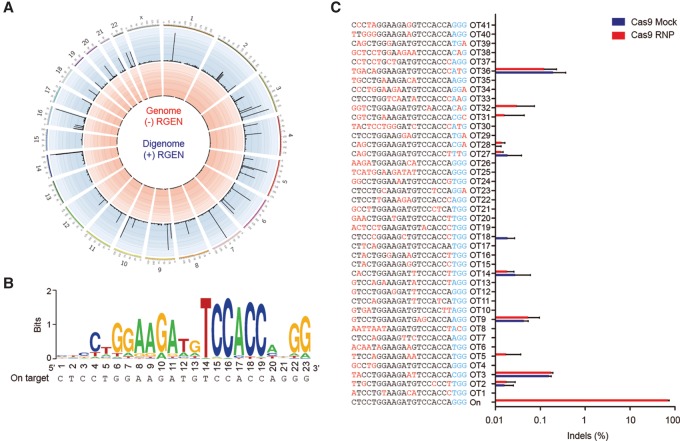
Genome-wide target specificity of the Vegfa-specific Cas9 RNP revealed by Digenome-seq. (A) Genome-wide Circos plot (Krzywinski et al. 2009) showing in vitro cleavage sites. Human genomic DNA is shown in red, and RGEN-digested genomic DNA is shown in blue. (B) Sequence logo obtained using 42 Digenome-captured sites. (C) Off-target site validated in human ARPE-19 cells by targeted deep sequencing. The mismatched nucleotides are shown in red, and PAM sequences are shown in blue.

References

    1. Bae S, Park J, Kim JS. 2014. Cas-OFFinder: a fast and versatile algorithm that searches for potential off-target sites of Cas9 RNA-guided endonucleases. Bioinformatics 30: 1473–1475. - PMC - PubMed
    1. Calcedo R, Franco J, Qin Q, Richardson DW, Mason JB, Boyd S, Wilson JM. 2015. Preexisting neutralizing antibodies to adeno-associated virus capsids in large animals other than monkeys may confound in vivo gene therapy studies. Hum Gene Ther Methods 26: 103–105. - PMC - PubMed
    1. CATT Research Group, Martin DF, Maguire MG, Ying GS, Grunwald JE, Fine SL, Jaffe GJ. 2011. Ranibizumab and bevacizumab for neovascular age-related macular degeneration. N Engl J Med 364: 1897–1908. - PMC - PubMed
    1. Chew WL, Tabebordbar M, Cheng JK, Mali P, Wu EY, Ng AH, Zhu K, Wagers AJ, Church GM. 2016. A multifunctional AAV–CRISPR–Cas9 and its host response. Nat Methods 13: 868–874. - PMC - PubMed
    1. Cho SW, Kim S, Kim Y, Kweon J, Kim HS, Bae S, Kim JS. 2014. Analysis of off-target effects of CRISPR/Cas-derived RNA-guided endonucleases and nickases. Genome Res 24: 132–141. - PMC - PubMed

MeSH terms

Substances