Review
. 2015 Jul 31:6:55-70.
doi: 10.2147/LCTT.S55176. eCollection 2015.

Targeting PD-1/PD-L1 in lung cancer: current perspectives

Affiliations
Review

Targeting PD-1/PD-L1 in lung cancer: current perspectives

María González-Cao et al. Lung Cancer (Auckl). .

Abstract

Increased understanding of tumor immunology has led to the development of effective immunotherapy treatments. One of the most important advances in this field has been due to pharmacological design of antibodies against immune checkpoint inhibitors. Anti-PD-1/PD-L1 antibodies are currently in advanced phases of clinical development for several tumors, including lung cancer. Results from Phase I-III trials with anti-PD-1/PD-L1 antibodies in non-small-cell lung cancer have demonstrated response rates of around 20% (range, 16%-50%). More importantly, responses are long-lasting (median duration of response, 18 months) and fast (50% of responses are detected at time of first tumor evaluation) with very low grade 3-4 toxicity (less than 5%). Recently, the anti-PD-1 antibody pembrolizumab received US Food and Drug Administration (FDA) breakthrough therapy designation for treatment of non-small-cell lung cancer, supported by data from a Phase Ib trial. Another anti-PD-1 antibody, nivolumab, has also been approved for lung cancer based on survival advantage demonstrated in recently released data from a Phase III trial in squamous cell lung cancer.

Keywords: cancer; checkpoint inhibitors; immunoncology; immunotherapy.


Conflict of interest statement

Disclosure The authors report no conflicts of interest in this work.

Figures
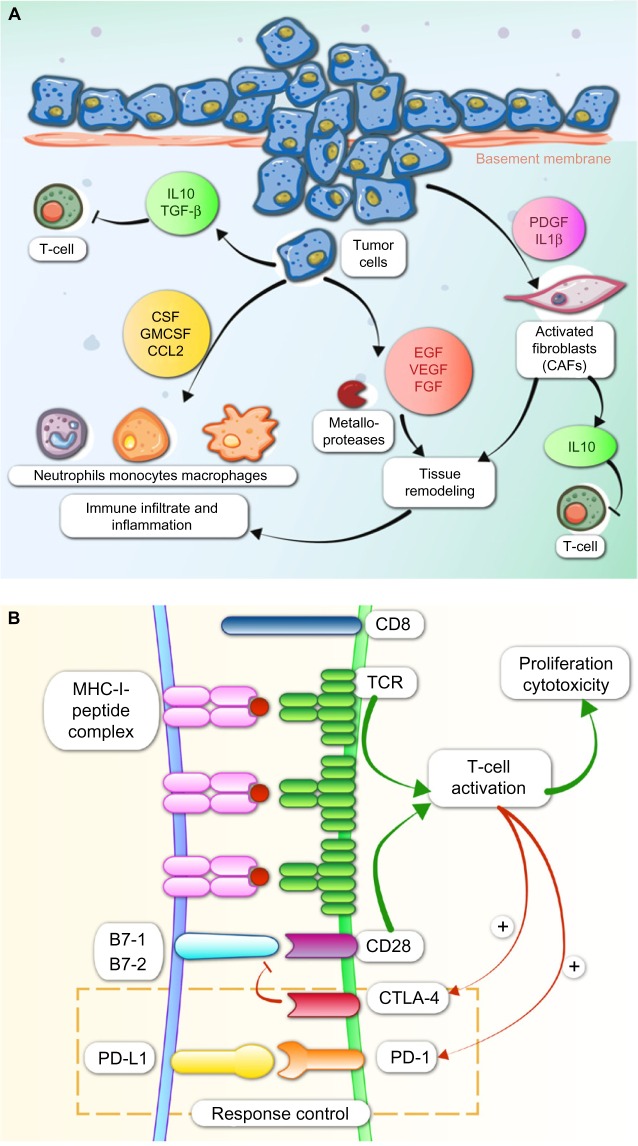
Figure 1
Figure 1
Major immunological processes involved in cancer. Notes: (A) Tumor cells produce immunosuppressive factors such as IL-10 and TGF-β that inhibit T-cell activity. Tumor cells secrete PDGF and IL-8 that activate fibroblasts (cancer-associated fibroblasts [CAFs]) that cause suppression of T-cell activity. Tumors have a peritumoral and intratumoral immune cell infiltrate consisting of macrophages, T-cells, B-cells, natural killer (NK) cells, neutrophils, dendritic cells, and eosinophils. These immunologic cells are enrolled due to the cytokine secretion by local inflammatory, stromal, and cancer cells. (B) Immunologic responses are induced by tumor-activated specific T lymphocytes CD8+ when the antigens are presented by antigen presenter cells into peptides complexed with MHC class I (MHC-I), and the positive regulator CD28 on T-cells binds to CD80 (B-7 or B7-1) and CD86 (B7-2) on dendritic cells. Expression of CTLA-4 is induced by TCR signaling allowing interaction with CD86 and CD80 to counteract CD28. The programmed cell death-1 (PD-1) receptor is another inhibitory T-cell receptor that is engaged by its ligands PD-L1 (also known as B7-H1 or CD274) and PD-L2 (also known as B7-DC or CD273). PD-1 is present in T activated cells, tumor-infiltrating T-cells, B-cells, monocytes, and NK T-cells. PD-L1 can be expressed in the tumor constitutively or as an acquired resistance mechanism. PD-1 activation inhibits CD8+ cytotoxic T lymphocyte proliferation, survival, and effector function. It can also induce apoptosis of tumor-infiltrating T-cells and promote differentiation of CD4+ T-cells into forkhead box P3-expressing (FOXP3+) regulatory T-cells. The PD-1 receptor is an inhibitory receptor engaged by its ligands PD-L1 (also known as B7-H1 or CD274) and PD-L2 (also known as B7-DC or CD273).

References

    1. Hodi FS, O’Day SJ, McDermott DF, et al. Improved survival with ipilimumab in patients with metastatic melanoma. N Engl J Med. 2010;363(8):711–723. - PMC - PubMed
    1. Topalian SL, Hodi FS, Brahmer JR, et al. Safety, activity, and immune correlates of anti-PD-1 antibody in cancer. N Engl J Med. 2012;366(26):2443–2454. - PMC - PubMed
    1. Brahmer JR, Drake CG, Wollner I, et al. Phase I study of single-agent anti-programmed death-1 (MDX-1106) in refractory solid tumors: safety, clinical activity, pharmacodynamics, and immunologic correlates. J Clin Oncol. 2010;28(19):3167–3175. - PMC - PubMed
    1. Dunn GP, Bruce AT, Ikeda H, Old LJ, Schreiber RD. Cancer immunoediting: from immunosurveillance to tumor escape. Nat Immunol. 2002;3(11):991–998. - PubMed
    1. Lenschow DJ, Walunas TL, Bluestone JA. CD28/B7 system of T cell costimulation. Annu Rev Immunol. 1996;14:233–258. - PubMed
