Review
. 2015 Jan 12;1(2):131-153.
doi: 10.1016/j.jcmgh.2014.12.008. eCollection 2015 Mar.

Decoding the Molecular and Mutational Ambiguities of Gastroenteropancreatic Neuroendocrine Neoplasm Pathobiology

Affiliations
Review

Decoding the Molecular and Mutational Ambiguities of Gastroenteropancreatic Neuroendocrine Neoplasm Pathobiology

Mark Kidd et al. Cell Mol Gastroenterol Hepatol. .

Abstract

Gastroenteropancreatic neuroendocrine neoplasms (GEP-NEN), considered a heterogeneous neoplasia, exhibit ill-defined pathobiology and protean symptomatology and are ubiquitous in location. They are difficult to diagnose, challenging to manage, and outcome depends on cell type, secretory product, histopathologic grading, and organ of origin. A morphologic and molecular genomic review of these lesions highlights tumor characteristics that can be used clinically, such as somatostatin-receptor expression, and confirms features that set them outside the standard neoplasia paradigm. Their unique pathobiology is useful for developing diagnostics using somatostatin-receptor targeted imaging or uptake of radiolabeled amino acids specific to secretory products or metabolism. Therapy has evolved via targeting of protein kinase B signaling or somatostatin receptors with drugs or isotopes (peptide-receptor radiotherapy). With DNA sequencing, rarely identified activating mutations confirm that tumor suppressor genes are relevant. Genomic approaches focusing on cancer-associated genes and signaling pathways likely will remain uninformative. Their uniquely dissimilar molecular profiles mean individual tumors are unlikely to be easily or uniformly targeted by therapeutics currently linked to standard cancer genetic paradigms. The prevalence of menin mutations in pancreatic NEN and P27KIP1 mutations in small intestinal NEN represents initial steps to identifying a regulatory commonality in GEP-NEN. Transcriptional profiling and network-based analyses may define the cellular toolkit. Multianalyte diagnostic tools facilitate more accurate molecular pathologic delineations of NEN for assessing prognosis and identifying strategies for individualized patient treatment. GEP-NEN remain unique, poorly understood entities, and insight into their pathobiology and molecular mechanisms of growth and metastasis will help identify the diagnostic and therapeutic weaknesses of this neoplasia.

Keywords: 5-HT, serotonin, 5-hydroxytryptamine; Akt, protein kinase B; BRAF, gene encoding serine/threonine-protein kinase B-Raf; Blood; CGH, comparative genomic hybridization; CREB, cAMP response element-binding protein; Carcinoid; CgA, chromogranin A; D cell, somatostatin; DAG, diacylglycerol; EC, enterochromaffin; ECL, enterochromaffin-like; EGFR, epidermal growth factor receptor; ERK, extracellular-signal-regulated kinase; G cell, gastrin; GABA, γ-aminobutyric acid; GEP-NEN, gastroenteropancreatic neuroendocrine neoplasms; GPCR, G-protein coupled receptor; Gastroenteropancreatic Neuroendocrine Neoplasms; IGF-I, insulin-like growth factor-I; ISG, immature secretory vesicles; Ki-67; LOH, loss of heterozygosity; MAPK, mitogen-activated protein kinase; MEN-1/MEN1, multiple endocrine neoplasia type 1; MSI, microsatellite instability; MTA, metastasis associated-1; NEN, neuroendocrine neoplasms; NFκB, nuclear factor κB; PET, positron emission tomography; PI3, phosphoinositide-3; PI3K, phosphoinositide-3 kinase; PKA, protein kinase A; PKC, protein kinase C; PTEN, phosphatase and tensin homolog deleted on chromosome 10; Proliferation; SD-208, 2-(5-chloro-2-fluorophenyl)-4-[(4-pyridyl)amino]p-teridine; SNV, single-nucleotide variant; SSA, somatostatin analog; SST, somatostatin; Somatostatin; TGF, transforming growth factor; TGN, trans-Golgi network; TSC2, tuberous sclerosis complex 2 (tuberin); Transcriptome; VMAT, vesicular monoamine transporters; X/A-like cells, ghrelin; cAMP, adenosine 3′,5′-cyclic monophosphate; mTOR, mammalian target of rapamycin; miR/miRNA, micro-RNA.


Figures
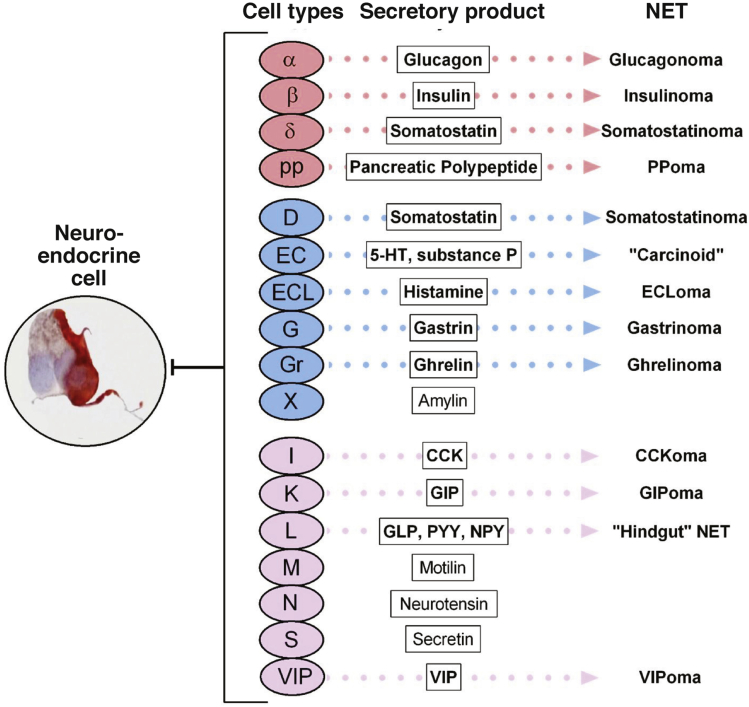
Figure 1
Figure 1
Gastrointestinal and pancreatic neuroendocrine cell types, secretory products, and associated neoplasms. CCK, cholecystokinin; GIP, gastric inhibitory peptide; GLP-1, glucagon-like peptide 1; NPY, neuropeptide Y (tyrosine); PP, pancreatic polypeptide; PYY, polypeptide YY (tyrosine, tyrosine).
Figure 2
Figure 2
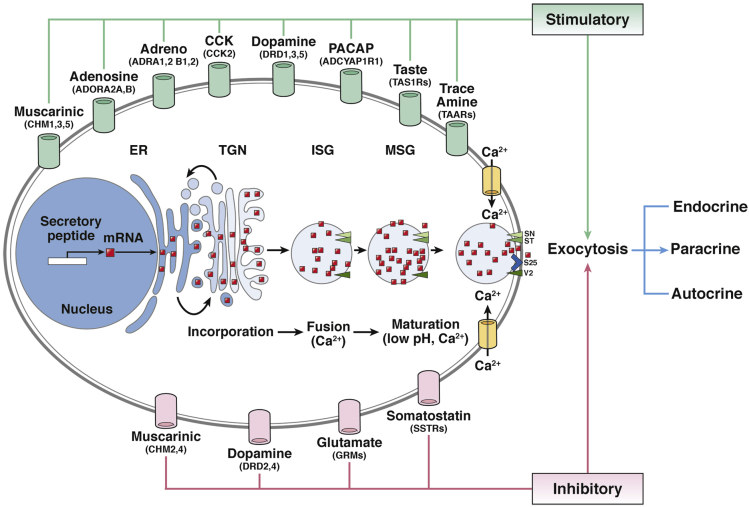
Mechanistic basis of secretory regulation in a neuroendocrine cell. Initial transcription and processing occurs in the nucleus and endoplasmic reticulum (ER) and thereafter secretory products accumulate in the trans-Golgi network (TGN). Subsequently, they are incorporated into immature vesicles that also contain other protein products destined for immature secretory vesicles (ISG). Multiple ISGs fuse into a mature secretory granule (MSG) in a process that involves calcium (Ca2+) influx, granule acidification, and prohormone processing as well as amine uptake (eg, serotonin). This sequence of processes is directed via positive regulatory inputs from diverse regulatory G-protein coupled receptors (GPCRs) (green). Ligand binding activates both signal pathways (PKA/cAMP, MAPK, PI3K/DAG/PKC) and membrane depolarization. Regulatory GPCRs are typically cell-type specific and include muscarinic, tastant, and trace amine receptors. Consequent upon activation MSGs are directed to the plasma membrane, and, after receptor-mediated Ca2+ influx, docking occurs at the cell membrane. This process involves the expression of a series of proteins including syntaxin (SY), synaptotagmin (ST), vesicle-associated membrane protein 2 (VAMP2) (V2), and synaptosomal-associated protein, 25-kDa (SNAP25) (S25) (green arrowheads). The ensuing vesicle-and-membrane fusion process culminates in MSG release of contents into the extracellular milieu (exocytosis). Inhibition of secretion occurs through a number of GPCRs (pink) (somatostatin > muscarinic > glutamate) which upon activation reverses the signaling pathway initiation process through dephosphorylation of signaling intermediates as well as inactivation of voltage-gated channels. Red dots = secretory protein. IUPHAR gene symbols are included for each of the GPCRs.
Figure 3
Figure 3
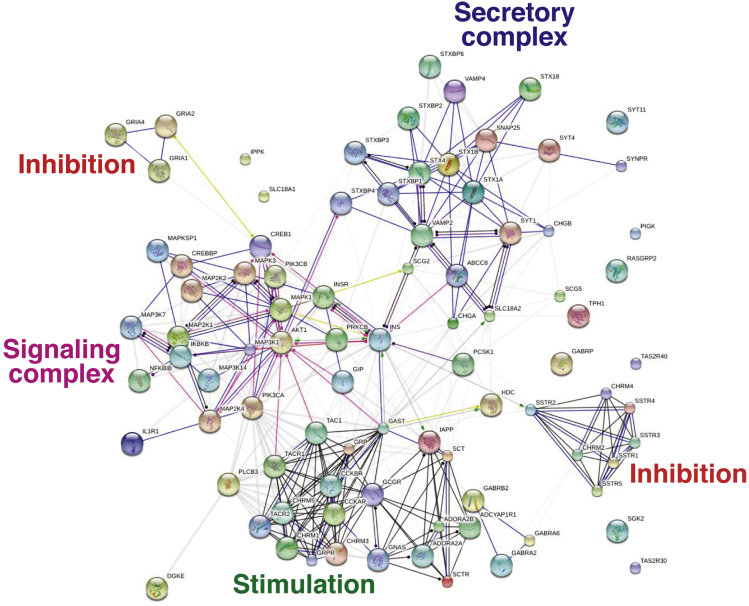
Protein interactomes involved in neuroendocrine neoplasm secretion.Secretory regulation includes tightly interrelated inputs from stimulatory receptors, including cholecystokinin, muscarinic, adenosine (AdoR-A), pituitary adenylate cyclase-activating polypeptide (PACAP), and GABA receptors (stimulation). These activate signaling pathways (signaling) including MAPK/PKC, PKA/cAMP/CREB, NFκβ, and PI3K activity. Secretion is activated through well-defined processes that include vesicular amine uptake, vesicle formation, migration, docking, and exocytosis. Inhibition occurs at the level of signaling and involves somatostatin—inhibition of protein kinase C—and the ionotropic glutamate receptor family (ligand-gated ion channels and depolarization). Created with protein/transcripts identified in neuroendocrine neoplasms and String 9.1.
Figure 4
Figure 4
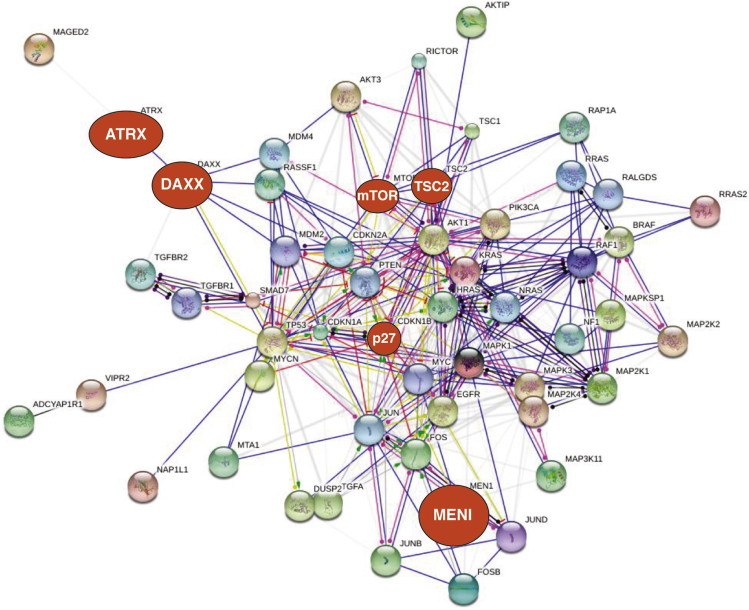
Protein interactome involved in neuroendocrine neoplasm proliferation.Proliferative signaling includes a tightly regulated signaling interactome (including RAS/RAF, MAPK, and PI3K/Akt). The number and extent of linkages illustrates the potential for pathway cross-activation and redundancy in signaling. CCND1 (cyclin D1) represents a nexus focus involved in regulation of G1/S transition during the cell cycle. Known mutations in the interactome are identified (red); the size being reflective of the frequency of mutations (ie, MEN1/ATRX/DAXX mutations occur in 40%–50%, mTOR ∼15%, P27KIP1 ∼10%). These are largely peripherally localized (except for P27, regulator of G1 progression), which is consistent with their known tumor-suppressor function. Targeting the somatostatin receptor family has clinical utility as an antiproliferative strategy, but there is no direct link between these receptors and proliferative signaling pathways. Because these somatostatin receptors interact with protein kinase C, this may provide a potential link by indirect inhibition of mitogen-activated protein kinase (MAPK) signaling. Current data renders it unlikely that somatostatin inhibitory effects are transduced via proliferative signaling inhibition. Created with protein/transcripts identified in neuroendocrine neoplasms and String 9.1.
Figure 5
Figure 5
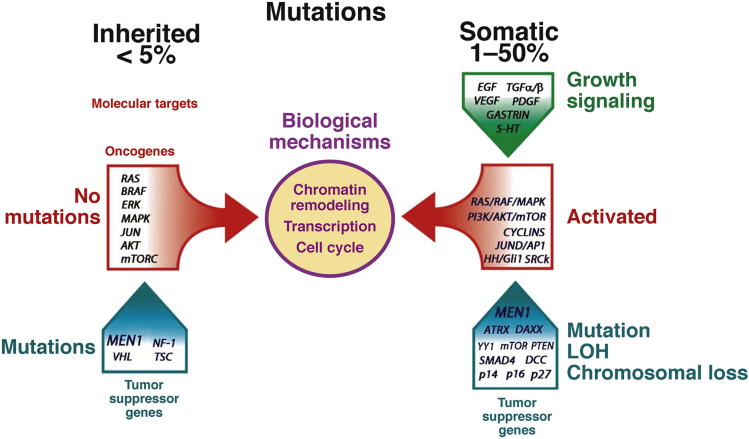
Inherited mutations have only been identified in tumor-suppressor genes (TSGs), and occur in <5% of all gastroenteropancreatic neuroendocrine neoplasms (GEP-NEN). Although no activating mutations have been identified in the molecular targets (eg, RAS or BRAF), the biologic results of TSG loss (chromatin and transcriptional alterations as well as changes in cell cycle regulation) are a consequence of alterations signaled by these oncogenes. The second “hit” under these conditions remains to be identified. Somatic alterations are more common and have been variably identified in 1%–50% of GEP-NEN. These typically involve mutations, loss of heterozygosity (LOH), and chromosomal changes (eg, telomeric or instabilities) that result in activated signaling pathways including RAS/RAF/MAPK, PI3K/Akt/mTOR, Src kinases, or histone modifications. They exhibit similar biologic consequences as inherited mutations. The growth regulatory milieu and proproliferative signaling, such as through growth factors, likely contribute to tumor development. Molecular alterations at a DNA level remain undefined in ∼50% of tumors.
Figure 6
Figure 6
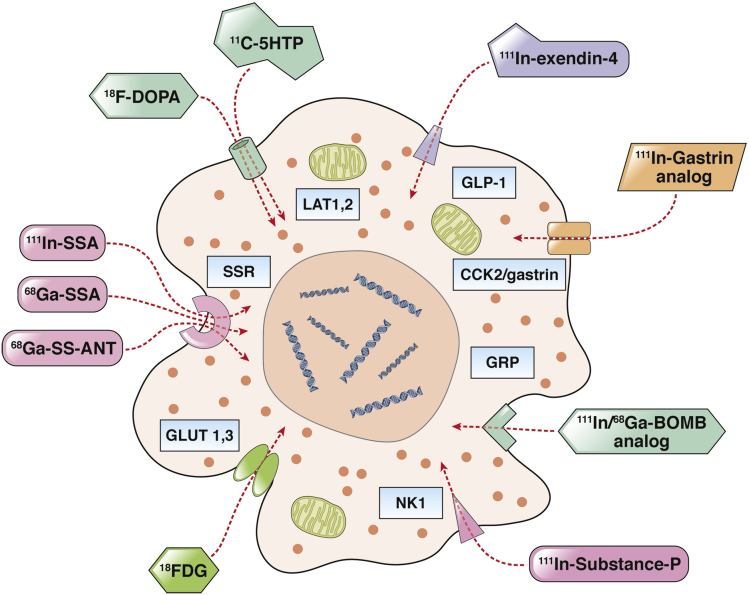
Functional imaging of gastroenteropancreatic neuroendocrine neoplasms (GEP-NEN) using radiolabeled ligands. Radiolabeled somatostatin analogs (SSAs) are the most exploited. Scintigraphy with 111In-pentretreotide and, more recently, positron emission tomography (PET)/computed tomography techniques with 68Ga-SSA target somatostatin receptors (SSR) are regarded as the optimal nuclear medicine NEN imaging tools. Alternative PET techniques with amine precursors such as 18F-DOPA and 11C-5HTP have also been shown to be sensitive modalities. Experimental techniques include the use of SSR antagonists, GLP-1, GRP, and NK ligands. BOMB, bombesin; 11C-5HTP, 11C-hydroxy-tryptophan; 18FDG, 18F-fluoro-2-deoxyglucose; 18F-DOPA, 18F-fFuoro-lL-DOPA; 68Ga-SSA: 68Ga-DOTATOC, 68Ga-DOTANOC, 68Ga-DOTATATE; 68Ga-SS-ANT, 68Ga-labeled SSR antagonists; GLP-1, glucagon-like peptide-1 receptor; GLUT-1,3, glucose transporter type 1 and 3; GRP, gastrin-releasing peptide receptor; 111In-SSA: 111In-Pentetreotide, 111In-Depreotide, 99mTc-EDDA-HYNIC-Tyr3-octreotide; LAT 1,2, large neutral amino acid transporter type 1 and 2; NK1, neurokinin 1 receptor; SSR, somatostatin receptor.

References

    1. Modlin I.M., Oberg K., Chung D.C. Gastroenteropancreatic neuroendocrine tumours. Lancet Oncol. 2008;9:61–72. - PubMed
    1. Strosberg J. Evolving treatment strategies for management of carcinoid tumors. Curr Treat Options Oncol. 2013;14:374–388. - PubMed
    1. Baudin E., Planchard D., Scoazec J.Y. Intervention in gastro-enteropancreatic neuroendocrine tumours. Best Pract Res Clin Gastroenterol. 2012;26:855–865. - PubMed
    1. Modlin I.M., Kidd M., Latich I. Current status of gastrointestinal carcinoids. Gastroenterology. 2005;128:1717–1751. - PubMed
    1. Yao J.C., Hassan M., Phan A. One hundred years after “carcinoid”: epidemiology of and prognostic factors for neuroendocrine tumors in 35,825 cases in the United States. J Clin Oncol. 2008;26:3063–3072. - PubMed