


Aflibercept as a Second Line Therapy for Neovascular Age Related Macular Degeneration in Israel (ASLI) study
- PMID: 28211882
- PMCID: PMC5518842
- DOI: 10.1038/eye.2017.7
Aflibercept as a Second Line Therapy for Neovascular Age Related Macular Degeneration in Israel (ASLI) study
Abstract
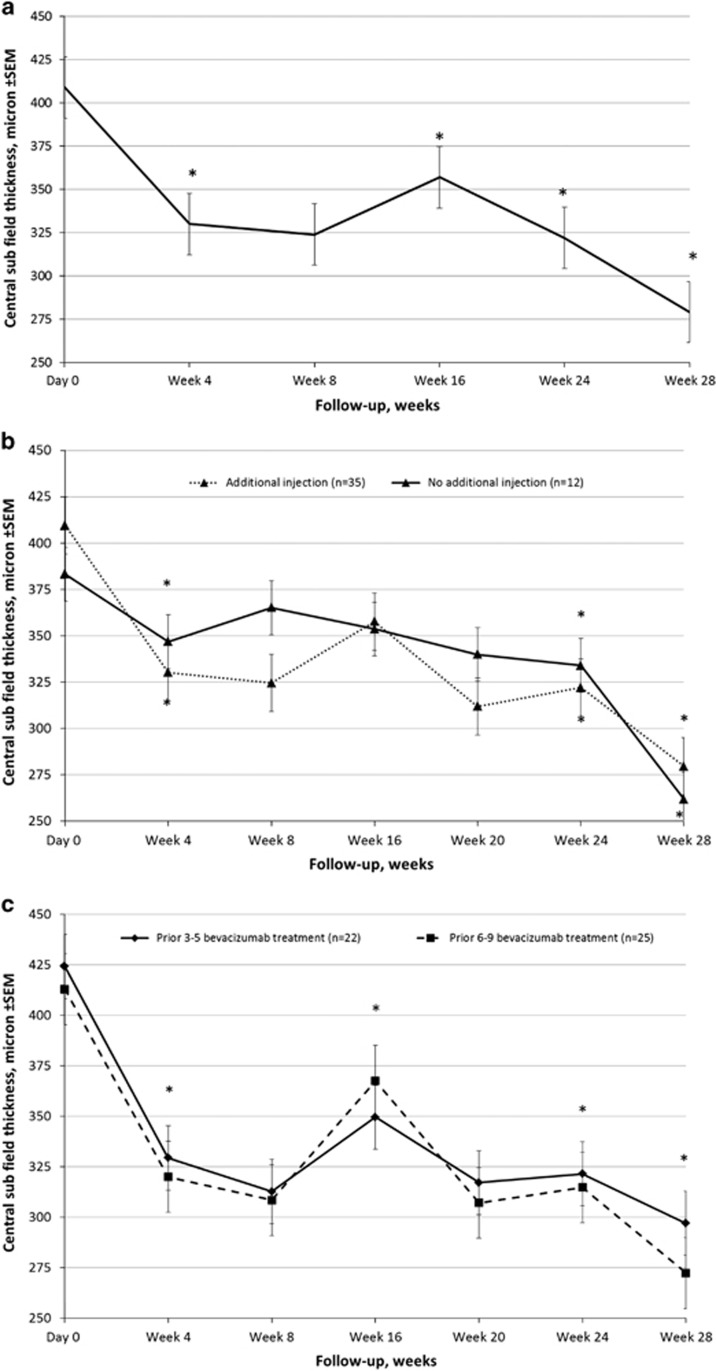
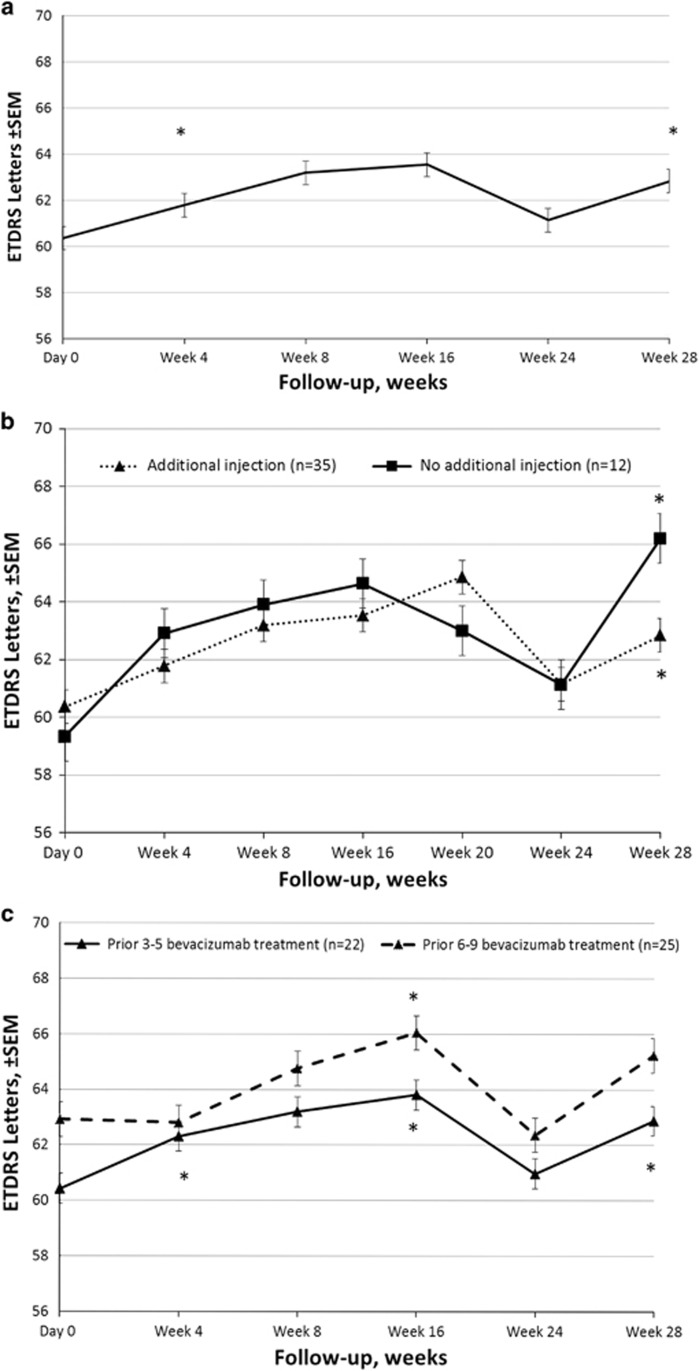
PurposeThe purpose of this study is to evaluate an early switch to aflibecept in eyes with neovascular age-related macular degeneration (nvAMD) showing partial or lack of response for initial therapy with bevacizumab.MethodsThe Aflibercept as a Second Line Therapy for Neovascular Age Related Macular Degeneration in Israel (ASLI) was a prospective, multicenter, single-arm clinical trial. Eyes with nvAMD having incomplete response to 3-9 prior bevacizumab injections were recruited. Three monthly intravitreal aflibercept (2 mg) injections were administered, followed by two bi-monthly injections and a final examination at week 28. An optional injection was allowed at week 20.ResultsForty-seven eyes of 46 patients (mean±SD age 76±8 years) were recruited. The mean number of prior bevacizumab injections was 5.5±2.9. The mean visual acuity improved from 60.3±10 ETDRS letters at baseline to 63.1±15 letters at week 28 (P=0.02, paired t-test). The central subfield thickness (CST) reduced from 409±127 micron at baseline to 330±110 microns at week 4 (P=0.0002; paired t-test), and 277±70 microns at week 28 (P=0.00002; paired t-test). Twenty-two eyes had three to five prior bevacizumab injections (mean 5.1±0.7), and 25 eyes had six to nine prior injections (7.32±1.2). Both groups had reduced CST from baseline to week 28 (P=0.0004 and P=0.0007; paired t-test, respectively). Thirty-five (75%) eyes required the optional additional aflibercept injection at week 20.ConclusionsThe ASLI study demonstrated improved BCVA and reduced CST following an early switch to aflibercept therapy in eyes with prior incomplete response to initial therapy with three to nine bevacizumab injections.
Conflict of interest statement
Dr Chowers serves as consultant for Lycored, Biokine, Bayer, and Novartis; Dr Goldstein serves as a consultant and invited lecturer for Novartis, Allergan, and Bayer; and Dr Polack serves as a consulted for Allergan and Bayer. The remaining authors declare no conflict of interest.
Figures
References
-
- Chakravarthy U, Harding SP, Rogers CA, Downes SM, Lotery AJ, Wordsworth S et al. Ranibizumab versus bevacizumab to treat neovascular age-related macular degeneration: one-year findings from the IVAN randomized trial. Ophthalmology 2012; 119: 1399–1411. - PubMed
-
- Kodjikian L, Souied EH, Mimoun G, Mauget-Faysse M, Behar-Cohen F, Decullier E et al. Ranibizumab versus bevacizumab for neovascular age-related macular degeneration: results from the GEFAL noninferiority randomized trial. Ophthalmology 2013; 120: 2300–2309. - PubMed
-
- Krebs I, Schmetterer L, Boltz A, Told R, Vecsei-Marlovits V, Egger S et al. A randomised double-masked trial comparing the visual outcome after treatment with ranibizumab or bevacizumab in patients with neovascular age-related macular degeneration. Br J Ophthalmol 2013; 97: 266–271. - PubMed
-
- Berg K, Pedersen TR, Sandvik L, Bragadottir R. Comparison of ranibizumab and bevacizumab for neovascular age-related macular degeneration according to LUCAS treat-and-extend protocol. Ophthalmology 2015; 122: 146–152. - PubMed
Publication types
MeSH terms
Substances
LinkOut - more resources
Full Text Sources
Other Literature Sources
