Review
. 2017 Feb 15;18(2):421.
doi: 10.3390/ijms18020421.

Methylglyoxal-Derived Advanced Glycation Endproducts in Multiple Sclerosis

Affiliations
Review

Methylglyoxal-Derived Advanced Glycation Endproducts in Multiple Sclerosis

Suzan Wetzels et al. Int J Mol Sci. .

Abstract

Multiple sclerosis (MS) is a demyelinating disease of the central nervous system (CNS). The activation of inflammatory cells is crucial for the development of MS and is shown to induce intracellular glycolytic metabolism in pro-inflammatory microglia and macrophages, as well as CNS-resident astrocytes. Advanced glycation endproducts (AGEs) are stable endproducts formed by a reaction of the dicarbonyl compounds methylglyoxal (MGO) and glyoxal (GO) with amino acids in proteins, during glycolysis. This suggests that, in MS, MGO-derived AGEs are formed in glycolysis-driven cells. MGO and MGO-derived AGEs can further activate inflammatory cells by binding to the receptor for advanced glycation endproducts (RAGE). Recent studies have revealed that AGEs are increased in the plasma and brain of MS patients. Therefore, AGEs might contribute to the inflammatory status in MS. Moreover, the main detoxification system of dicarbonyl compounds, the glyoxalase system, seems to be affected in MS patients, which may contribute to high MGO-derived AGE levels. Altogether, evidence is emerging for a contributing role of AGEs in the pathology of MS. In this review, we provide an overview of the current knowledge on the involvement of AGEs in MS.

Keywords: advanced glycation endproducts; glyoxalase system; methylglyoxal; multiple sclerosis; receptor for advanced glycation endproduct.


Conflict of interest statement

The authors declare no conflict of interest.

Figures
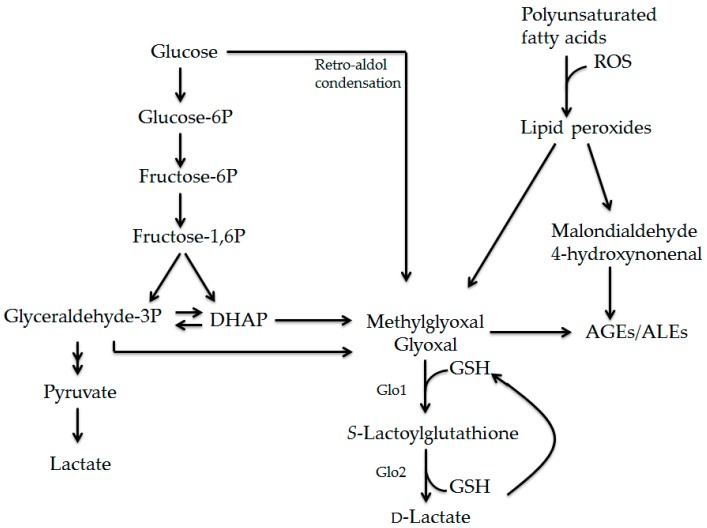
Figure 1
Figure 1
Formation of reactive dicarbonyl compounds and AGEs/ALEs via glucose and lipid intermediates. During glycolysis, glucose is converted into pyruvate and subsequently into lactate. Fragmentation of glyceraldehyde-3-phosphate (GAP) and dihydroxyacetone phosphate (DHAP) leads to the formation of methylglyoxal and glyoxal. In addition to glycolysis, lipid peroxidation of polyunsaturated fatty acids leads to the formation of lipid peroxides that can undergo fragmentation resulting in the formation of malondialdehyde, 4-hydroxynonenal, methylglyoxal, and glyoxal. Moreover, glyoxal can be directly created from glucose, via a retro-aldol condensation reaction. Incubation of these highly reactive compounds with proteins, lipids, and nucleic acids, leads to the fast formation of advanced glycation endproducts (AGEs) and advanced lipoxidation endproducts (ALEs). Methylglyoxal and glyoxal are detoxified via the glyoxalase system. First, methylglyoxal and glyoxal are converted to S-Lactoylglutathione by Glo1, which uses glutathione as a cofactor. Subsequently, S-Lactoylglutathione is metabolized to d-lactate by Glo-2. Glutathione gets recycled during this last step in the process.
Figure 2
Figure 2
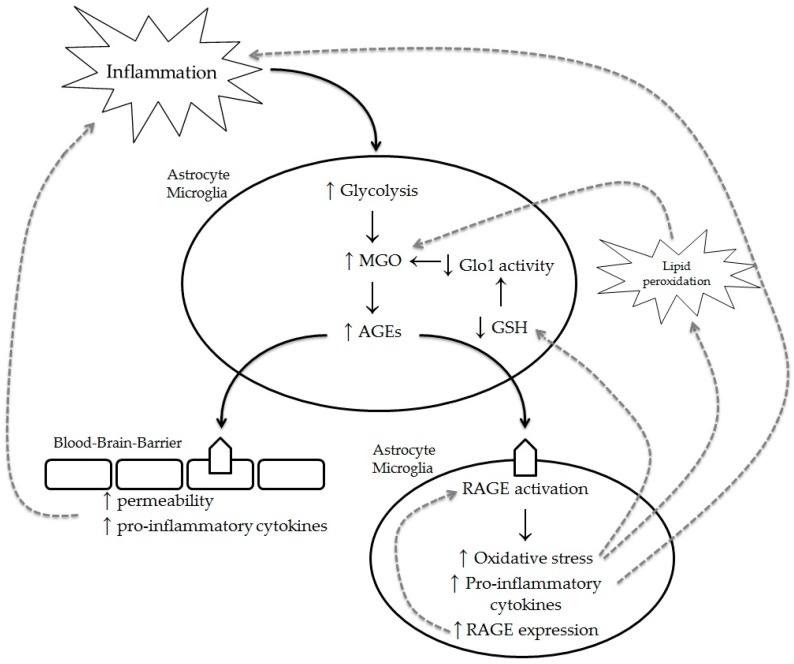
Schematic overview of the effects of methylglyoxal (MGO) on key cells in MS development. The inflammatory environment in the central nervous system (CNS) during MS leads to an increase (↑) in glycolysis in astrocytes and microglia. This induces (↑) the production of MGO and subsequently, AGEs. AGEs activate RAGE, which is present on astrocytes, microglia, and endothelial cells, leading to increased oxidative stress, the production of pro-inflammatory cytokines, and increased RAGE expression. Moreover, the BBB is affected by AGEs, leading to a loss of tight-junction proteins and thereby increasing permeability. Several positive feedback loops (dashed lines) are possible to further stimulate the inflammatory environment and moreover, increase the AGE levels in the CNS. The upregulation of RAGE upon its activation leads to an increased pathway activation and thus, oxidative stress and pro-inflammatory cytokines. Moreover, the production of pro-inflammatory cytokines contributes to the inflammatory status of the CNS. In addition, oxidative stress depletes (↓) glutathione (GSH), leading to decreased (↓) Glo1 activity, and stimulates lipid peroxidation, all of which contribute to the production of MGO, among others. ↑ upward arrow indicates increased production, ↓ downwards arrow indicates decreased production and/or activity.

References

    1. Compston A., Coles A. Multiple sclerosis. Lancet. 2008;372:1502–1517. doi: 10.1016/S0140-6736(08)61620-7. - DOI - PubMed
    1. Bar-Or A., Oliveira E.M., Anderson D.E., Hafler D.A. Molecular pathogenesis of multiple sclerosis. J. Neuroimmunol. 1999;100:252–259. doi: 10.1016/S0165-5728(99)00193-9. - DOI - PubMed
    1. Ellwardt E., Zipp F. Molecular mechanisms linking neuroinflammation and neurodegeneration in MS. Exp. Neurol. 2014;262:8–17. doi: 10.1016/j.expneurol.2014.02.006. - DOI - PubMed
    1. Scalfari A., Neuhaus A., Daumer M., Muraro P.A., Ebers G.C. Onset of secondary progressive phase and long-term evolution of multiple sclerosis. J. Neurol. Neurosurg. 2014;85:67–75. doi: 10.1136/jnnp-2012-304333. - DOI - PubMed
    1. Duffy S.S., Lees J.G., Moalem-Taylor G. The contribution of immune and glial cell types in experimental autoimmune encephalomyelitis and multiple sclerosis. Mult. Scler. Int. 2014;2014:285245. doi: 10.1155/2014/285245. - DOI - PMC - PubMed

Substances