


Common Genetic Variant Risk Score Is Associated With Drug-Induced QT Prolongation and Torsade de Pointes Risk: A Pilot Study
- PMID: 28213480
- PMCID: PMC5380476
- DOI: 10.1161/CIRCULATIONAHA.116.023980
Common Genetic Variant Risk Score Is Associated With Drug-Induced QT Prolongation and Torsade de Pointes Risk: A Pilot Study
Abstract
Background: Drug-induced QT interval prolongation, a risk factor for life-threatening ventricular arrhythmias, is a potential side effect of many marketed and withdrawn medications. The contribution of common genetic variants previously associated with baseline QT interval to drug-induced QT prolongation and arrhythmias is not known.
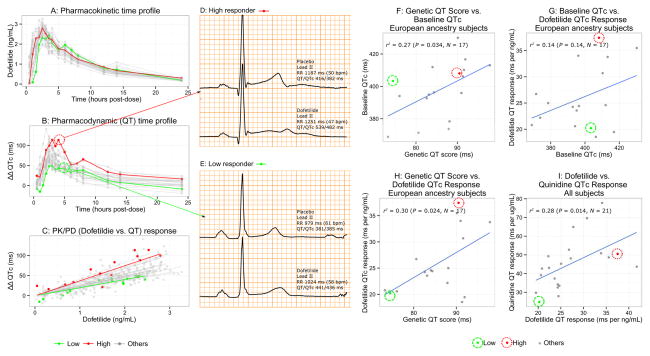
Methods: We tested the hypothesis that a weighted combination of common genetic variants contributing to QT interval at baseline, identified through genome-wide association studies, can predict individual response to multiple QT-prolonging drugs. Genetic analysis of 22 subjects was performed in a secondary analysis of a randomized, double-blind, placebo-controlled, crossover trial of 3 QT-prolonging drugs with 15 time-matched QT and plasma drug concentration measurements. Subjects received single doses of dofetilide, quinidine, ranolazine, and placebo. The outcome was the correlation between a genetic QT score comprising 61 common genetic variants and the slope of an individual subject's drug-induced increase in heart rate-corrected QT (QTc) versus drug concentration.
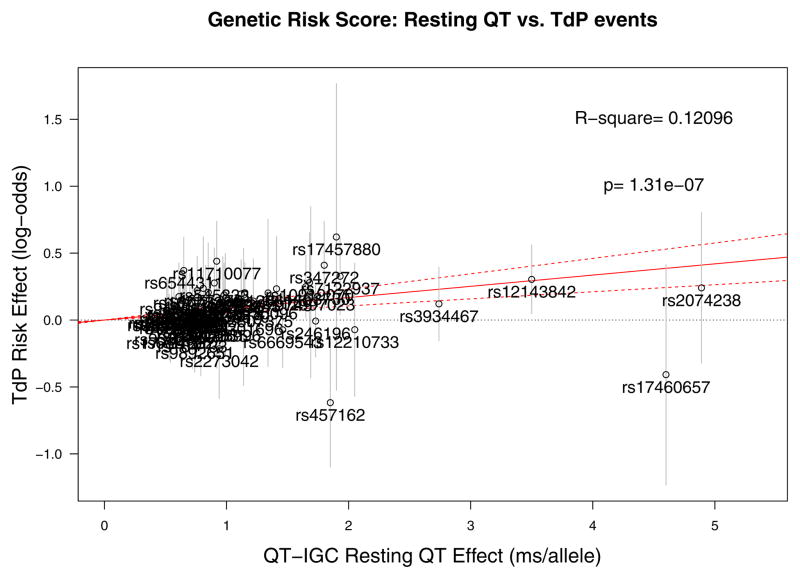
Results: The genetic QT score was correlated with drug-induced QTc prolongation. Among white subjects, genetic QT score explained 30% of the variability in response to dofetilide (r=0.55; 95% confidence interval, 0.09-0.81; P=0.02), 23% in response to quinidine (r=0.48; 95% confidence interval, -0.03 to 0.79; P=0.06), and 27% in response to ranolazine (r=0.52; 95% confidence interval, 0.05-0.80; P=0.03). Furthermore, the genetic QT score was a significant predictor of drug-induced torsade de pointes in an independent sample of 216 cases compared with 771 controls (r2=12%, P=1×10⁻⁷).
Conclusions: We demonstrate that a genetic QT score comprising 61 common genetic variants explains a significant proportion of the variability in drug-induced QT prolongation and is a significant predictor of drug-induced torsade de pointes. These findings highlight an opportunity for recent genetic discoveries to improve individualized risk-benefit assessment for pharmacological therapies. Replication of these findings in larger samples is needed to more precisely estimate variance explained and to establish the individual variants that drive these effects.
Clinical trial registration: URL: http://www.clinicaltrials.gov. Unique identifier: NCT01873950.
Keywords: anti-arrhythmia agents; drug therapy; genetic testing; genetics; genomics; pharmacogenetics; torsade de pointes.
© 2017 American Heart Association, Inc.
Conflict of interest statement
Figures
Comment in
-
Questions, Behavior, and Responsibility in Precision Medicine.Circulation. 2017 Apr 4;135(14):1321-1324. doi: 10.1161/CIRCULATIONAHA.116.025307. Circulation. 2017. PMID: 28373525 No abstract available.
References
-
- Roden DM. Drug-induced prolongation of the QT interval. N Engl J Med. 2004;350:1013–1022. - PubMed
-
- Newton-Cheh C, Eijgelsheim M, Rice KM, de Bakker PI, Yin X, Estrada K, Bis JC, Marciante K, Rivadeneira F, Noseworthy PA, Sotoodehnia N, Smith NL, Rotter JI, Kors JA, Witteman JC, Hofman A, Heckbert SR, O’Donnell CJ, Uitterlinden AG, Psaty BM, Lumley T, Larson MG, Stricker BH. Common variants at ten loci influence QT interval duration in the QTGEN Study. Nat Genet. 2009;41:399–406. - PMC - PubMed
-
- Arking DE, Pulit SL, Crotti L, van der Harst P, Munroe PB, Koopmann TT, Sotoodehnia N, Rossin EJ, Morley M, Wang X, Johnson AD, Lundby A, Gudbjartsson DF, Noseworthy PA, Eijgelsheim M, Bradford Y, Tarasov KV, Dorr M, Muller-Nurasyid M, Lahtinen AM, Nolte IM, Smith AV, Bis JC, Isaacs A, Newhouse SJ, Evans DS, Post WS, Waggott D, Lyytikainen LP, Hicks AA, Eisele L, Ellinghaus D, Hayward C, Navarro P, Ulivi S, Tanaka T, Tester DJ, Chatel S, Gustafsson S, Kumari M, Morris RW, Naluai AT, Padmanabhan S, Kluttig A, Strohmer B, Panayiotou AG, Torres M, Knoflach M, Hubacek JA, Slowikowski K, Raychaudhuri S, Kumar RD, Harris TB, Launer LJ, Shuldiner AR, Alonso A, Bader JS, Ehret G, Huang H, Kao WH, Strait JB, Macfarlane PW, Brown M, Caulfield MJ, Samani NJ, Kronenberg F, Willeit J, Smith JG, Greiser KH, Meyer Zu Schwabedissen H, Werdan K, Carella M, Zelante L, Heckbert SR, Psaty BM, Rotter JI, Kolcic I, Polasek O, Wright AF, Griffin M, Daly MJ, Arnar DO, Holm H, Thorsteinsdottir U, Denny JC, Roden DM, Zuvich RL, Emilsson V, Plump AS, Larson MG, O’Donnell CJ, Yin X, Bobbo M, D’Adamo AP, Iorio A, Sinagra G, Carracedo A, Cummings SR, Nalls MA, Jula A, Kontula KK, Marjamaa A, Oikarinen L, Perola M, Porthan K, Erbel R, Hoffmann P, Jockel KH, Kalsch H, Nothen MM, den Hoed M, Loos RJ, Thelle DS, Gieger C, Meitinger T, Perz S, Peters A, Prucha H, Sinner MF, Waldenberger M, de Boer RA, Franke L, van der Vleuten PA, Beckmann BM, Martens E, Bardai A, Hofman N, Wilde AA, Behr ER, Dalageorgou C, Giudicessi JR, Medeiros-Domingo A, Barc J, Kyndt F, Probst V, Ghidoni A, Insolia R, Hamilton RM, Scherer SW, Brandimarto J, Margulies K, Moravec CE, del Greco MF, Fuchsberger C, O’Connell JR, Lee WK, Watt GC, Campbell H, Wild SH, El Mokhtari NE, Frey N, Asselbergs FW, Mateo Leach I, Navis G, van den Berg MP, van Veldhuisen DJ, Kellis M, Krijthe BP, Franco OH, Hofman A, Kors JA, Uitterlinden AG, Witteman JC, Kedenko L, Lamina C, Oostra BA, Abecasis GR, Lakatta EG, Mulas A, Orru M, Schlessinger D, Uda M, Markus MR, Volker U, Snieder H, Spector TD, Arnlov J, Lind L, Sundstrom J, Syvanen AC, Kivimaki M, Kahonen M, Mononen N, Raitakari OT, Viikari JS, Adamkova V, Kiechl S, Brion M, Nicolaides AN, Paulweber B, Haerting J, Dominiczak AF, Nyberg F, Whincup PH, Hingorani AD, Schott JJ, Bezzina CR, Ingelsson E, Ferrucci L, Gasparini P, Wilson JF, Rudan I, Franke A, Muhleisen TW, Pramstaller PP, Lehtimaki TJ, Paterson AD, Parsa A, Liu Y, van Duijn CM, Siscovick DS, Gudnason V, Jamshidi Y, Salomaa V, Felix SB, Sanna S, Ritchie MD, Stricker BH, Stefansson K, Boyer LA, Cappola TP, Olsen JV, Lage K, Schwartz PJ, Kaab S, Chakravarti A, Ackerman MJ, Pfeufer A, de Bakker PI, Newton-Cheh C Consortium H, Consortium CA, Consortium C, eMC, Dcct/Edic. Genetic association study of QT interval highlights role for calcium signaling pathways in myocardial repolarization. Nat Genet. 2014;46:826–836. - PMC - PubMed
-
- Pfeufer A, Sanna S, Arking DE, Muller M, Gateva V, Fuchsberger C, Ehret GB, Orru M, Pattaro C, Kottgen A, Perz S, Usala G, Barbalic M, Li M, Putz B, Scuteri A, Prineas RJ, Sinner MF, Gieger C, Najjar SS, Kao WH, Muhleisen TW, Dei M, Happle C, Mohlenkamp S, Crisponi L, Erbel R, Jockel KH, Naitza S, Steinbeck G, Marroni F, Hicks AA, Lakatta E, Muller-Myhsok B, Pramstaller PP, Wichmann HE, Schlessinger D, Boerwinkle E, Meitinger T, Uda M, Coresh J, Kaab S, Abecasis GR, Chakravarti A. Common variants at ten loci modulate the QT interval duration in the QTSCD Study. Nat Genet. 2009;41:407–414. - PMC - PubMed
MeSH terms
Associated data
Grants and funding
LinkOut - more resources
Full Text Sources
Other Literature Sources
Medical
