. 2017 Feb 18;6(2):e004402.
doi: 10.1161/JAHA.116.004402.

Evaluation of Timing and Route of Epinephrine in a Neonatal Model of Asphyxial Arrest

Affiliations

Evaluation of Timing and Route of Epinephrine in a Neonatal Model of Asphyxial Arrest

Payam Vali et al. J Am Heart Assoc. .

Abstract

Background: Epinephrine administered by low umbilical venous catheter (UVC) or endotracheal tube (ETT) is indicated in neonates who fail to respond to positive pressure ventilation and chest compressions at birth. Pharmacokinetics of ETT epinephrine via fluid-filled lungs or UVC epinephrine in the presence of fetal shunts is unknown. We hypothesized that epinephrine administered by ETT or low UVC results in plasma epinephrine concentrations and rates of return of spontaneous circulation (ROSC) similar to right atrial (RA) epinephrine.

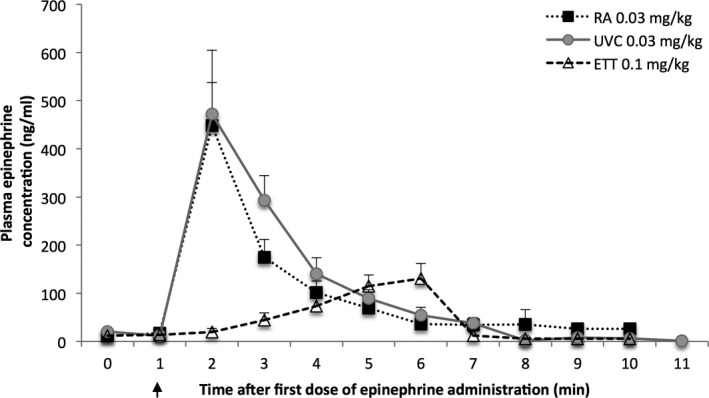
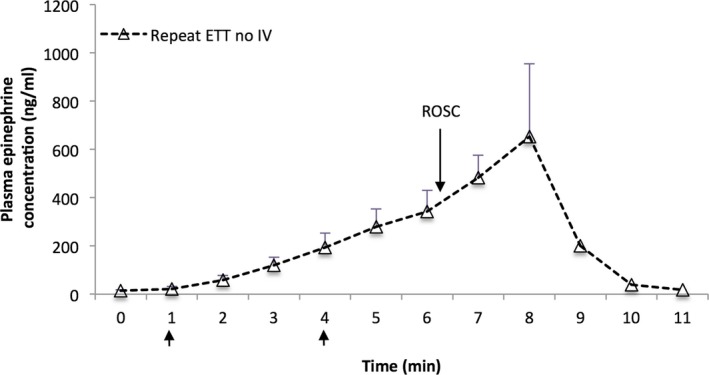
Methods and results: Forty-four lambs were randomized into the following groups: RA epinephrine (0.03 mg/kg), low UVC epinephrine (0.03 mg/kg), postcompression ETT epinephrine (0.1 mg/kg), and precompression ETT epinephrine (0.1 mg/kg). Asystole was induced by umbilical cord occlusion. Resuscitation was initiated following 5 minutes of asystole. Thirty-eight of 44 lambs achieved ROSC (10/11, 9/11, and 12/22 in the RA, UVC, and ETT groups, respectively; subsequent RA epinephrine resulted in a total ROSC of 19/22 in the ETT groups). Median time (interquartile range) to achieve ROSC was significantly longer in the ETT group (including those that received RA epinephrine) compared to the intravenous group (4.5 [2.9-7.4] versus 2 [1.9-3] minutes; P=0.02). RA and low UVC epinephrine administration achieved comparable peak plasma epinephrine concentrations (470±250 versus 450±190 ng/mL) by 1 minute compared to ETT values of 130±60 ng/mL at 5 minutes; P=0.03. Following ROSC with ETT epinephrine alone, there was a delayed peak epinephrine concentration (652±240 ng/mL).

Conclusions: The absorption of ETT epinephrine is low and delayed at birth. RA and low UVC epinephrine rapidly achieve high plasma concentrations resulting in ROSC.

Keywords: cardiac arrest; cardiac arrhythmia; epinephrine; neonate; pharmacokinetics; resuscitation.


Figures

Figure 1
Figure 1
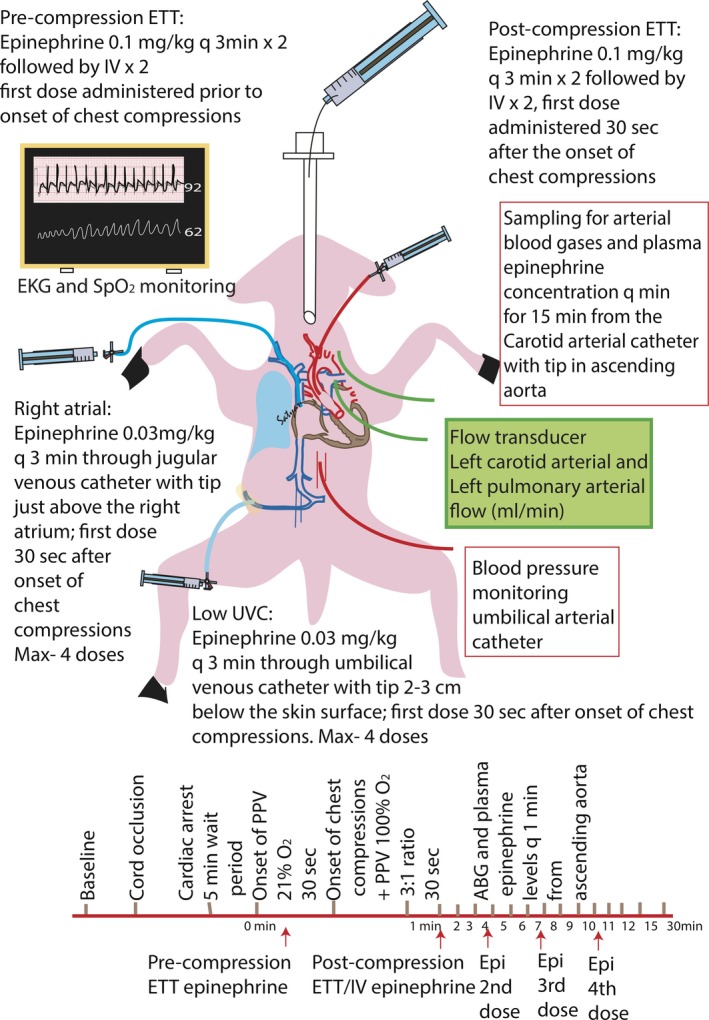
Schematic of study lamb illustrating invasive and noninvasive monitoring. ABG indicates arterial blood gas; ETT, endotracheal tube; PPV, positive pressure ventilation; UVC, umbilical venous catheter.
Figure 2
Figure 2
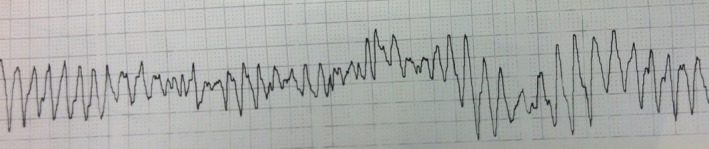
Tachyarrhythmia (torsades de pointes) in a lamb that received multiple epinephrine doses.
Figure 3
Figure 3
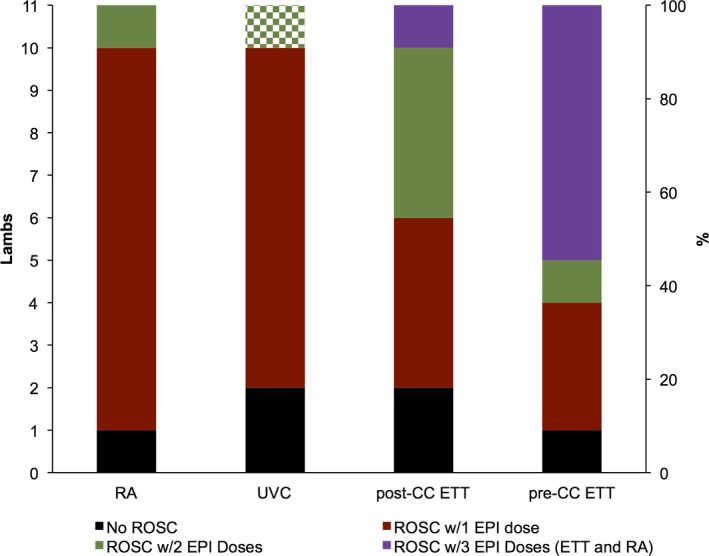
Animals achieving ROSC with varied epinephrine route by group. In the UVC group, the checkered bar represents 4 UVC epinephrine doses. The purple bars represent the lambs that received 2 ETT epinephrine doses followed by 1 dose of RA epinephrine prior to achieving ROSC. CC indicates chest compression; EPI, epinephrine; ETT, endotracheal tube; RA, right atrium; ROSC, return of spontaneous circulation; UVC, umbilical venous catheter.
Figure 4
Figure 4
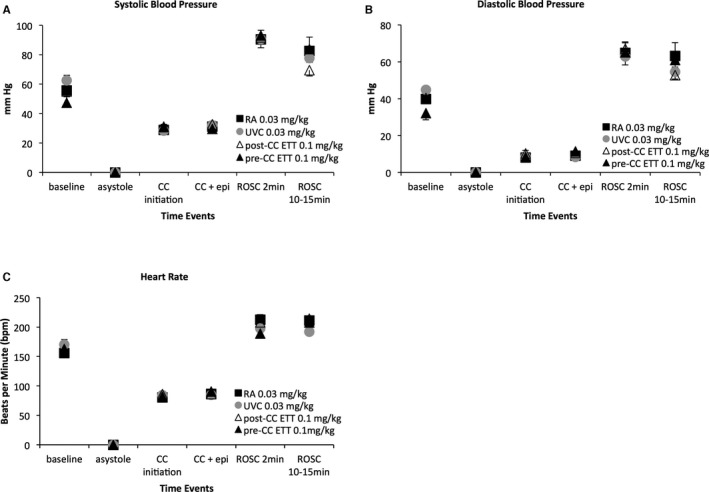
Systolic (A) and diastolic (B) blood pressures, and heart rate (C) are similar among groups. Epinephrine did not significantly increase systolic (A) or diastolic (B) pressures during chest compressions. The chest compression rate was maintained around 90 per minute (C). In the lambs that achieved ROSC, there was a significant increase in systolic (A) and diastolic (B) blood pressures that started to improve by the end of the study. Heart rate stayed high following ROSC (C). Data are mean±SEM. CC indicates chest compression; EPI, epinephrine; ETT, endotracheal tube; RA, right atrium; ROSC, return of spontaneous circulation; UVC, umbilical venous catheter.
Figure 5
Figure 5
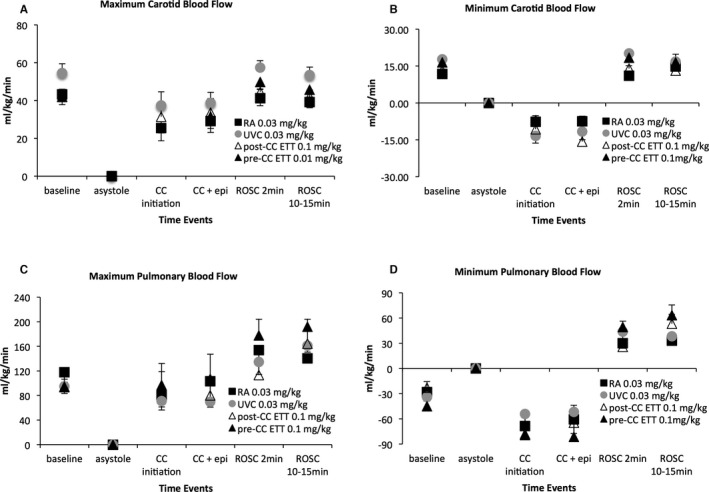
Maximum (A) and minimum (B) left carotid blood flows, and maximum (C) and minimum (D) left pulmonary blood flows are similar among groups. Epinephrine did not significantly increase blood flows during chest compression. Minimum left carotid (B) and minimum left pulmonary (D) blood flows are retrograde during the relaxation (“diastolic”) phase of chest compressions. Minimum pulmonary blood flows (D) are also retrograde in the fetus at baseline because of the high pulmonary vascular resistance in utero. Data are mean±SEM. CC indicates chest compression; ETT, endotracheal tube; RA, right atrium; ROSC, return of spontaneous circulation; UVC, umbilical venous catheter.
Figure 6
Figure 6
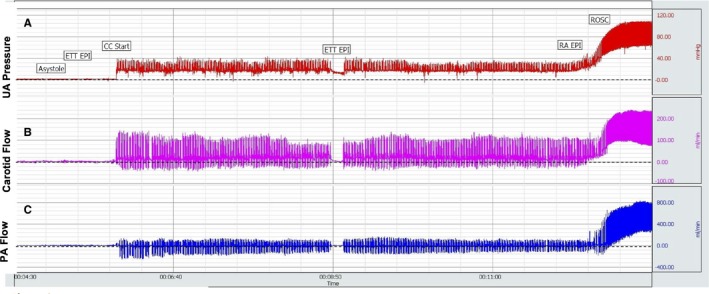
Snapshot of Biopac showing umbilical arterial pressure (A), left carotid blood flow (B), and left pulmonary arterial blood flow (C) from asystole through resuscitation and ROSC. Dashed line represents value “0.” Blood flows below dashed lines represent retrograde flow. With ROSC and cessation of chest compressions, blood flow is exclusively anterograde. CC indicates chest compressions; ETT, endotracheal tube; PA, pulmonary artery; RA, right atrium; ROSC, return of spontaneous circulation; UA, umbilical artery.
Figure 7
Figure 7
Plasma epinephrine concentrations from lambs that received 1 dose of epinephrine. The precompression ETT and postcompression ETT groups were combined in this graph. Arrow indicates time of epinephrine administration. Data are mean±SEM. ETT indicates endotracheal tube; RA, right atrium; UVC, umbilical venous catheter.
Figure 8
Figure 8
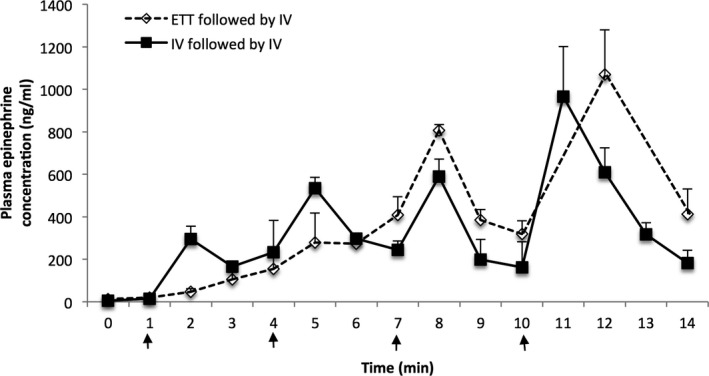
Plasma epinephrine concentrations from lambs that received multiple doses of epinephrine. All lambs in the ETT followed by IV group required at least 1 dose of intravenous epinephrine. Arrows indicate epinephrine administration. In the IV followed by IV group, all doses were IV at 0.03 mg/kg. In the ETT followed by IV group, epinephrine for the first 2 doses was 0.1 mg/kg by ETT, followed by IV epi at 0.03 mg/kg. Data are mean±SEM. ETT indicates endotracheal tube.
Figure 9
Figure 9
Plasma epinephrine concentrations in lambs that achieved ROSC following 2 doses of tracheal epinephrine without any intravenous epinephrine. The peak value at 8 minutes (ie, 4 minutes after the last ETT dose) occurred following ROSC. Arrows indicate ETT epinephrine at 0.1 mg/kg. Data are mean±SEM. ETT indicates endotracheal tube; ROSC, return of spontaneous circulation.

References

    1. Black RE, Cousens S, Johnson HL, Lawn JE, Rudan I, Bassani DG, Jha P, Campbell H, Walker CF, Cibulskis R, Eisele T, Liu L, Mathers C; Child Health Epidemiology Reference Group of WHO and UNICEF . Global, regional, and national causes of child mortality in 2008: a systematic analysis. Lancet. 2010;375:1969–1987. - PubMed
    1. Barber CA, Wyckoff MH. Use and efficacy of endotracheal versus intravenous epinephrine during neonatal cardiopulmonary resuscitation in the delivery room. Pediatrics. 2006;118:1028–1034. - PubMed
    1. Kapadia VS, Wyckoff MH. Drugs during delivery room resuscitation—what, when and why? Semin Fetal Neonatal Med. 2013;18:357–361. - PubMed
    1. Harrington DJ, Redman CW, Moulden M, Greenwood CE. The long‐term outcome in surviving infants with Apgar zero at 10 minutes: a systematic review of the literature and hospital‐based cohort. Am J Obstet Gynecol. 2007;196:463.e1‐5. - PubMed
    1. Wyckoff MH, Salhab WA, Heyne RJ, Kendrick DE, Stoll BJ, Laptook AR; National Institute of Child H and Human Development Neonatal Research N . Outcome of extremely low birth weight infants who received delivery room cardiopulmonary resuscitation. J Pediatr. 2012;160:239–244.e2. - PMC - PubMed

Publication types

MeSH terms