Review
. 2017 Aug;66(8):969-977.
doi: 10.1007/s00262-017-1958-2. Epub 2017 Feb 18.

Dendritic cell rehab: new strategies to unleash therapeutic immunity in ovarian cancer

Affiliations
Review

Dendritic cell rehab: new strategies to unleash therapeutic immunity in ovarian cancer

Chang-Suk Chae et al. Cancer Immunol Immunother. 2017 Aug.

Abstract

Immune-based therapies that induce remarkable and durable responses against melanoma and lung cancer have unfortunately demonstrated limited success in ovarian cancer patients. This is likely due to the exceptional immunoregulatory nature of ovarian tumors, which employ numerous strategies to effectively suppress anti-tumor immunity. Here, we summarize a decade of research indicating that ovarian cancers possess an exquisite capacity to subvert the activity of host dendritic cells (DCs) as a key mechanism to impede the development and maintenance of protective T cell-based immune responses. Identifying, understanding, and disabling the precise mechanisms promoting DC dysfunction in ovarian cancer are, therefore, fundamental requirements for devising the next generation of successful immunotherapies against this devastating malignancy.

Keywords: Dendritic cells; Immunosuppression; Immunotherapy; Ovarian cancer; Regulatory myeloid suppressor cells; Tumor microenvironment.


Conflict of interest statement

Juan R. Cubillos-Ruiz is co-founder and scientific advisor for Quentis Therapeutics, Inc. The other authors declare no conflict of interest.

Figures
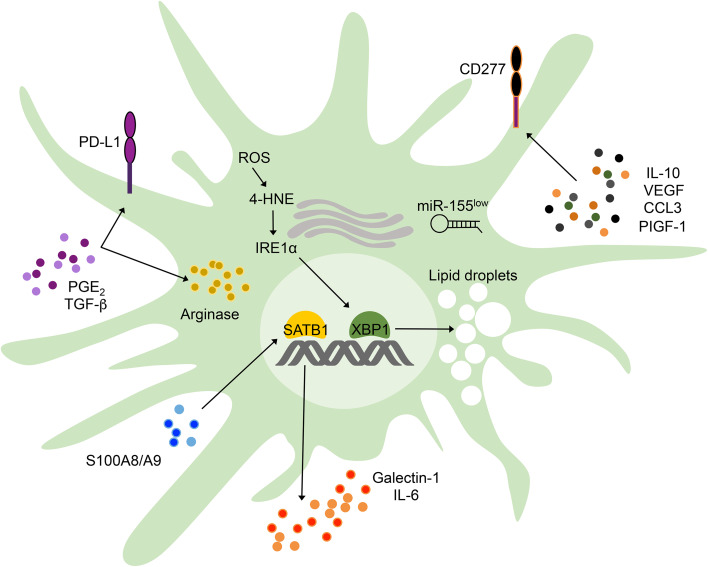
Fig. 1
Fig. 1
Factors promoting DC malfunction in ovarian tumors. Ovarian cancer cells secrete PGE2 and TGF-β, which induce PD-L1 expression and increase Arginase activity in DCs to restrain anti-cancer T-cell activity. IL-10, VEGF, CCL3, and PIGF-1 are commonly present in the ovarian cancer microenvironment and induce overexpression of immunoregulatory CD277 in DCs. In addition, microenvironmental S100A8/A9 proteins provoke relentless SATB1 activation in tumor-associated DCs, which endows them with the capacity to secrete pro-inflammatory IL-6 and immunosuppressive Galectin-1. Furthermore, the local antigen-presenting capacity of ovarian cancer-associated DCs is severely deteriorated due to reduced expression of functional miR-155 and to the accumulation of ROS-driven lipid peroxidation byproducts, such as 4-HNE, which cause ER stress, IRE1α-XBP1 overactivation, and abnormal lipid droplet accumulation
Fig. 2
Fig. 2
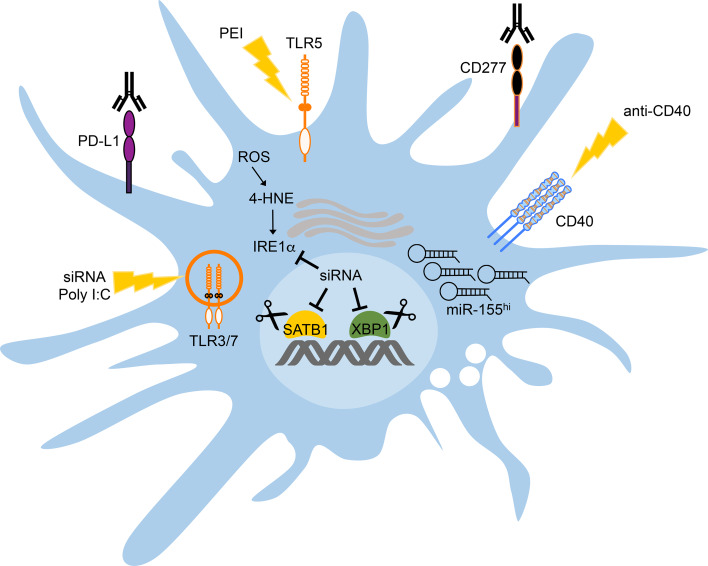
Therapeutic strategies to improve DC function in ovarian cancer. CD40 and TLR3 co-activation enhances the capacity of tumor-infiltrating DCs to process and present tumor antigens, and up-regulates expression of co-stimulatory molecules. Selective targeting of ovarian cancer-associated DCs using siRNA-PEI nanoparticles stimulates TLR3/7 (siRNA) and TLR5 (PEI), thus promoting DC activation in situ. PEI-based nanoparticles loaded with siRNA targeting SATB1 or IRE1α/XBP1 further reduces the suppressive capacity of tumor-associated DCs while enhancing their antigen-presenting capacity. miR-155 replacement therapy via PEI-based nanoparticles encapsulating miRNA mimetics can be used to globally re-program ovarian cancer-associated DCs from immunosuppressive to immunostimulatory cells. Furthermore, neutralizing PD-L1 and CD277 could also decrease the T-cell-suppressive capacity of tumor-associated DCs. These experimental interventions have proven effective at restoring DC function in pre-clinical models of ovarian cancer, and lead to the generation of therapeutic anti-tumor immune responses. Gene-editing technologies based on CRISPR/Cas9 could also be exploited to simultaneously ablate SATB1 and XBP1 in therapeutic DC-based vaccines prior to transfer into the patient

References

    1. Siegel RL, Miller KD, Jemal A. Cancer statistics, 2016. CA Cancer J Clin. 2016;66(1):7–30. doi: 10.3322/caac.21332. - DOI - PubMed
    1. Matulonis UA, et al. Ovarian cancer. Nat Rev Dis Primers. 2016;2:16061. doi: 10.1038/nrdp.2016.61. - DOI - PMC - PubMed
    1. Giornelli GH. Management of relapsed ovarian cancer: a review. SpringerPlus. 2016;5(1):1197. doi: 10.1186/s40064-016-2660-0. - DOI - PMC - PubMed
    1. Zhang L, et al. Intratumoral T cells, recurrence, and survival in epithelial ovarian cancer. N Engl J Med. 2003;348(3):203–213. doi: 10.1056/NEJMoa020177. - DOI - PubMed
    1. Nesbeth Y, et al. CCL5-mediated endogenous antitumor immunity elicited by adoptively transferred lymphocytes and dendritic cell depletion. Cancer Res. 2009;69(15):6331–6338. doi: 10.1158/0008-5472.CAN-08-4329. - DOI - PMC - PubMed

Substances

LinkOut - more resources