Prevalence of Phantom Limb Pain, Stump Pain, and Phantom Limb Sensation among the Amputated Cancer Patients in India: A Prospective, Observational Study
- PMID: 28216859
- PMCID: PMC5294433
- DOI: 10.4103/0973-1075.197944
Prevalence of Phantom Limb Pain, Stump Pain, and Phantom Limb Sensation among the Amputated Cancer Patients in India: A Prospective, Observational Study
Abstract
Introduction: The phantom limb pain (PLP) and phantom limb sensation (PLS) are very common among amputated cancer patients, and they lead to considerable morbidity. In spite of this, there is a lack of epidemiological data of this phenomenon among the Asian population. This study was done to provide the data from Indian population.
Methods: The prevalence of PLP, stump pain (SP), and PLS was prospectively analyzed from the amputated cancer patients over a period of 2 years in Dr. B.R.A. Institute Rotary Cancer Hospital, All India Institute of Medical Sciences, New Delhi. The risk factors and the impact of phantom phenomenon on patients were also noted.
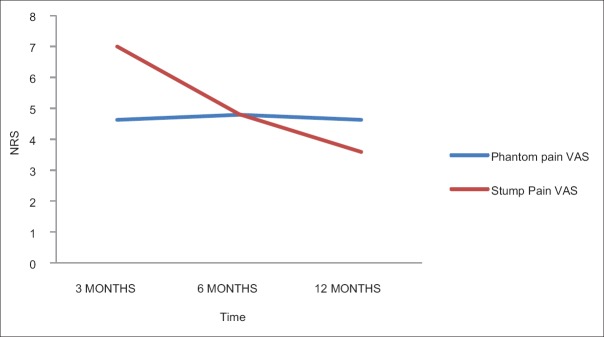
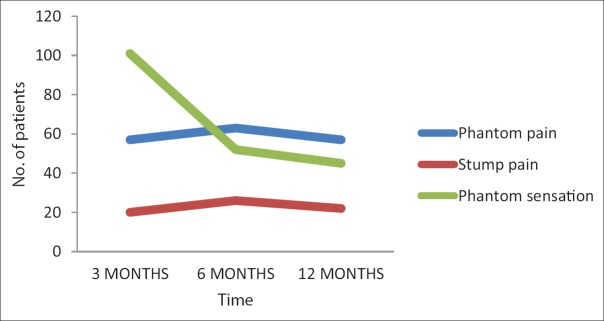
Results: The prevalence of PLP was 41% at 3 and 12 months and 45.3% at 6 months, whereas that of SP and PLS was 14.4% and 71.2% at 3 months, 18.75% and 37.1% at 6 months, 15.8% and 32.4% at 12 months, respectively. There was higher prevalence of PLP and PLS among the patients with history of preamputation pain, smoking with proximal level of amputation, receiving general anesthesia, receiving intravenous (IV) opioid postoperative analgesia, and developing neuroma or infection.
Conclusion: The prevalence of PLP and PLS was higher among the cancer amputees as compared to SP, and a few risk factors responsible for their higher prevalence were found in our study. The PLP and PLS lead to considerable morbidity in terms of sleep disturbance and depression.
Keywords: Amputation; cancer; neuropathic pain; phantom limb pain; phantom limb phenomenon; phantom limb sensation; stump pain.
Conflict of interest statement
There are no conflicts of interest.
Figures
References
-
- Keil G. So-called initial description of phantom pain by Ambroise Paré. Fortschr Med. 1990;108:62–6. - PubMed
-
- Wall R, Novotny-Joseph P, Macnamara TE. Does preamputation pain influence phantom limb pain in cancer patients? South Med J. 1985;78:34–6. - PubMed
-
- Sin EI, Thong SY, Poon KH. Incidence of phantom limb phenomena after lower limb amputations in a Singapore tertiary hospital. Singapore Med J. 2013;54:75–81. - PubMed
-
- Lacoux PA, Crombie IK, Macrae WA. Pain in traumatic upper limb amputees in Sierra Leone. Pain. 2002;99:309–12. - PubMed
-
- Husum H, Resell K, Vorren G, Heng YV, Murad M, Gilbert M, et al. Chronic pain in land mine accident survivors in Cambodia and Kurdistan. Soc Sci Med. 2002;55:1813–6. - PubMed
LinkOut - more resources
Full Text Sources
Other Literature Sources
Research Materials