


Whole Grains Contribute Only a Small Proportion of Dietary Fiber to the U.S. Diet
- PMID: 28218657
- PMCID: PMC5331584
- DOI: 10.3390/nu9020153
Whole Grains Contribute Only a Small Proportion of Dietary Fiber to the U.S. Diet
Abstract
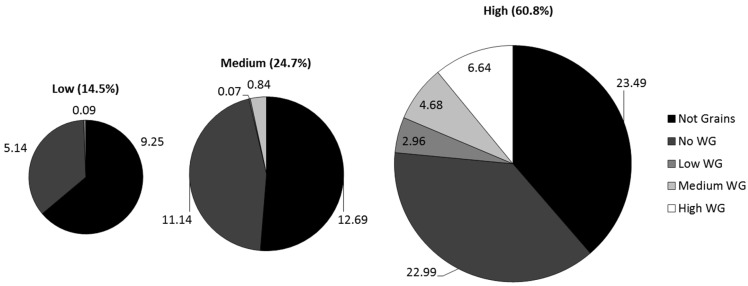
Dietary fiber (DF), found in whole fruits, vegetables, and whole grains (WG), is considered a nutrient of concern in the US diet and increased consumption is recommended. The present study was designed to highlight this critical importance of the difference between WG, high-fiber WG, and sources of fiber that are not from WG. The study is based on the two-day diets reported consumed by the nationally representative sample of Americans participating in What We Eat In America, the dietary component of the National Health and Nutrition Examination Survey from 2003-2010. Foods consumed were classified into tertiles of DF and WG and the contribution of fiber by differing levels of WG content were examined. Foods containing high amounts of WG and DF only contributed about 7% of total fiber intake. Overall, grain-based foods contributed 54.5% of all DF consumed. Approximately 39% of DF came from grain foods that contained no WG, rather these foods contained refined grains, which contain only small amounts of DF but are consumed in large quantities. All WG-containing foods combined contributed a total of 15.3% of DF in the American diet. Thus, public health messaging needs to be changed to specifically encourage consumption of WG foods with high levels of DF to address both recommendations.
Keywords: Dietary Guidelines for Americans; dietary fiber; healthy diet; nutrition monitoring; sources of dietary fiber; whole grain intake.
Conflict of interest statement
The authors declare no conflict of interest. The funding sponsors had no role in the design of the study; in the collection, analyses, or interpretation of data; in the writing of the manuscript, and in the decision to publish the results.
Figures
References
-
- U.S. Department of Health and Human Services. U.S. Department of Agriculture [(accessed on 13 December 2016)];2015–2020 Dietary Guidelines for Americans. (8th ed.). 2015 Available online: https://health.gov/dietaryguidelines/2015/guidelines/
-
- NHS How to Get More Fibre into Your Diet. [(accessed on 13 January 2017)]. Available online: http://www.nhs.uk/Livewell/Goodfood/Pages/how-to-get-more-fibre-into-you...
-
- Institute of Medicine of the National Academy of Sciences . Dietary Reference Intakes for Energy, Carbohydrate, Fiber, Fat, Fatty Acids, Cholesterol, Protein, and Amino Acids (Macronutrients) National Academy Press; Washington, DC, USA: 2002. - PubMed
MeSH terms
LinkOut - more resources
Full Text Sources
Other Literature Sources
Medical
Miscellaneous
