Review
. 2017 Feb 17;8(2):76.
doi: 10.3390/genes8020076.

Immune-Mediated Therapies for Liver Cancer

Affiliations
Review

Immune-Mediated Therapies for Liver Cancer

Rajagopal N Aravalli et al. Genes (Basel). .

Abstract

In recent years, immunotherapy has gained renewed interest as an alternative therapeutic approach for solid tumors. Its premise is based on harnessing the power of the host immune system to destroy tumor cells. Development of immune-mediated therapies, such as vaccines, adoptive transfer of autologous immune cells, and stimulation of host immunity by targeting tumor-evasive mechanisms have advanced cancer immunotherapy. In addition, studies on innate immunity and mechanisms of immune evasion have enhanced our understanding on the immunology of liver cancer. Preclinical and clinical studies with immune-mediated therapies have shown potential benefits in patients with liver cancer. In this review, we summarize current knowledge and recent developments in tumor immunology by focusing on two main primary liver cancers: hepatocellular carcinoma and cholangiocarcinoma.

Keywords: adaptive immunity; adoptive cell transfer; cancer vaccines; cholangiocarcinoma; hepatocellular carcinoma; immune checkpoint blockade; immunotherapy; innate immunity; tumor immunology.


Conflict of interest statement

The authors declare no conflict of interest.

Figures
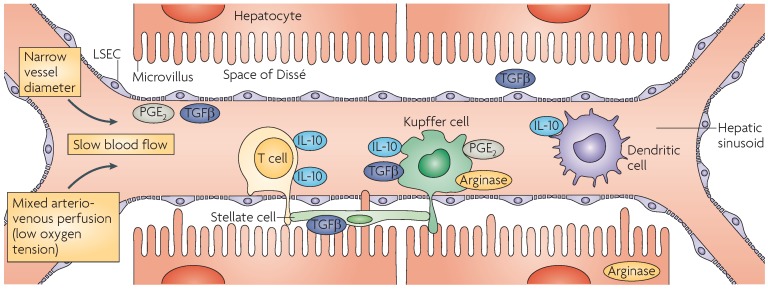
Figure 1
Figure 1
Anatomical location of hepatic antigen-presenting cells (APCs) and the factors that regulate their function. Branches of the hepatic artery merge with sinusoidal vessels carrying blood from the portal vein in the liver, resulting in a mixed arterio-venous perfusion of the liver with low oxygen tension. Owing to extensive branching of portal vessels into liver sinusoids, and the accompanying increase in cumulative vessel diameter, the hepatic microcirculation is characterized by low pressure and slow, sometimes irregular, blood flow. Together with the narrow diameter of hepatic sinusoids, this facilitates the interaction of circulating leukocytes with hepatic sinusoidal cell populations. The hepatic sinusoids are lined by a population of microvascular liver sinusoidal endothelial cells (LSECs) that separate hepatocytes and hepatic stellate cells (HSCs) (all of which function as APCs) from leukocytes circulating through the liver in the blood. Fenestrations in the LSEC lining allow the passive exchange of molecules between the Space of Dissé and the blood, as well as direct contact of lymphocyte filopodia with hepatocyte microvilli. The liver interstitium is highly enriched in cells of the innate immune system (such as antigen-presenting DCs, KCs, NK and NKT cells, and in T cells, which participate in adaptive immune responses. Mediators produced by both parenchymal and non-parenchymal cells, including interleukin-10 (IL-10), transforming growth factor-β (TGFβ), arginase, and prostaglandin E2 (PGE2), regulate immune function within the liver. Reprinted with permission from NPG [13].
Figure 2
Figure 2
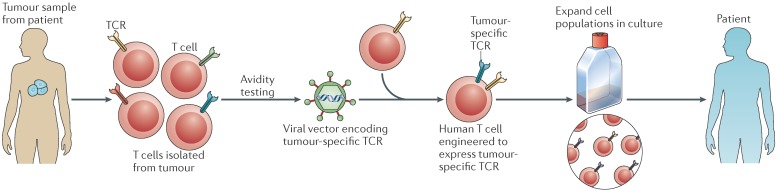
Adoptive cell transfer. T cells can be genetically engineered to recognize tumor-associated antigens in various ways. If a patient expresses a tumor-associated antigen (TAA) that is recognized by an available receptor structure, autologous T cells can be genetically engineered to express the desired receptor. New receptors can be generated in a variety of ways. T cells can be identified and cloned from patients with particularly good antitumor responses. Their T cell receptors (TCRs) can be cloned and inserted into retroviruses or lentiviruses, which are then used to infect autologous T cells from the patient to be treated. Reproduced with permission from NPG with modifications [99].
Figure 3
Figure 3
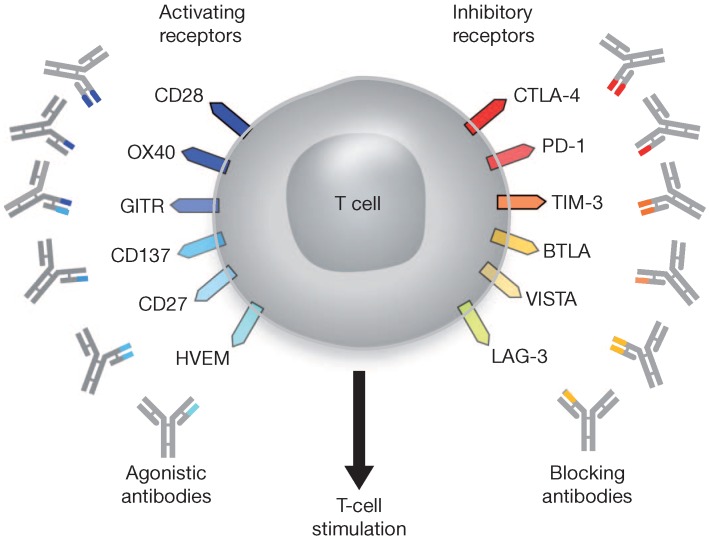
T cell targets for immunoregulatory therapy using antibodies. In addition to specific antigen recognition through the TCR, T-cell activation is regulated through a balance of positive and negative signals provided by co-stimulatory receptors. These surface proteins are typically members of either the TNF receptor or B7 superfamilies. Agonistic antibodies directed against activating co-stimulatory molecules and blocking antibodies against negative co-stimulatory molecules might enhance T-cell stimulation to promote tumor destruction. Reprinted with permission from NPG [109].

References

    1. Nordenstedt H., White D.L., El-Serag H.B. The changing pattern of epidemiology in hepatocellular carcinoma. Dig. Liver Dis. 2010;42:S206–S214. doi: 10.1016/S1590-8658(10)60507-5. - DOI - PMC - PubMed
    1. Aravalli R.N., Steer C.J., Cressman E.N. Molecular mechanisms of hepatocellular carcinoma. Hepatology. 2008;48:1049–1053. doi: 10.1002/hep.22580. - DOI - PubMed
    1. Lazaridis K.N., Gores G.J. Cholangiocarcinoma. Gastroenterology. 2005;128:1655–1667. doi: 10.1053/j.gastro.2005.03.040. - DOI - PubMed
    1. Bergquist A., Von Seth E. Epidemiology of cholangiocarcinoma. Best Pract. Res. Clin. Gastroenterol. 2015;29:221–232. doi: 10.1016/j.bpg.2015.02.003. - DOI - PubMed
    1. Shin H.R., Oh J.K., Masuyer E., Curado M.P., Bouvard V., Fang Y.Y., Wiangnon S., Sripa B., Hong S.T. Epidemiology of cholangiocarcinoma: An update focusing on risk factors. Cancer Sci. 2010;101:579–585. doi: 10.1111/j.1349-7006.2009.01458.x. - DOI - PMC - PubMed

LinkOut - more resources