


Aquaculture genomics, genetics and breeding in the United States: current status, challenges, and priorities for future research
- PMID: 28219347
- PMCID: PMC5319170
- DOI: 10.1186/s12864-017-3557-1
Aquaculture genomics, genetics and breeding in the United States: current status, challenges, and priorities for future research
Erratum in
-
Erratum to: Aquaculture genomics, genetics and breeding in the United States: current status, challenges, and priorities for future research.BMC Genomics. 2017 Mar 16;18(1):235. doi: 10.1186/s12864-017-3614-9. BMC Genomics. 2017. PMID: 28302067 Free PMC article. No abstract available.
Abstract
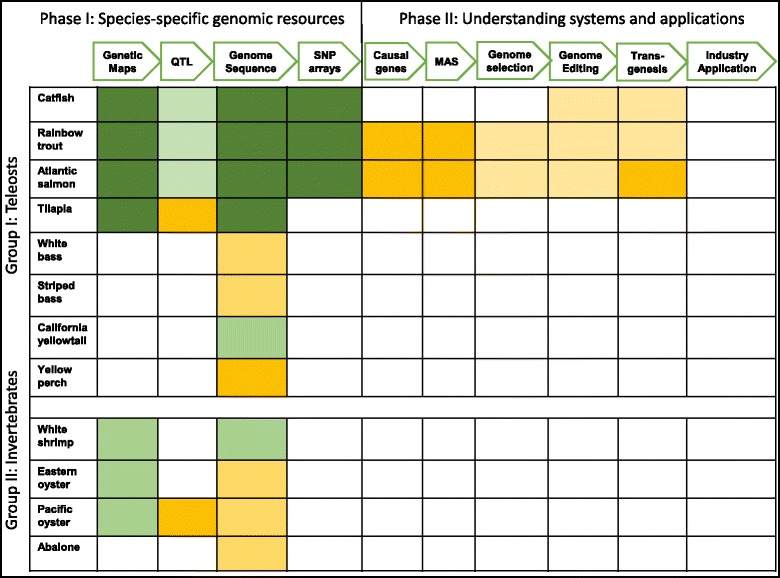
Advancing the production efficiency and profitability of aquaculture is dependent upon the ability to utilize a diverse array of genetic resources. The ultimate goals of aquaculture genomics, genetics and breeding research are to enhance aquaculture production efficiency, sustainability, product quality, and profitability in support of the commercial sector and for the benefit of consumers. In order to achieve these goals, it is important to understand the genomic structure and organization of aquaculture species, and their genomic and phenomic variations, as well as the genetic basis of traits and their interrelationships. In addition, it is also important to understand the mechanisms of regulation and evolutionary conservation at the levels of genome, transcriptome, proteome, epigenome, and systems biology. With genomic information and information between the genomes and phenomes, technologies for marker/causal mutation-assisted selection, genome selection, and genome editing can be developed for applications in aquaculture. A set of genomic tools and resources must be made available including reference genome sequences and their annotations (including coding and non-coding regulatory elements), genome-wide polymorphic markers, efficient genotyping platforms, high-density and high-resolution linkage maps, and transcriptome resources including non-coding transcripts. Genomic and genetic control of important performance and production traits, such as disease resistance, feed conversion efficiency, growth rate, processing yield, behaviour, reproductive characteristics, and tolerance to environmental stressors like low dissolved oxygen, high or low water temperature and salinity, must be understood. QTL need to be identified, validated across strains, lines and populations, and their mechanisms of control understood. Causal gene(s) need to be identified. Genetic and epigenetic regulation of important aquaculture traits need to be determined, and technologies for marker-assisted selection, causal gene/mutation-assisted selection, genome selection, and genome editing using CRISPR and other technologies must be developed, demonstrated with applicability, and application to aquaculture industries.Major progress has been made in aquaculture genomics for dozens of fish and shellfish species including the development of genetic linkage maps, physical maps, microarrays, single nucleotide polymorphism (SNP) arrays, transcriptome databases and various stages of genome reference sequences. This paper provides a general review of the current status, challenges and future research needs of aquaculture genomics, genetics, and breeding, with a focus on major aquaculture species in the United States: catfish, rainbow trout, Atlantic salmon, tilapia, striped bass, oysters, and shrimp. While the overall research priorities and the practical goals are similar across various aquaculture species, the current status in each species should dictate the next priority areas within the species. This paper is an output of the USDA Workshop for Aquaculture Genomics, Genetics, and Breeding held in late March 2016 in Auburn, Alabama, with participants from all parts of the United States.
Keywords: Aquaculture; Fish; Genetic resources; Genome; QTL; RNA-Seq; SNP; Shellfish; Transcriptome.
Figures
References
-
- Alcivar‐Warren A, Dunham R, Gaffney P. First aquaculture species genome mapping workshop. Anim Genet. 1997;28(6):451–452. doi: 10.1111/j.1365-2052.1997.00202.x. - DOI
-
- Vallejo RL, Leeds TD, Fragomeni BO, Gao G, Hernandez AG, Misztal I, Welch TJ, Wiens GD, Palti Y. Evaluation of genome-enabled selection for bacterial cold water disease resistance using progeny performance data in rainbow trout: Insights on genotyping methods and genomic prediction models. Front Genet. 2016;7:96. doi: 10.3389/fgene.2016.00096. - DOI - PMC - PubMed
-
- Vallejo RL, Leeds TD, Gao G, Parsons JE, Martin KE, Evenhuis JP, Fragomeni BO, Wiens GD, Palti Y. Genomic selection models double the accuracy of predicted breeding values for bacterial cold water disease resistance compared to a traditional pedigree-based model in rainbow trout aquaculture. Genet Select Evol. 2017;49(1):17. - PMC - PubMed
Publication types
MeSH terms
LinkOut - more resources
Full Text Sources
Other Literature Sources
