. 2017 Feb 20;18(1):33.
doi: 10.1186/s13059-017-1167-5.

Genomic insights into divergence and dual domestication of cultivated allotetraploid cottons

Affiliations

Genomic insights into divergence and dual domestication of cultivated allotetraploid cottons

Lei Fang et al. Genome Biol. .

Abstract

Background: Cotton has been cultivated and used to make fabrics for at least 7000 years. Two allotetraploid species of great commercial importance, Gossypium hirsutum and Gossypium barbadense, were domesticated after polyploidization and are cultivated worldwide. Although the overall genetic diversity between these two cultivated species has been studied with limited accessions, their population structure and genetic variations remain largely unknown.

Results: We resequence the genomes of 147 cotton accessions, including diverse wild relatives, landraces, and modern cultivars, and construct a comprehensive variation map to provide genomic insights into the divergence and dual domestication of these two important cultivated tetraploid cotton species. Phylogenetic analysis shows two divergent groups for G. hirsutum and G. barbadense, suggesting a dual domestication processes in tetraploid cottons. In spite of the strong genetic divergence, a small number of interspecific reciprocal introgression events are found between these species and the introgression pattern is significantly biased towards the gene flow from G. hirsutum into G. barbadense. We identify selective sweeps, some of which are associated with relatively highly expressed genes for fiber development and seed germination.

Conclusions: We report a comprehensive analysis of the evolution and domestication history of allotetraploid cottons based on the whole genomic variation between G. hirsutum and G. barbadense and between wild accessions and modern cultivars. These results provide genomic bases for improving cotton production and for further evolution analysis of polyploid crops.

Keywords: Allotetraploid cottons; Divergence; Domestication; Resequencing.


Figures
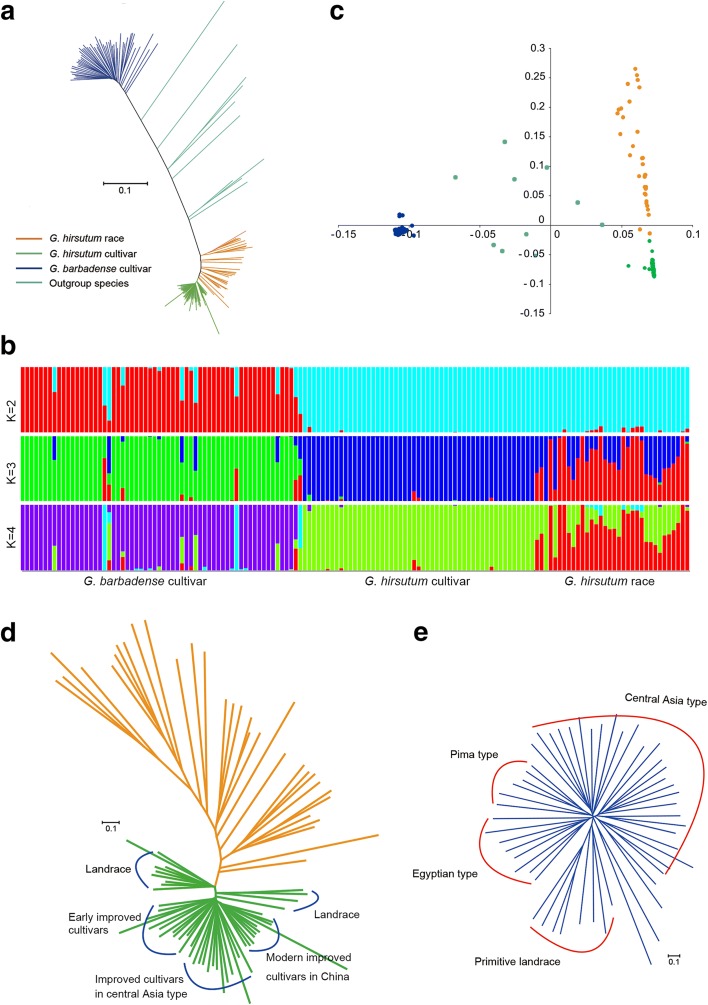
Fig. 1
Fig. 1
Phylogenetic relationships of 147 cotton accessions. a A neighbor-joining tree was constructed using whole-genome SNP data. The cotton samples were divided into G. hirsutum races (orange), G. hirsutum cultivars (green), G. barbadense cultivars (dark blue) and outgroup species (light blue). b Population structure of cotton accessions determined using STRUCTURE. The accessions were divided into three groups when K = 3. c Principal component analysis of all cotton accessions using whole-genome SNP data. d Phylogenetic relationships between G. hirsutum cultivars and races. e Phylogenetic relationships between G. barbadense landraces and cultivars. The scale bar indicates the simple matching distance
Fig. 2
Fig. 2
Characterization of the genetic diversity and introgression on chromosomes A01 and D01 in cotton. The levels of genetic diversity in G. hirsutum cultivars (π Gh cultivar) (a) and races (π Gh race) (b), the level of genetic diversity in G. barbadense (π Gb cultivar) (c), and the level of genetic differentiation between G. hirsutum and G. barbadense (d). For introgression analysis, the genetic backgrounds of G. hirsutum cultivars, G. hirsutum races, and G. barbadense cultivars are illustrated in green (a), orange (b) and blue (c), respectively
Fig. 3
Fig. 3
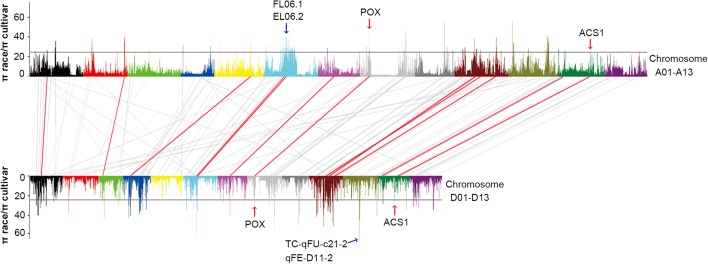
Identification and comparative analysis of the selective sweeps in G. hirsutum. The values of π race/π cultivar were plotted against the position on each of the 26 chromosomes. The relationships between each selective sweep and its corresponding homologous region in the allotetraploid genome are indicated by grey lines. The 12 selective sweep pairs with high or modest selection signals in homoeologous regions are indicated by red lines. The blue arrow indicates the fiber quality related QTLs around the strongest selection signal locus in D11 and the longest selection region in A06. The red arrow indicates the POX and ACS1 genes in the A08/D08 and A12/D12 homoeologous regions
Fig. 4
Fig. 4
Expression pattern of ten fiber-related genes related to cotton fiber quality. a Expression pattern of ten genes related to fiber quality in distinct tissues. b Expression level of these genes in domesticated cotton (TM-1) and two wild relatives (TX665, G. hirsutum var. palmeri; TX2094, G. hirsutum var. yucatanense). Fisher’s exact test, * P value <0.05 and fold change >2. c Identification of 109 selective sweeps through comparisons of races and cultivars in G. hirsutum. The values of π race/π cultivar were plotted against the position on each of the 26 chromosomes. The horizontal line indicates the genome-wide threshold of selection signals (π race/π cultivar >25). Asterisks indicate the strongest selection signal locus in D11 and the longest selective sweep in A06. Lines linking b and c indicate the gene locus in selection sweeps. The fiber quality-related QTLs around these gene loci are shown beside these lines

References

    1. Hutchinson JB. The application of genetics to cotton improvement. Cambridge: Cambridge University Press; 1959.
    1. Kohel RJ, Lewis CF. Cotton. Madison: American Society of Agronomy; 1984.
    1. Wendel JF. New World tetraploid cottons contain Old-World cytoplasm. Proc Natl Acad Sci U S A. 1989;86:4132–4136. doi: 10.1073/pnas.86.11.4132. - DOI - PMC - PubMed
    1. Fryxell PA. Natural history of the cotton tribe. College Station, TX: Texas A&M University Press; 1979; Suppl 74:4–7
    1. Stephens SG. Some observations on photoperiodism and the development of annual forms of domesticated cottons. Econ Bot. 1976;30:409. doi: 10.1007/BF02904663. - DOI

Publication types

LinkOut - more resources