


Emotion Regulation Therapy: A Mechanism-Targeted Treatment for Disorders of Distress
- PMID: 28220089
- PMCID: PMC5292405
- DOI: 10.3389/fpsyg.2017.00098
Emotion Regulation Therapy: A Mechanism-Targeted Treatment for Disorders of Distress
Abstract
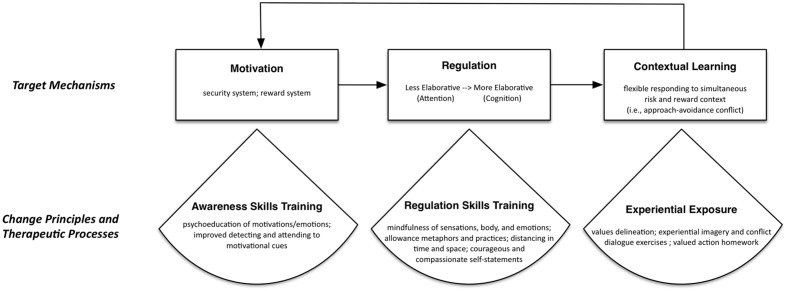
"Distress disorders," which include generalized anxiety disorder and major depression are often highly comorbid with each other and appear to be characterized by common temperamental features that reflect heightened sensitivity to underlying motivational systems related to threat/safety and reward/loss. Further, individuals with distress disorders tend to utilize self-referential processes (e.g., worry, rumination, self-criticism) in a maladaptive attempt to respond to motivationally relevant distress, often resulting in suboptimal contextual learning. Despite the success of cognitive behavioral therapies for emotional disorders, a sizable subgroup of patients with distress disorders fail to evidence adequate treatment response. Emotion Regulation Therapy (ERT) is a theoretically derived, evidence based, treatment that integrates principles (e.g., skills training, exposure) from traditional and contemporary therapies with findings from basic and translational affective science to offer a framework for improving intervention by focusing on the motivational responses and corresponding regulatory characteristics of individuals with high levels of chronic distress. Open and randomized controlled trials have demonstrated preliminary support for the utility of ERT as reflected by strong effect sizes comparable to and exceeding established intervention approaches. In addition, pilot findings support the role of underlying proposed mechanisms in this efficacious response. This article presents the functional model associated with ERT and describes the proposed mechanisms of the treatment. Additionally, a clinical case is presented, allowing the reader to gain a greater applied understanding of the different components of the ERT model and treatment.
Keywords: depression; emotion regulation; generalized anxiety disorder; mindfulness; treatment.
Figures
References
-
- American Psychiatric Association (2013). Diagnostic and Statistical Manual of Mental Disorders, 5th Edn Washington, DC: American Psychiatric Association.
-
- Bieling P. J., Hawley L. L., Bloch R. T., Corcoran K. M., Levitan R. D., Young L. T., et al. (2012). Treatment-specific changes in decentering following mindfulness-based cognitive therapy versus antidepressant medication or placebo for prevention of depressive relapse. J. Consult. Clin. Psychol. 80 365–372. 10.1037/a0027483 - DOI - PMC - PubMed
Grants and funding
LinkOut - more resources
Full Text Sources
Other Literature Sources
Medical
