Review
. 2017 Feb 6:8:16.
doi: 10.3389/fendo.2017.00016. eCollection 2017.

New Insights in Glucocorticoid Receptor Signaling-More Than Just a Ligand-Binding Receptor

Affiliations
Review

New Insights in Glucocorticoid Receptor Signaling-More Than Just a Ligand-Binding Receptor

Karin Scheschowitsch et al. Front Endocrinol (Lausanne). .

Abstract

The clinical use of classical glucocorticoids (GC) is narrowed by the many side effects it causes and the resistance to GC observed in some diseases. Since the great majority of GC effects depend on the activation of a glucocorticoid receptor (GR), many research groups had focused to better understand the signaling pathways involving those receptors. Transgenic animal models and genetic modifications of the receptor brought a huge insight into GR mechanisms of action. This in turn opened a new window for the search of selective GR modulators that ideally may have agonistic and antagonistic combined effects and activate one specific signaling pathway, inducing mostly transrepression or transactivation mechanisms. Another important research field concerns to posttranslational modifications that affect the GR and consequently also affect its signaling and function. In this mini review, we discuss many of those aspects of GR signaling, as well as findings like the ligand-independent activation of GR, which add another layer of complexity in GR signaling pathways. Although several recent data have been added to the GR field, much work has yet to be done, especially to find out the biological relevance of those alternative GR signaling pathways. Improving the knowledge about alternative GR signaling pathways and understanding how these pathways intercommunicate and in which situations they are relevant might help to develop new strategies to take benefit of it and to improve GC or other compounds efficacy causing minimal side effects.

Keywords: glucocorticoid receptor; glucocorticoids; nuclear translocation; selective glucocorticoid receptor modulators; signaling pathways.


Figures
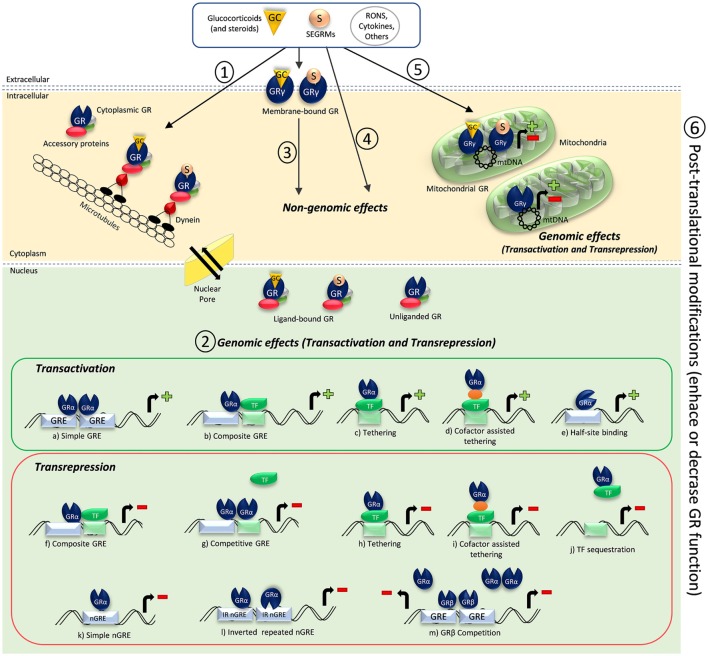
Figure 1
Figure 1
Schematic illustration of glucocorticoid receptor (GR) activation and GR-mediated mechanisms of action. (1) Cytoplasmic GR resides in the cytoplasm complexed with accessory proteins and present high affinity to ligands. Once ligands like glucocorticoids and other steroids or selective glucocorticoid receptor modulators (SEGRMs) bind to the cytoplasmic GR, the GR complex interacts with dynein and is transported along microtubules to a nuclear pore. Interaction with importins and nucleoporins of the nuclear pore allow the GR complex to enter the nucleus, dissociate from chaperones, and induce genomic effects. Dissociated chaperones and GR constantly shuttle between the nucleus and the cytoplasm through the nuclear pore. Reactive oxygen and nitrogen species (RONS), some cytokines, other substances, and conditions like shear stress can induce unliganded GR nuclear translocation, which seem to be cytoskeleton independent. However, unliganded GR nuclear translocation is still not completely understood. (2) Ligand-bound GR, and sometimes unliganded GR, can induce genomic effects through direct or indirect transactivation or transrepression mechanisms. GRα homodimers binding to glucocorticoid-responsive elements (GRE) (A), monomeric GRα DNA binding in a concerted manner with another transcription factor (TF) (B), direct (C) or indirect (D) binding of GRα onto a TF, and recently demonstrated monomeric GRα half-site binding (E) can result in promoter activation and gene expression. GR-negative regulation of gene transcription can occur by monomeric GRα DNA-binding crosstalk with another TF (F), GRα homodimers competition for an overlapping binding site (G), direct (H) or indirect (I) binding of GRα onto a TF, sequestration of a DNA-bound TF (J), direct binding of monomeric GRα onto a negative GRE (nGRE) (K), two monomeric GRα binding with inverted polarities to inverted repeated nGREs (L), or GRβ competition for an overlapping GRE, impairing GRα binding (M). (3) Ligands and other substances also can bind and interact with membrane-bound GR (claimed to be a GRγ isoform), causing fast non-genomic effects. (4) Ligands, particularly steroids in high concentrations, can induce non-genomic effects through GR-independent mechanisms of action. (5) Ligands and other substances can bind to mitochondrial GR, which is also suggested to be a GRγ isoform. Ligand-bound and unliganded mitochondrial GR induce genomic effects when bound to the mitochondrial DNA (mtDNA), and those effects are important to regulate mitochondrial functions and energy metabolism. (6) Posttranslational modifications can affect GR activation and function in all stages, enhancing or decreasing its function.

References

    1. Sundahl N, Bridelance J, Libert C, De Bosscher K, Beck IM. Selective glucocorticoid receptor modulation: new directions with non-steroidal scaffolds. Pharmacol Ther (2015) 152:28–41. 10.1016/j.pharmthera.2015.05.001 - DOI - PubMed
    1. Sapolsky RM, Romero LM, Munck AU. How do glucocorticoids influence stress responses? Integrating permissive, suppressive, stimulatory, and preparative actions. Endocr Rev (2000) 21:55–89. 10.1210/er.21.1.55 - DOI - PubMed
    1. Meir Drexler S, Wolf OT. The role of glucocorticoids in emotional memory reconsolidation. Neurobiol Learn Mem (2016). 10.1016/j.nlm.2016.11.008 - DOI - PubMed
    1. Baschant U, Tuckermann J. The role of the glucocorticoid receptor in inflammation and immunity. J Steroid Biochem Mol Biol (2010) 120:69–75. 10.1016/j.jsbmb.2010.03.058 - DOI - PubMed
    1. Silverman MN, Sternberg EM. Glucocorticoid regulation of inflammation and its functional correlates: from HPA axis to glucocorticoid receptor dysfunction. Ann N Y Acad Sci (2012) 1261:55–63. 10.1111/j.1749-6632.2012.06633.x - DOI - PMC - PubMed

LinkOut - more resources
