


Costs and effects of a state-wide health promotion program in primary schools in Germany - the Baden-Württemberg Study: A cluster-randomized, controlled trial
- PMID: 28222101
- PMCID: PMC5319648
- DOI: 10.1371/journal.pone.0172332
Costs and effects of a state-wide health promotion program in primary schools in Germany - the Baden-Württemberg Study: A cluster-randomized, controlled trial
Abstract
Aim: To evaluate the cost-effectiveness of the state-wide implementation of the health promotion program "Join the Healthy Boat" in primary schools in Germany.
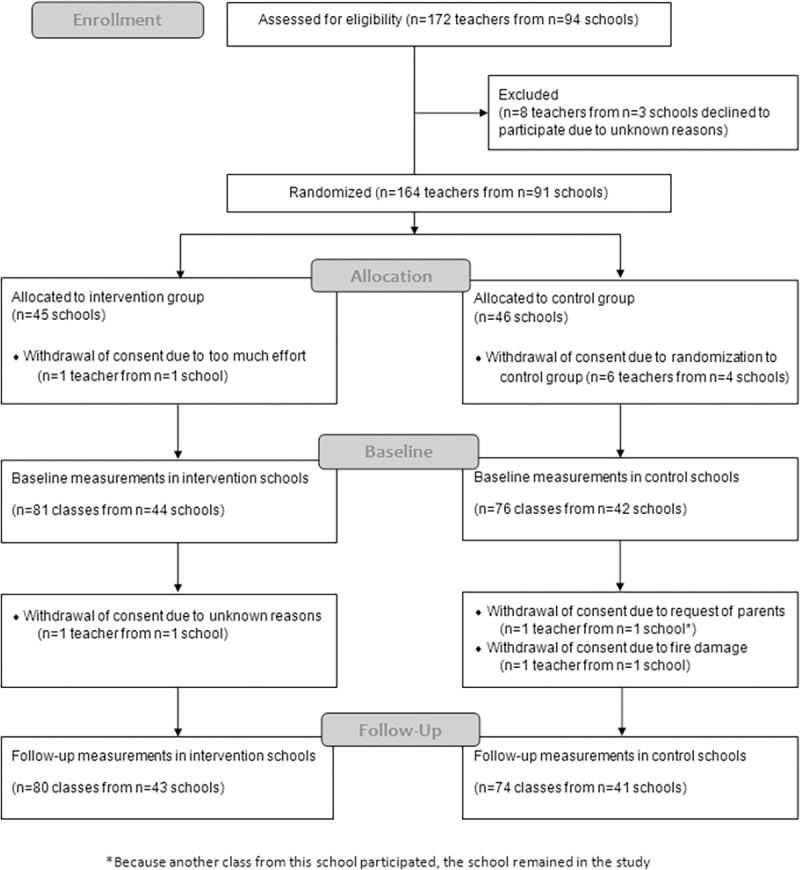
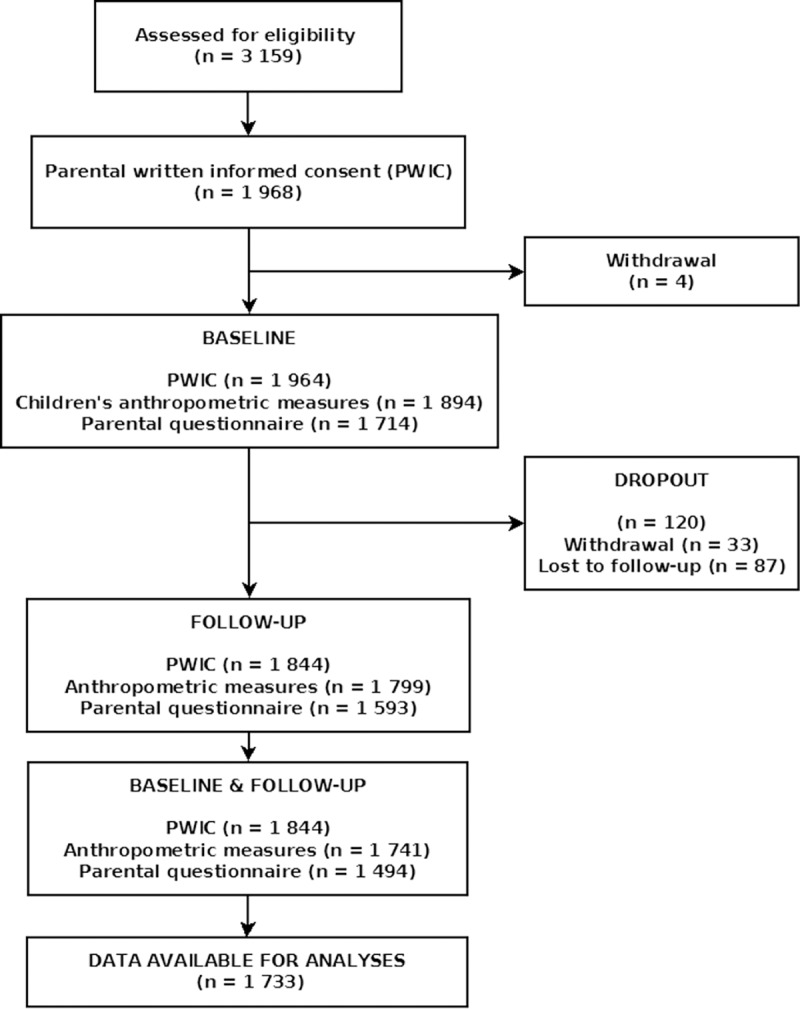
Methods: Cluster-randomized intervention trial with wait-list control group. Anthropometric data of 1733 participating children (7.1 ± 0.6 years) were taken by trained staff before and after a one year intervention period in the academic year 2010/11. Parents provided information about the health status, and the health behaviour of their children and themselves, parental anthropometrics, and socio-economic background variables. Incidence of abdominal obesity, defined as waist-to-height ratio (WHtR) ≥ 0.5, was determined. Generalized linear models were applied to account for the clustering of data within schools, and to adjust for baseline-values. Losses to follow-up and missing data were analysed. From a societal perspective, the overall costs, costs per pupil, and incremental cost-effectiveness ratio (ICER) to identify the costs per case of averted abdominal obesity were calculated.
Results: The final regression model for the incidence of abdominal obesity shows lower odds for the intervention group after an adjustment for grade, gender, baseline WHtR, and breakfast habits (odds ratio = 0.48, 95% CI [0.25; 0.94]). The intervention costs per child/year were €25.04. The costs per incidental case of averted abdominal obesity varied between €1515 and €1993, depending on the different dimensions of the target group.
Conclusion: This study demonstrates the positive effects of state-wide, school-based health promotion on incidental abdominal obesity, at affordable costs and with proven cost-effectiveness. These results should support allocative decisions of policymakers. An early start to the prevention of abdominal obesity is of particular importance because of its close relationship to non-communicable diseases.
Trial registration: German Clinical Trials Register (DRKS), Freiburg University, Germany, DRKS-ID: DRKS00000494.
Conflict of interest statement
Figures
References
-
- Bloom DE, Cafiero ET, Jané-Llopis E, Abrahams-Gessel S, Bloom LR, Fathima S, et al. The Global Economic Burden of Non-communicable Diseases Geneva: World Economic Forum; 2011.
-
- Olds T, Maher C, Zumin S, Péneau S, Lioret S, Castetbon K, et al. Evidence that the prevalence of childhood overweight is plateauing: data from nine countries. Int J Pediatr Obes. 2011;6(June):342–60. - PubMed
-
- Garnett SP, Baur LA, Cowell CT. The prevalence of increased central adiposity in Australian school children 1985 to 2007. Obes Rev. 2011;12(15):887–96. - PubMed
Publication types
MeSH terms
LinkOut - more resources
Full Text Sources
Other Literature Sources
Medical
