


Sensitive simultaneous quantitation of testosterone and estradiol in serum by LC-MS/MS without derivatization and comparison with the CDC HoSt program
- PMID: 28222335
- PMCID: PMC5379634
- DOI: 10.1016/j.jchromb.2017.02.006
Sensitive simultaneous quantitation of testosterone and estradiol in serum by LC-MS/MS without derivatization and comparison with the CDC HoSt program
Abstract
Background: Very sensitive measurements of serum estrogens and testosterone are important in adult and pediatric endocrinology and immunoassays are known to lack the required performance at very low levels. Our aim was to develop a sensitive HPLC-MS/MS assay for both estradiol (E2) and testosterone (Te) in serum without the need for chemical derivatization and using commercially available calibrators.
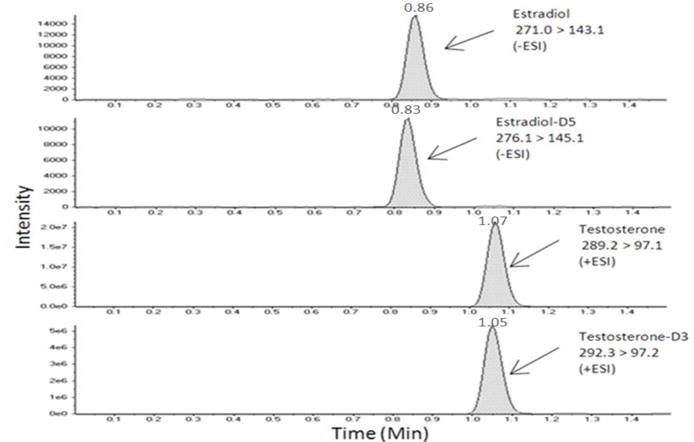
Methods: Serum samples were prepared by the addition of internal standards followed by extraction using hexane:ethyl acetate. Chromatographic separation was achieved using a C18 column and mass spectrometry was performed in both positive and negative ion modes.
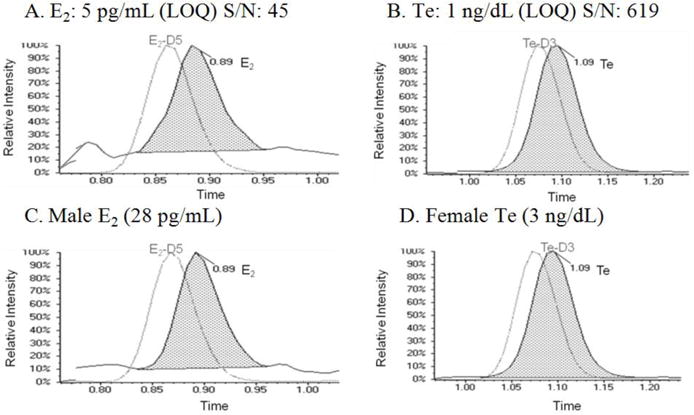
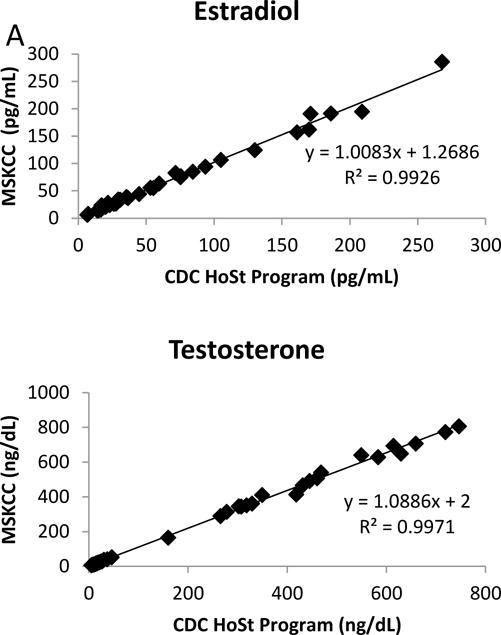
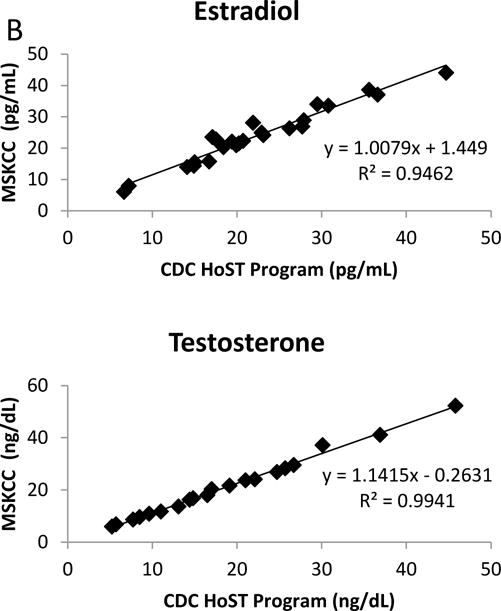
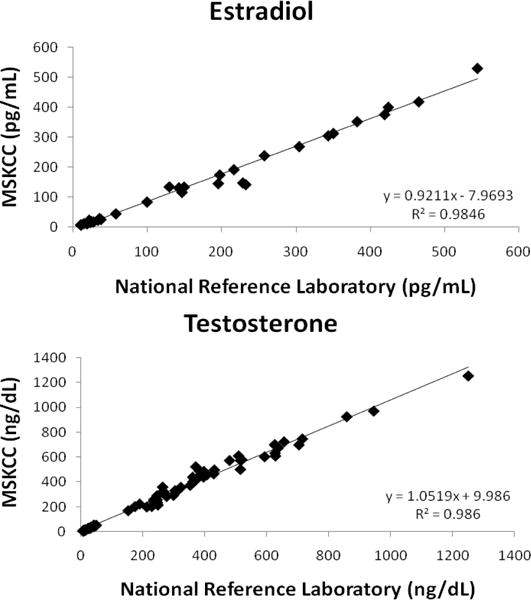
Results: The lower limits of quantitation (LLOQs) of E2 and Te were 5pg/mL and 1ng/dL, respectively. The analytical measurement range (AMR) for E2 was 5-600pg/mL and 1-1,170ng/dL for Te. Assay accuracy was determined both by comparison with a LC-MS/MS method performed at a national laboratory and the CDC HoSt program. Comparison with samples analyzed by both methods showed excellent correlation. Within-day (N=10) and between-day (N=20) CVs at concentrations spanning the AMR were less than 7% for both analytes.
Conclusion: We have developed an accurate and highly sensitive assay to measure E2 and Te levels in serum by HPLC-MS/MS without chemical derivatization and using commercially available calibrators.
Keywords: CDC HoSt; Estradiol; Liquid chromatography; Mass spectrometry; Method correlation; NIST SRM 971; Testosterone.
Copyright © 2017 Elsevier B.V. All rights reserved.
Figures
References
-
- Nelson R, Grebe SK, O’Kane DJ, Singh RJ. Liquid chromatography–tandem mass spectrometry assay for simultaneous measurement of estradiol and estrone in human plasma. Clin Chem. 2004;50(2):373–384. - PubMed
-
- Kushnir MM, Blamires T, Rockwood AL, Roberts WL, Yue B, Erdogan E, Bunker AM, Meikle AW. Liquid chromatography-tandem mass spectrometry assay for androstenedione, dehydroepiandrosterone, and testosterone with pediatric and adult reference intervals. Clin Chem. 2010;56(7):1138–1147. - PubMed
-
- Herold DA, Fitzgerald RL. Immunoassays for testosterone in women: better than a guess? Clin Chem. 2003;49(8):1250–1251. - PubMed
-
- Demers LM. Testosterone and estradiol assays: current and future trends. Steroids. 2008;73(13):1333–1338. - PubMed
-
- Leung YS, Dees K, Cyr R, Schoegel L, Kao PC. Falsely increased serum estradiol results reported in direct estradiol assays. Clin Chem. 1997;43(7):1250–1251. - PubMed
Publication types
MeSH terms
Substances
Grants and funding
LinkOut - more resources
Full Text Sources
Other Literature Sources
