


Biological aspects of axonal damage in glaucoma: A brief review
- PMID: 28223179
- PMCID: PMC6545378
- DOI: 10.1016/j.exer.2017.02.006
Biological aspects of axonal damage in glaucoma: A brief review
Abstract
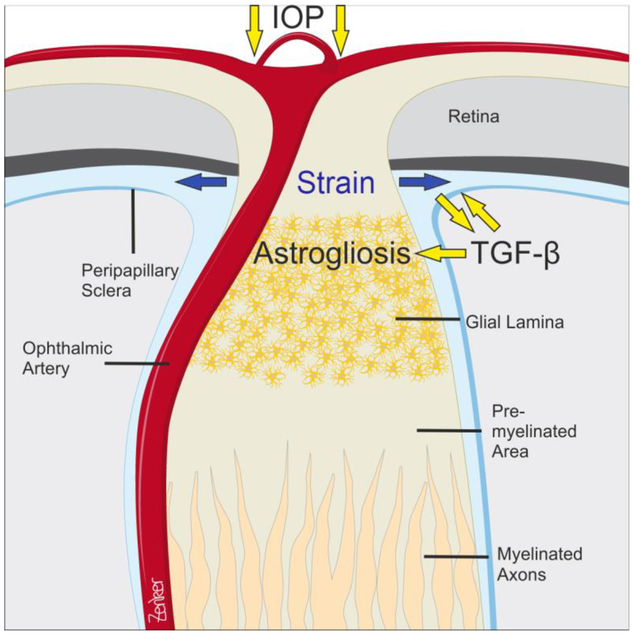
Intraocular pressure (IOP) is a critical risk factor in glaucoma, and the available evidence derived from experimental studies in primates and rodents strongly indicates that the site of IOP-induced axonal damage in glaucoma is at the optic nerve head (ONH). However, the mechanisms that cause IOP-induced damage at the ONH are far from understood. A possible sequence of events could originate with IOP-induced stress in the ONH connective tissue elements (peripapillary sclera, scleral canal and lamina cribrosa) that leads to an increase in biomechanical strain. In consequence, molecular signaling cascades might be activated that result in extracellular matrix turnover of the peripapillary sclera, changing its biomechanical properties. Peripapillary sclera strain might induce reactive changes in ONH astrocytes and cause astrogliosis. The biological changes that are associated with ONH astrocyte reactivity could lead to withdrawal of trophic or metabolic support for optic nerve axons and cause their degeneration. Alternatively, the expression of neurotoxic molecules might be induced. Unfortunately, direct experimental in vivo evidence for these or other scenarios is currently lacking. The pathogenic processes that cause axonal degeneration at the ONH in glaucoma need to be identified before any regenerative therapy is likely to succeed. Several topics and emerging techniques should be pursued to enhance our understanding of the mechanisms that are behind axonal degeneration. Among them are: Advanced imaging techniques, the development of in vivo markers to identify axonal injury, the generation of molecular approaches for in vivo detection of mechanosensitivity and for molecular manipulation of the ONH, a more complete characterization of retinal ganglion cells, the use of organ cultures, 3D-bioprinting, and the engineering of microdevices that can measure pressure. Questions that need to be answered relate to the specific roles of astrogliosis, neuroinflammation, blood flow and intracranial pressure in axonal degeneration at the ONH.
Copyright © 2017. Published by Elsevier Ltd.
Figures
References
-
- Anderson DR, 1969. Ultrastructure of human and monkey lamina cribrosa and optic nerve head. Arch. Ophthalmol. 82, 800–814. - PubMed
-
- Berdahl JP, Allingham RR, Johnson DH, 2008a. Cerebrospinal fluid pressure is decreased in primary open-angle glaucoma. Ophthalmology 115, 763–768. - PubMed
-
- Burgoyne CF, Downs JC, Bellezza AJ, Suh JK, Hart RT, 2005. The optic nerve head as a biomechanical structure: a new paradigm for understanding the role of IOP-related stress and strain in the pathophysiology of glaucomatous optic nerve head damage. Prog. Retin. Eye Res. 24, 39–73. - PubMed
Publication types
MeSH terms
Grants and funding
LinkOut - more resources
Full Text Sources
Other Literature Sources
Medical
