


Reduced First-Phase Ejection Fraction and Sustained Myocardial Wall Stress in Hypertensive Patients With Diastolic Dysfunction: A Manifestation of Impaired Shortening Deactivation That Links Systolic to Diastolic Dysfunction and Preserves Systolic Ejection Fraction
- PMID: 28223475
- PMCID: PMC5344180
- DOI: 10.1161/HYPERTENSIONAHA.116.08545
Reduced First-Phase Ejection Fraction and Sustained Myocardial Wall Stress in Hypertensive Patients With Diastolic Dysfunction: A Manifestation of Impaired Shortening Deactivation That Links Systolic to Diastolic Dysfunction and Preserves Systolic Ejection Fraction
Abstract
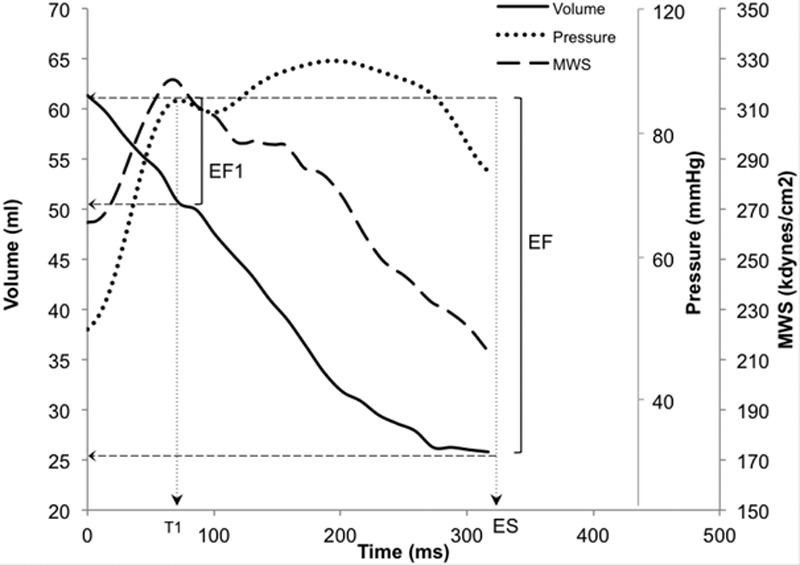
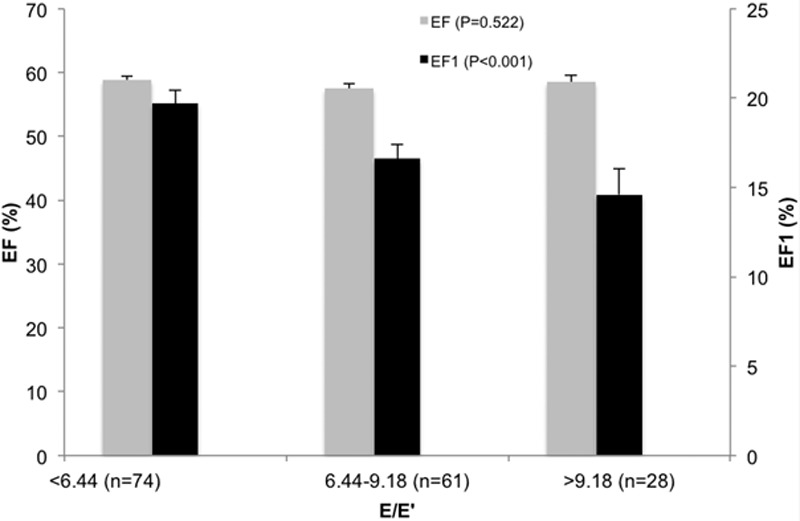
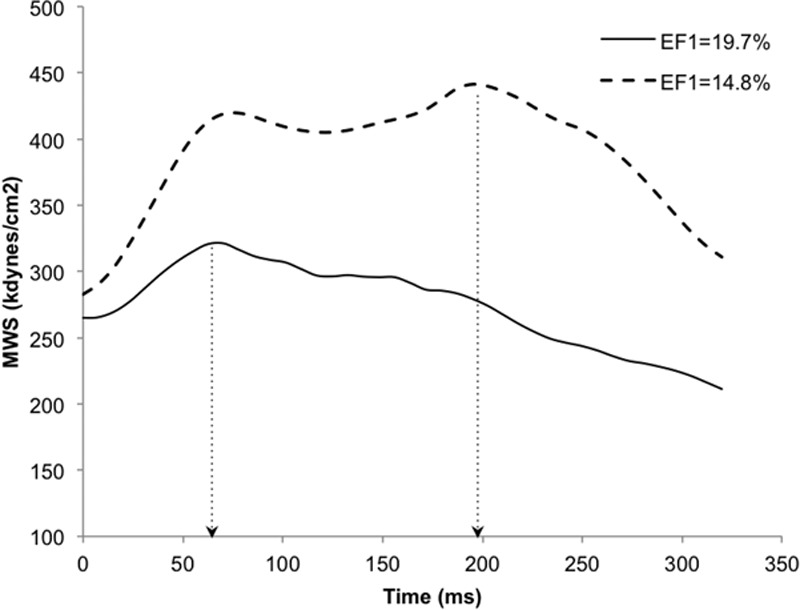
Impaired shortening deactivation of cardiac myocytes could sustain myocardial contraction, preserving ejection fraction at the expense of diastolic dysfunction. We examined the relationship between first-phase ejection fraction (EF1), the fraction of left ventricular volume ejected from the start of systole to the time of the first peak in left ventricular pressure (corresponding to the time of maximal ventricular shortening) to the duration of myocardial contraction and diastolic function in patients with hypertension (n=163), and varying degrees of diastolic dysfunction. Left ventricular systolic pressure was estimated by carotid tonometry; time-resolved left ventricular cavity and wall volume were obtained by echocardiography with speckle wall tracking. Measurements were repeated after nitroglycerin, a drug known to influence ventricular dynamics, in a subsample (n=18) of patients. EF1 and time of onset of ventricular relaxation (as determined from the temporal pattern of myocardial wall stress) were independently correlated with diastolic relaxation as measured by tissue Doppler early diastolic mitral annular velocity (E', standardized regression coefficients 0.48 and -0.34 for EF1 and time of onset of ventricular relaxation, respectively, each P<0.001, irrespective of adjustment for age, sex, antihypertensive treatment, measures of afterload, and ventricular geometry) and with diastolic function measured by the ratio of transmitral Doppler early filling velocity (E) to E' (E/E', regression coefficients -0.34 and 0.34, respectively, each P<0.001). Nitroglycerin increased EF1, decreased time of onset of ventricular relaxation, and improved diastolic function (each P<0.05). Hypertensive patients with diastolic dysfunction exhibit reduced EF1 which may sustain myocardial contraction, preserving systolic ejection fraction at the expense of impaired diastolic function.
Keywords: blood pressure; diastole; echocardiography; hypertension; ventricular function.
© 2017 The Authors.
Figures
Comment in
-
Deciphering Systolic-Diastolic Coupling in the Intact Heart.Hypertension. 2017 Apr;69(4):575-577. doi: 10.1161/HYPERTENSIONAHA.116.08849. Epub 2017 Feb 21. Hypertension. 2017. PMID: 28223470 Free PMC article. No abstract available.
References
-
- Brady AJ. Time and displacement dependence of cardiac contractility: problems in defining the active state and force-velocity relations. Fed Proc. 1965;24:1410–1420. - PubMed
-
- Housmans PR, Lee NK, Blinks JR. Active shortening retards the decline of the intracellular calcium transient in mammalian heart muscle. Science. 1983;221:159–161. - PubMed
-
- Ezzaher A, el Ouazzani T, Crozatier B. Timing and velocity of ejection as major determinants of end-systolic pressure in isolated rabbit hearts. Circulation. 1994;90:3055–3062. - PubMed
-
- Kentish JC, ter Keurs HE, Ricciardi L, Bucx JJ, Noble MI. Comparison between the sarcomere length-force relations of intact and skinned trabeculae from rat right ventricle. Influence of calcium concentrations on these relations. Circ Res. 1986;58:755–768. - PubMed
-
- Piazzesi G, Reconditi M, Linari M, Lucii L, Bianco P, Brunello E, Decostre V, Stewart A, Gore DB, Irving TC, Irving M, Lombardi V. Skeletal muscle performance determined by modulation of number of myosin motors rather than motor force or stroke size. Cell. 2007;131:784–795. doi: 10.1016/j.cell.2007.09.045. - PubMed
Publication types
MeSH terms
Grants and funding
LinkOut - more resources
Full Text Sources
Other Literature Sources
Medical
