. 2017 Feb 7:8:179.
doi: 10.3389/fmicb.2017.00179. eCollection 2017.

Assessment of Ruminal Bacterial and Archaeal Community Structure in Yak (Bos grunniens)

Affiliations

Assessment of Ruminal Bacterial and Archaeal Community Structure in Yak (Bos grunniens)

Zhenming Zhou et al. Front Microbiol. .

Abstract

The aim of this study was to determine the microbial community composition in the rumen of yaks under different feeding regimes. Microbial communities were assessed by sequencing bacterial and archaeal 16S ribosomal RNA gene fragments obtained from yaks (Bos grunniens) from Qinghai-Tibetan Plateau, China. Samples were obtained from 14 animals allocated to either pasture grazing (Graze), a grazing and supplementary feeding regime (GSF), or an indoor feeding regime (Feed). The predominant bacterial phyla across feeding regimes were Bacteroidetes (51.06%) and Firmicutes (32.73%). At genus level, 25 genera were shared across all samples. The relative abundance of Prevotella in the graze and GSF regime group were significantly higher than that in the feed regime group. Meanwhile, the relative abundance of Ruminococcus was lower in the graze group than the feed and GSF regime groups. The most abundant archaeal phylum was Euryarchaeota, which accounted for 99.67% of the sequences. Ten genera were detected across feeding regimes, seven genera were shared by all samples, and the most abundant was genus Methanobrevibacter (91.60%). The relative abundance of the most detected genera were similar across feeding regime groups. Our results suggest that the ruminal bacterial community structure differs across yak feeding regimes while the archaeal community structures are largely similar.

Keywords: feeding regimes; ruminal archaeal community structures; ruminal bacterial community structure; sequencing; yak.


Figures
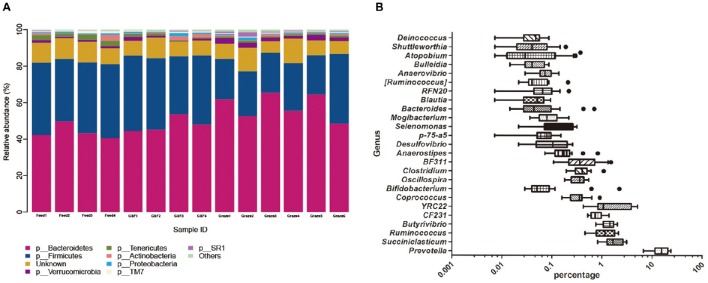
Figure 1
Figure 1
Dominant bacterial phylum in individual samples and the shared bacterial genera across ruminal samples. (A) The bacterial taxonomic composition of individual yak ruminal samples at the phylum level. (B) The relative abundance of shared bacterial genera across yak ruminal samples in shown via a box plot of the relative abundance of bacterial genera shared by all samples. Percentage is shown on the X-axis. The boxes represent the interquartile range (IQR) between the first and third quartiles (i.e., 25th and 75th%, respectively), and the vertical line inside the box defines the median. Whiskers represent the lowest and highest values within 1.5 times the IQR from the first and third quartiles. Samples with a relative abundance for a given genus exceeding those values are represented as points beside the boxes. The groups are: indoor feeding regime (feed), pasture grazing regime (graze), and grazing, and supplementary feeding regime (GSF).
Figure 2
Figure 2
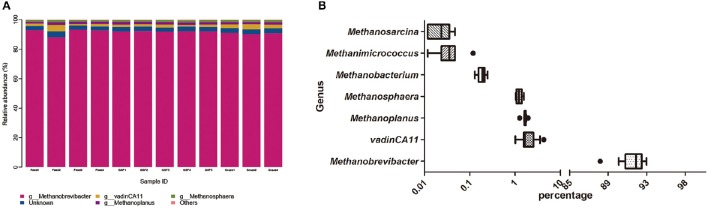
Dominant archaeal genera in individual sample and the shared archaeal genera across ruminal samples. (A) Archaeal taxonomic composition of individual yak ruminal samples at the genus level. (B) Relative abundance of shared archaeal genera across yak ruminal samples, showen as a box plot of relative bacterial genera abundance shared by all samples with percentage on the X-axis. The boxes represent the interquartile range (IQR) between the first and third quartiles (i.e., 25th and 75th%, respectively), and the vertical line inside the box defines the median. The whiskers represent the lowest and highest values within 1.5 times the IQR of the first and third quartiles, respectively. Samples with a relative abundance exceeding those values for a given genus are represented as points besides the boxes. The groups are: indoor feeding regime (feed), pasture grazing regime (graze), and grazing and supplementary feeding regime (GSF).
Figure 3
Figure 3
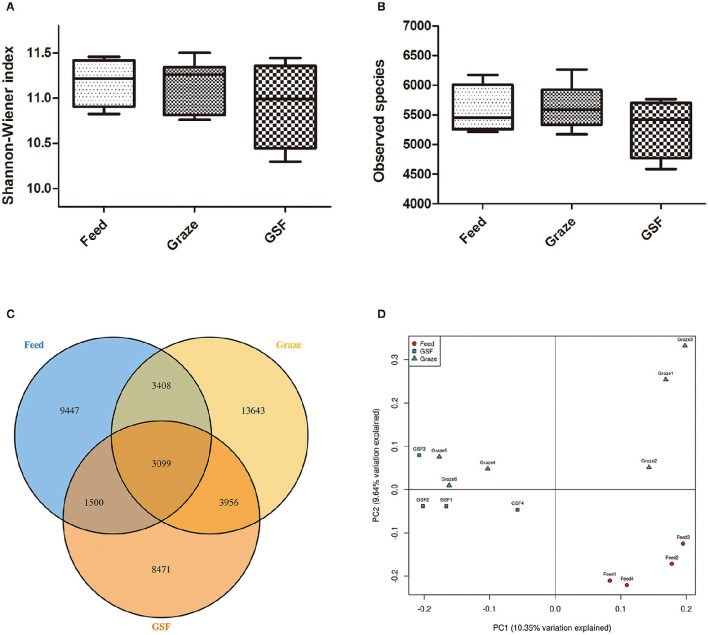
Differences in bacterial community diversity, richness, and OTUs between feeding regimes. (A) Shannon-Weiner diversity in yak ruminal samples. (B) Observed species in yak ruminal samples. (C) A venn diagram showing the different and similar OTUs between feeding regimes. (D) A principal coordinate analysis (PCoA) of the yak ruminal microbiota from the three feeding groups. The PCoA plots were constructed using the unweighted UniFrac method. The groups are: indoor feeding regime (feed), pasture grazing regime (graze), and grazing and supplementary feeding regime (GSF).
Figure 4
Figure 4
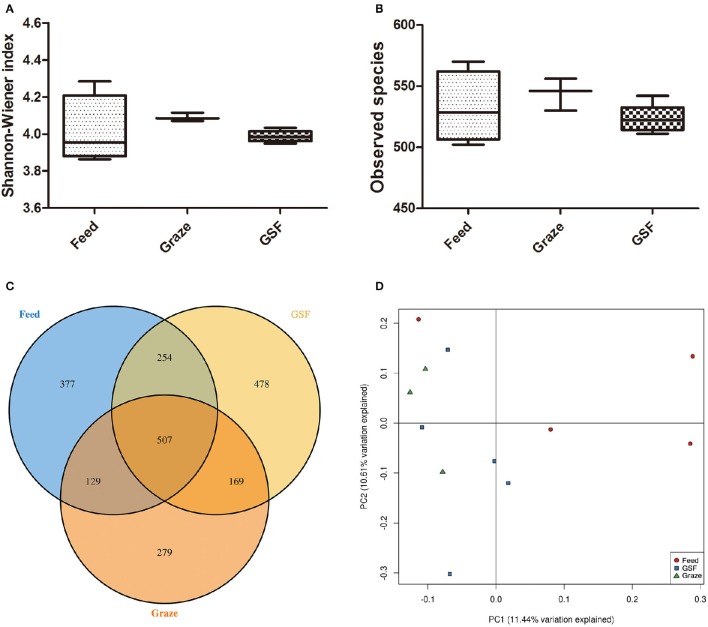
Differences in archaeal community diversity, richness, and OTUs between the feeding regimes. (A) Shannon-Weiner diversity in yak ruminal samples. (B) Observed species in yak ruminal samples. (C) A Venn diagram showing the number of differences and shared OTUs between the feeding regimes. (D) Principal Coordinate Analysis (PCoA) of archaeal community structures of the yak ruminal microbiota of the three feeding groups. The PCoA plots were constructed using the unweighted UniFrac method. The groups are: indoor feeding regime (feed), pasture grazing regime (graze), and grazing and supplementary feeding regime (GSF).

References

    1. An D. D., Dong X. Z., Dong Z. Y. (2005). Prokaryote diversity in the rumen of yak (Bos grunniens) and Jinnan cattle (Bos taurus) estimated by 16S rDNA homology analyses. Anaerobe 11, 207–215. 10.1016/j.anaerobe.2005.02.001 - DOI - PubMed
    1. Caporaso J. G., Kuczynski J., Stombaugh J., Bittinger K., Bushman F. D., Costello E. K., et al. (2010). QIIME allows analysis of high-throughput community sequencing data. Nat. Methods 7, 335–336. 10.1038/nmeth.f.303 - DOI - PMC - PubMed
    1. Caporaso J. G., Lauber C. L., Walters W. A., Berg-Lyons D., Lozupone C. A., Turnbaugh P. J., et al. (2011). Global patterns of 16S rRNA diversity at a depth of millions of sequences per sample. Proc. Natl. Acad. Sci. U.S.A. 108, 4516–4522. 10.1073/pnas.1000080107 - DOI - PMC - PubMed
    1. Cersosimo L. M., Lachance H., St-Pierre B., van Hoven W., Wright A. D. G. (2015). Examination of the rumen bacteria and methanogenic archaea of wild impalas (Aepyceros melampus melampus) from Pongola, South Africa. Microb. Ecol. 69, 577–585. 10.1007/s00248-014-0521-3 - DOI - PubMed
    1. Chen Y. B., Lan D. L., Tang C., Yang X. N., Li J. (2015). Effect of DNA extraction methods on the apparent structure of yak rumen microbial communities as revealed by 16s rdna sequencing. Pol. J. Microbiol. 64, 29–36. - PubMed

LinkOut - more resources