


Database fingerprint (DFP): an approach to represent molecular databases
- PMID: 28224019
- PMCID: PMC5293704
- DOI: 10.1186/s13321-017-0195-1
Database fingerprint (DFP): an approach to represent molecular databases
Abstract
Background: Molecular fingerprints are widely used in several areas of chemoinformatics including diversity analysis and similarity searching. The fingerprint-based analysis of chemical libraries, in particular of large collections, usually requires the molecular representation of each compound in the library that may lead to issues of storage space and redundant calculations. In fact, information redundancy is inherent to the data, resulting on binary digit positions in the fingerprint without significant information.
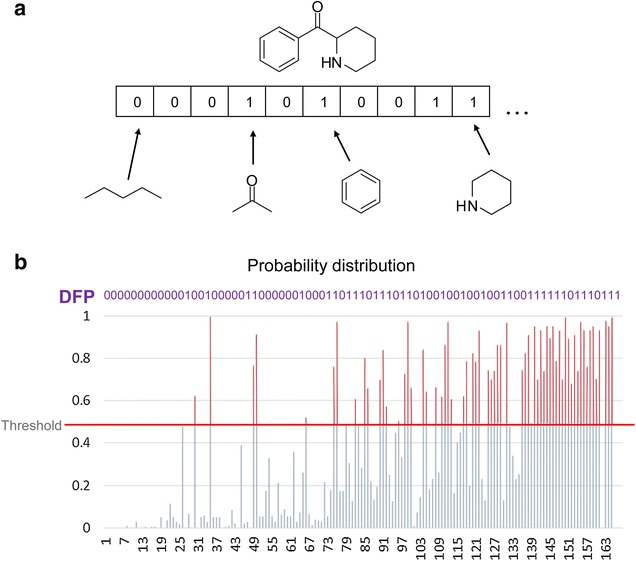
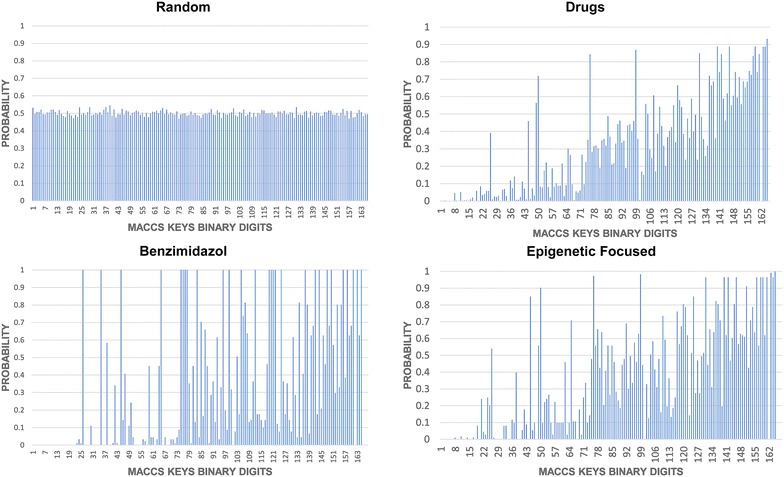
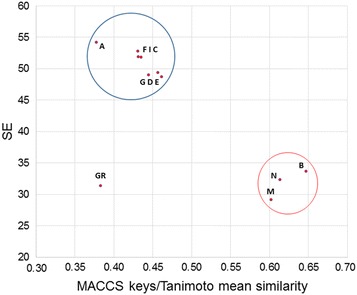
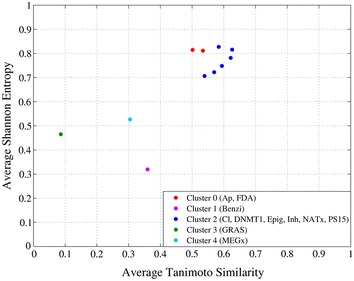
Results: Herein is proposed a general approach to represent an entire compound library with a single binary fingerprint. The development of the database fingerprint (DFP) is illustrated first using a short fingerprint (MACCS keys) for 10 data sets of general interest in chemistry. The application of the DFP is further shown with PubChem fingerprints for the data sets used in the primary example but with a larger number of compounds, up to 25,000 molecules. The performance of DFP were studied through differential Shannon entropy, k-mean clustering, and DFP/Tanimoto similarity.
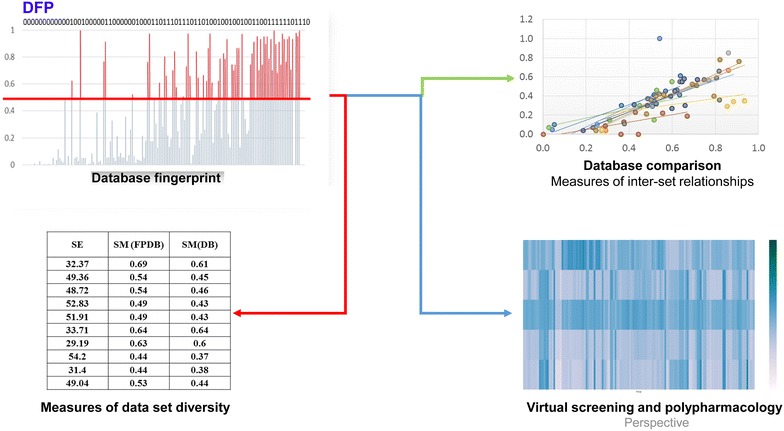
Conclusions: The DFP is designed to capture key information of the compound collection and can be used to compare and assess the diversity of molecular libraries. This Preliminary Communication shows the potential of the novel fingerprint to conduct inter-library relationships. A major future goal is to apply the DFP for virtual screening and developing DFP for other data sets based on several different type of fingerprints.Graphical AbstractDatabase fingerprint captures the key information of molecular databases to perform chemical space characterization and virtual screening.
Keywords: Diversity; Information content; Molecular fingerprints; Shannon entropy; Similarity.
Figures
References
-
- Medina-Franco JL, Maggiora GM. Molecular similarity analysis. In: Bajorath J, editor. Chemoinformatics for drug discovery. Hoboken: Wiley; 2014. pp. 343–399.
-
- Shannon CE, Weaver W. The mathematical theory of communication. Urbana: University of Illinois Press; 1963.
-
- Godden JW, Bajorath J. Analysis of chemical information content using shannon entropy. In: Lipkowitz KB, Cundari TR, editors. Reviews in computational chemistry. Hoboken: Wiley; 2007. pp. 263–289.
LinkOut - more resources
Full Text Sources
Other Literature Sources
